Frankopan Castle
Frankopan Castle stands prominently on Kamplin Square in Rijeka, Croatia, opposite the Krk cathedral and near the bishop's palace. This historic castle served as the central defensive stronghold of the town, reflecting centuries of architectural evolution from the 12th to the 18th century. Its layered history and well-preserved structure make it a significant monument in Croatian medieval and Renaissance heritage.
The origins and early architecture of Frankopan Castle
The oldest surviving element of the castle is the square tower, commonly referred to as Frankopan's tower and courtyard. An important Latin inscription above its door dates its completion to 1191, during the tenure of Bishop John of Krk and counts Bartul and Vid, sons of Dujam I Krčki, the first Count of Krk. This inscription not only confirms the construction date but also acknowledges the involvement of the entire local community in its creation.
Architecturally, the tower stands out for its construction technique, employing large blocks of finely carved stone reminiscent of the nearby Romanesque Church of San Quirino. This similarity has led scholars to theorize that the tower may have originally existed independently before being incorporated into the castle complex. The tower's walls are nearly two meters thick in places, underscoring its intended vertical prominence.
Evidence of its possible original sacred function is found in the remains of a religious fresco on the ground floor, suggesting the tower may have initially served as a bell tower. This theory is supported by historical context, as Romanesque bell towers were common in diocesan centers during the 12th and 13th centuries, comparable to those in Rab and Zara. The tower’s design and the presence of a bell tower on the city map held by San Quirino in a 16th-century polychrome further reinforce this interpretation.
Medieval fortifications and expansions
The castle's walls connect the southeast tower, known as the "Austrian tower" to the remains of the tower above the Pizanska Vrata gate. Stylistic and construction techniques date this part of the castle to the 14th century. Some theories suggest that parts of the walls and the upper floor of the tower might date back to the Romanesque period, but this is debated, with evidence favoring a 15th-century origin for these structures.
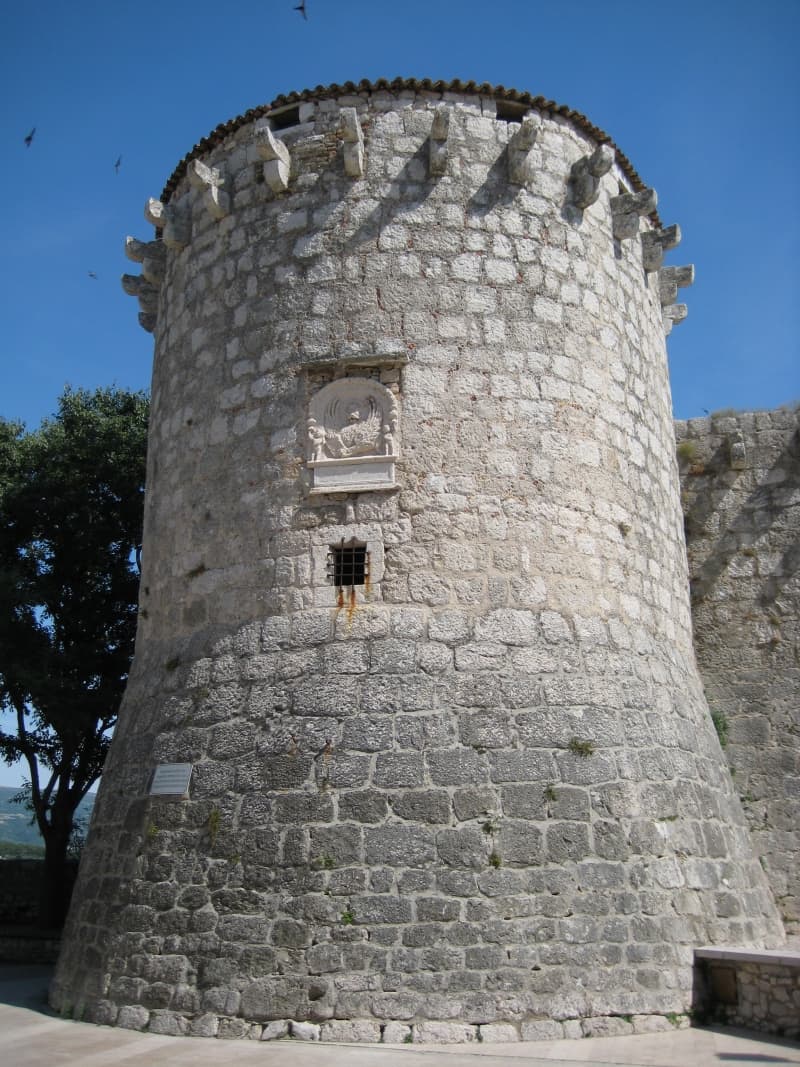
The "Venetian" tower on Kamplin Square has undergone several alterations over time. It features unique conical cannon openings on its ground floor, two of which are original. A stone slab bearing the inscription "Aurea Venetorum Libertati" and the symbol of St. Mark reflects the Venetian influence and control during the Renaissance period. The tower’s door mechanism, with an iron pole lowered through a groove from the first floor, indicates a different original tower shape, possibly with a conical roof that was later modified.
Renaissance transformation and noble residence
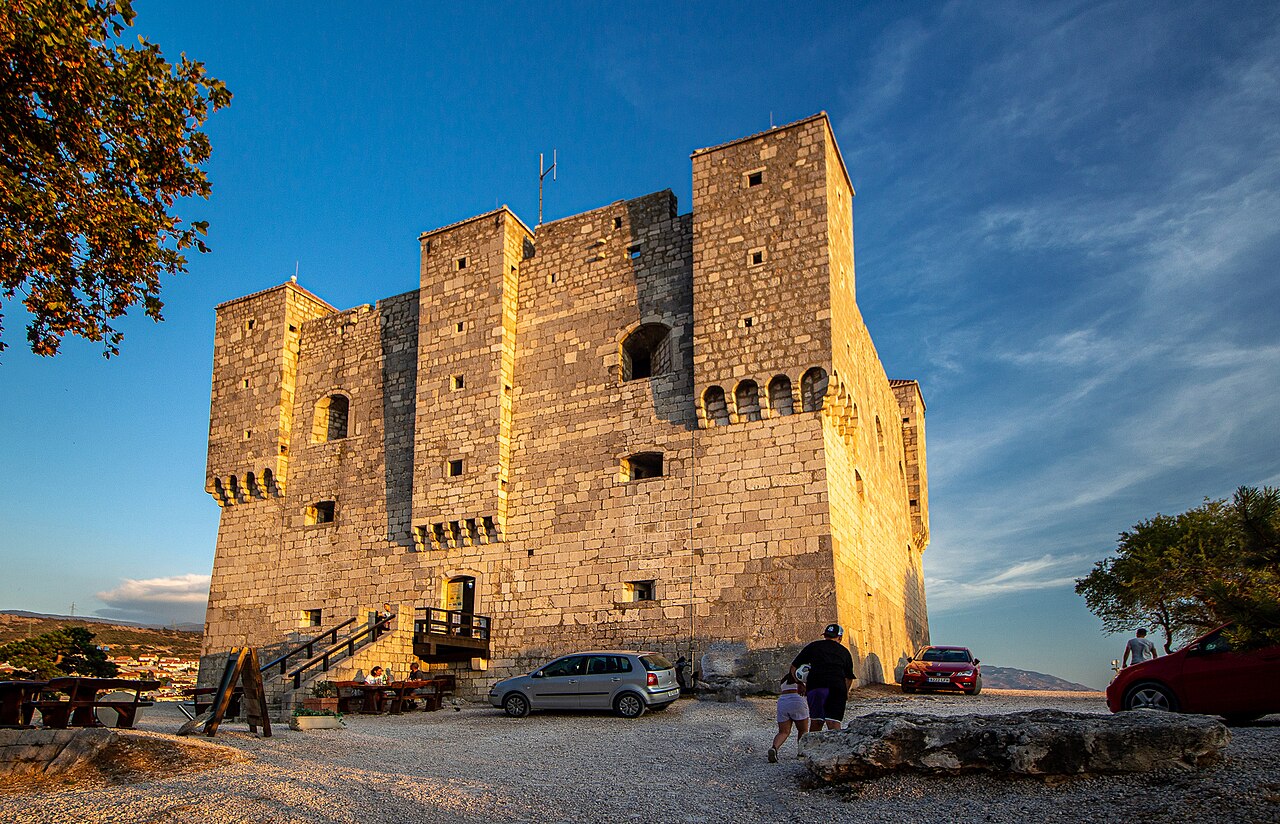
Frankopan Castle experienced significant reconstruction in the Renaissance period, notably in 1651 when Petar Zrinski began building a new castle on the hill of the peninsula at the entrance of the Bay of Bakar. This large rectangular complex, measuring 44 by 36 meters, was designed with four large corner towers and a square inner courtyard featuring a central cistern. The builders, likely Venetian craftsmen, created a residence befitting a powerful feudal dynasty, combining defensive features with aristocratic luxury.
The castle originally had a basement, ground floor, and first floor. In the 19th century, the Jesuits, who later owned the castle, added a second floor. The interior reflected the opulence of its noble inhabitants, particularly under Katarina Frankopan, wife of Petar Zrinski. The main salon was lavishly decorated with gilded leather wallpaper, marble fireplaces, and floors paved with marble mosaics. Door frames were crafted from black and white marble, emphasizing the castle’s grandeur.
One of the 17th-century paintings depicts a special room called the "Museum," where the Frankopan family's rich heritage was stored. This early form of a museum, known as a "cabinet of wonders," was among the first of its kind in Croatia, showcasing the family's collections and cultural treasures. This tradition of a family museum is revived today in the castle’s visitor center, preserving the spirit of the noble lineage.
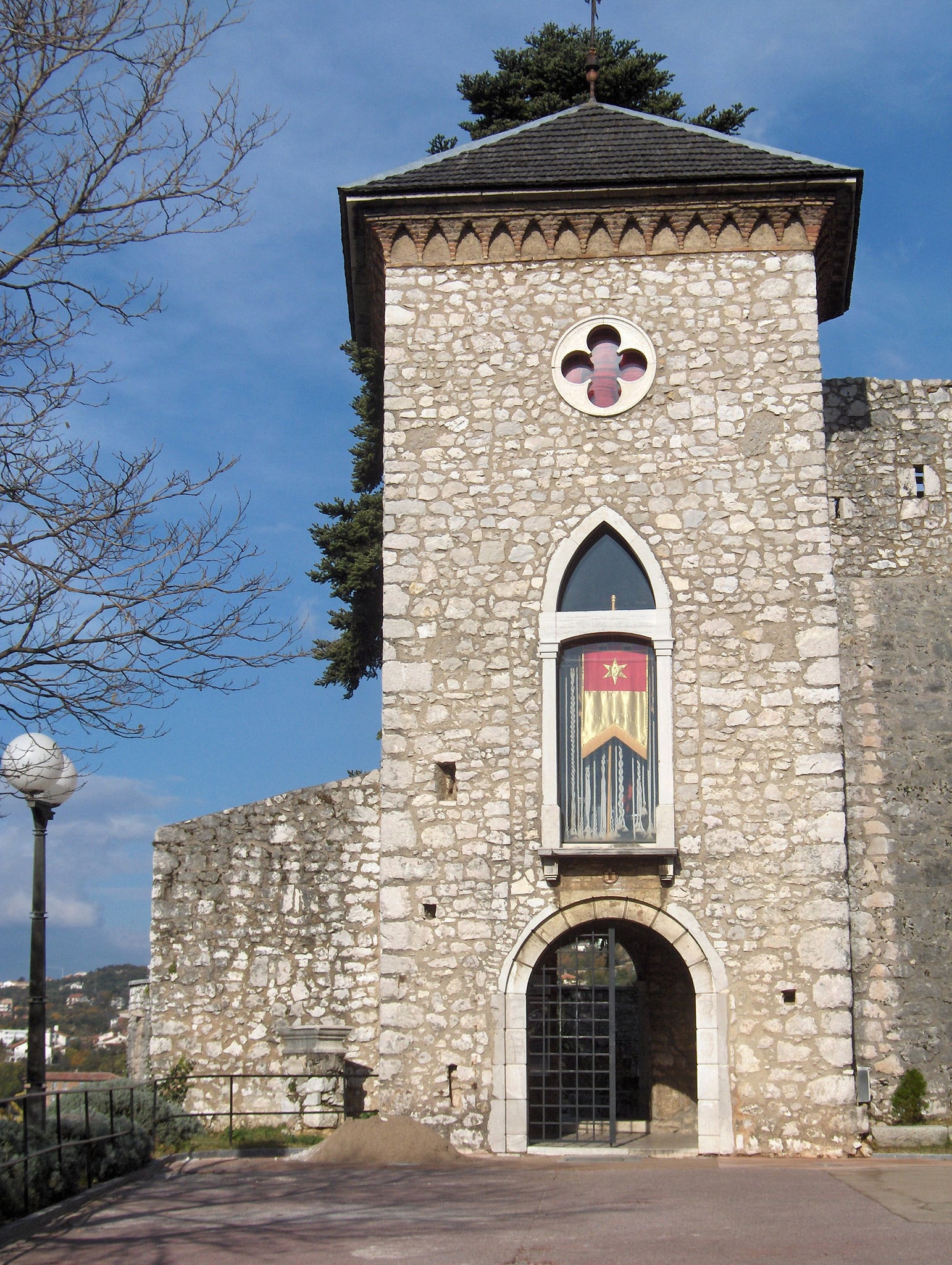
Photo by Georges Jansoone JoJan • CC BY-SA 3.0
Historical significance and cultural legacy
The Frankopan family played a pivotal role in the history of the region, with their influence extending over the island of Krk and the town itself. After the death of Dujam I Krčki, his sons continued to dominate the area, leaving architectural and cultural legacies that shaped the town’s development. The castle served not only as a defensive fortress but also as a center of administration and noble residence.
The round tower on the northern corner, built after the square tower probably in the 13th century, was restored several times, notably around 1480 and again circa 1600. It bears the inscription "Aureae Venetorum libertati" with the lions of St. Mark, dating from around 1500, highlighting the Venetian influence in the region. This cylindrical tower, with two floors and an attic, once had doors opening to Kamplin and the castle interior, reflecting its strategic importance.
By 1348, the entire castle complex was completed, incorporating various defensive and residential elements. It remains the only medieval monument in the city of Krk, symbolizing the town’s rich historical tapestry.
Modern restoration and current use
Today, Frankopan Castle is restored and well-preserved, offering visitors a glimpse into its multifaceted history. A walk along part of the castle wall has been opened, and a small exhibition of archaeological artifacts is displayed within its walls. The castle also serves as a venue for summer cultural events, continuing its legacy as a center of community and culture.
Architectural features and defensive elements
The castle’s architecture showcases a blend of Romanesque and Renaissance styles, reflecting its long construction history. The massive stone walls, towers with cannon openings, and strategic location on a hill made it a formidable defensive structure. The cistern in the inner courtyard was a vital feature for water storage during sieges.
The use of carved regular stones and thick walls in the oldest tower contrasts with the later Renaissance additions, which emphasize symmetry and residential comfort. The castle’s defensive gates, such as Pizanska Vrata, and the sentry box on the western side, illustrate its military function alongside its noble residence role.
The castle in the context of Croatian heritage
Frankopan Castle is a testament to the enduring legacy of one of Croatia’s most influential noble families. It encapsulates the historical transitions from medieval fortifications to Renaissance aristocratic residences. Its preservation allows insight into the architectural and cultural developments in the Adriatic region over several centuries.
Visitors to the castle can explore its rich history, architectural details, and the cultural heritage of the Frankopan family, making it a significant destination for those interested in Croatian history and medieval architecture.
Frequently asked questions (FAQ)
- What is the historical significance of Frankopan Castle?
- Frankopan Castle, located in Rijeka, Croatia, is a significant historical monument that dates back to the 13th century. It served as a strategic military fortification and residence for the influential Frankopan family, playing a crucial role in the region's history and politics.
- When was Frankopan Castle built?
- Frankopan Castle was constructed in the late 12th century, with notable expansions and renovations occurring in the subsequent centuries. Its architecture reflects the medieval influences and the strategic importance of the site during various historical periods.
- Can I visit Frankopan Castle?
- Yes, visitors can explore Frankopan Castle during its opening hours, which typically run from 10 AM to 6 PM. Guided tours are available, providing insights into the castle's history, architecture, and the surrounding area.
- Is it possible to access Frankopan Castle with mobility challenges?
- Frankopan Castle has made efforts to improve accessibility; however, due to its historical structure, some areas may still be challenging for those with mobility issues. It is advisable to check with the castle's visitor services for specific accommodations.
- What are the ticket prices for visiting Frankopan Castle?
- Ticket prices for Frankopan Castle vary, with discounts available for students and seniors. Typically, adult tickets are around 50 HRK, while children under 12 may enter for free, making it an affordable option for families.
- When is the best time to visit Frankopan Castle?
- The best time to visit Frankopan Castle is during the spring and early fall months, when the weather is mild and the tourist crowds are smaller. Visiting during these times allows for a more enjoyable experience of the castle and its surroundings.
- Are there any nearby attractions to visit after Frankopan Castle?
- Yes, after visiting Frankopan Castle, you can explore the nearby city of Rijeka, known for its vibrant cultural scene and beautiful waterfront. Additionally, the picturesque Opatija and the stunning Učka Nature Park are just a short drive away.
- What are the opening hours of Frankopan Castle?
- Frankopan Castle typically opens from 10 AM to 6 PM, but hours may vary during the off-season or on holidays. It’s recommended to check the castle's official website for the most current information before planning your visit.
Photo gallery


Information
Loading map...
Visitor reviews
No reviews yet. Been here? Write the first review and help other travelers!
Write the first reviewVisited this castle? Share your experience
Your review helps other travelers and adds first-hand knowledge to our encyclopedia.