Franchimont Castle
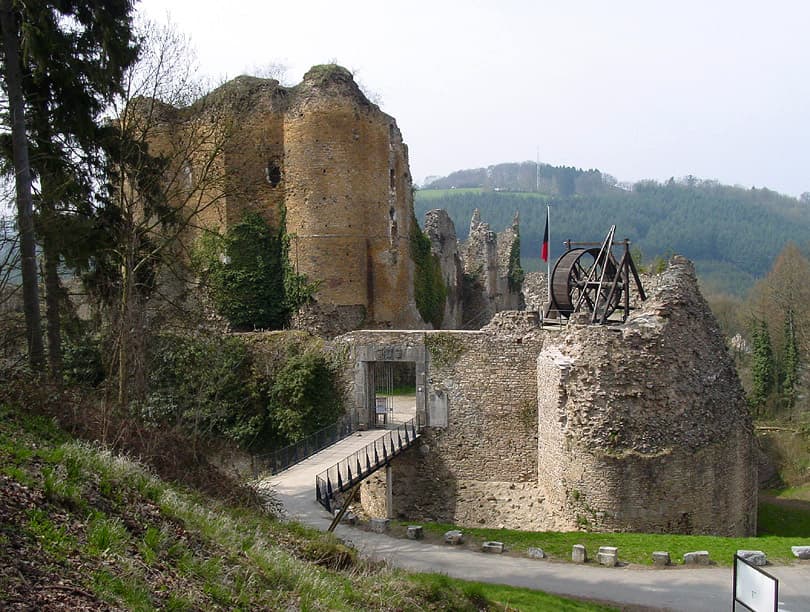
Franchimont Castle, also known locally as Château de Franchimont, is a remarkable medieval fortress situated in the Wallonia region of Belgium, specifically in the province of Liège near the village of Theux. Perched atop a natural rocky spur overlooking the Hoëgne valley, this hill castle commands strategic views of the surrounding landscape and historically guarded key access routes. Its origins trace back to the High Medieval period, with construction beginning in the 13th century and significant modifications extending into the early 16th century, reflecting evolving military technologies and architectural styles.
The castle was originally established on the site of an earlier Carolingian estate ceded to the Prince-Bishopric of Liège in 898. It first appears in written records in 1155 under the name "Castrum Franchiermont," emphasizing its early importance as a defensive stronghold within the theocratic principality. Throughout the Middle Ages, Franchimont Castle was repeatedly rebuilt and expanded, notably after a destructive fire in 1387 and following a siege in 1487 during a turbulent period of regional conflict involving the Lords of Franchimont and the influential De La Marck family.
Historical significance and ownership transitions
Franchimont Castle served as a critical military and administrative center for the Prince-Bishopric of Liège. It was the seat of the Marquessate of Franchimont, a small province within the principality, and a refuge for prince-bishops during popular revolts. The castle's jurisdiction transitioned to the De La Marck family between 1477 and 1505, a period marked by siege warfare and political upheaval. Under the rule of Bishop Érard de La Marck (1506-1538), the castle underwent extensive renovations that transformed it from a purely military fortress into a more comfortable residence with larger windows, a new chapel, and expanded kitchens.
Architectural evolution and defensive features
Medieval core and donjon
The heart of Franchimont Castle is its imposing medieval donjon, a fortified tower dating from the mid-14th century. This donjon is distinguished by its exceptionally thick walls—approximately seven meters thick—and a unique pentagonal shape formed by a projecting buttress flanked by two turrets. This design provided enhanced resilience against siege engines and early artillery. Surrounding the donjon were residential buildings or logis, which, together with the donjon, formed a large pentagonal enclosure typical of late medieval military architecture.
16th-century artillery fortifications
Responding to the advent of gunpowder artillery, Bishop Érard de La Marck commissioned significant fortification upgrades in the early 1500s. These included a massive pentagonal outer wall equipped with low, thick-walled casemates—locally called "moineaux" or "little sparrows"—designed as enclosed firing positions with small cannon openings and sturdy masonry roofs. These casemates were interconnected by protected underground passageways, allowing defenders to move safely during combat.
Additionally, an enormous artillery tower was constructed at the northeastern corner of the outer wall to guard the main entrance path. This tower, about 26 meters in diameter with walls roughly eight meters thick, was built to mount heavy cannons and dominate the approach to the castle. Although partially demolished in the late 17th century by order of King Louis XIV to reduce its defensive capabilities, the remaining sections of the tower now house a small exhibition and the ticket office for visitors.
Decline, preservation, and modern use
By the 17th century, Franchimont Castle's military importance waned due to its vulnerability to artillery positioned on surrounding heights. It was demilitarized and repurposed as a prison and summer residence for prince-bishops. Further damage was inflicted by an earthquake in 1692, and after the Liège Revolution in 1795, the castle fell into decay. During the 19th century, local inhabitants quarried stone from the ruins for building materials, accelerating its deterioration.
Interest in Franchimont Castle revived during the 19th century, inspired by romantic medievalism. The Belgian state acquired the site in 1899, initiating archaeological excavations and partial restorations. Since 1967, the Compagnons de Franchimont foundation has overseen ongoing excavations and conservation efforts. Today, the castle ruins are owned by the municipality of Theux and are open to the public, offering visitors a chance to explore its extensive casemates, steep stairways carved into solid rock, and panoramic views of the surrounding countryside.
Visitor experience and architectural highlights
Visitors to Franchimont Castle can explore a fascinating blend of medieval and Renaissance military architecture. The casemates are particularly notable for their design and accessibility, featuring long, steep stairways cut directly into the rock and illuminated for safety. These enclosed firing positions provide insight into early modern defensive strategies against artillery.
The castle's combination of a massive medieval donjon, residential logis, and advanced artillery fortifications exemplifies the evolution of military architecture from the 13th to the 16th centuries. The surviving structures, including the remnants of the artillery tower and the pentagonal outer walls with their interconnected casemates, highlight the castle's adaptation to the changing nature of warfare.
Beyond its military aspects, the castle also reflects the domestic and administrative functions it served, with features such as a chapel, kitchens, and a Renaissance gallery indicating its role as a princely residence. The site's well-preserved ruins and ongoing archaeological work make Franchimont Castle a significant cultural and historical landmark in Belgium.
Frequently asked questions (FAQ)
- What is the historical significance of Franchimont Castle?
- Franchimont Castle is a remarkable example of medieval architecture, built in the 11th century and serving as a strategic fortress during various conflicts. It played a crucial role in the defense of the region and has witnessed significant historical events, making it a key site for understanding the area's past.
- When was Franchimont Castle built?
- Franchimont Castle was constructed in the early 11th century, with its origins dating back to 1050. The castle has undergone various modifications and restorations over the centuries, reflecting the architectural styles of different periods.
- Can I visit Franchimont Castle?
- Yes, visitors are welcome to explore Franchimont Castle. The site offers guided tours that provide insight into its rich history and architectural features, making it a great destination for history enthusiasts and tourists alike.
- What are the opening hours for Franchimont Castle?
- Franchimont Castle is typically open to visitors from 10 AM to 6 PM during the tourist season, which usually runs from April to October. However, it's advisable to check the official website for any seasonal changes or special events that may affect opening hours.
- Is it possible to access Franchimont Castle with limited mobility?
- While Franchimont Castle is a historical site with some uneven terrain, efforts have been made to improve accessibility for visitors with limited mobility. It's recommended to contact the castle administration ahead of your visit to inquire about specific accommodations and access routes.
- What are the ticket prices for visiting Franchimont Castle?
- Ticket prices for Franchimont Castle vary depending on age and group size, with discounts available for children and seniors. Generally, adult tickets are priced around €7, while children under a certain age may enter for free or at a reduced rate.
- When is the best time to visit Franchimont Castle?
- The best time to visit Franchimont Castle is during the spring and summer months when the weather is pleasant, and the gardens are in full bloom. Additionally, special events and festivals often take place during this time, enhancing the visitor experience.
- Are there any nearby attractions to Franchimont Castle?
- Yes, there are several nearby attractions, including the picturesque town of Theux and the beautiful natural landscapes of the Ardennes region. Visitors can also explore other historical sites, hiking trails, and local restaurants that showcase the charm of the area.
Photo gallery

Information
Sources & official resources
Verify the information above using these authoritative references.
Loading map...
Visitor reviews
No reviews yet. Been here? Write the first review and help other travelers!
Write the first reviewVisited this castle? Share your experience
Your review helps other travelers and adds first-hand knowledge to our encyclopedia.