Fotheringhay Castle
Fotheringhay Castle stands as a significant monument in English medieval history, located in the village of Fotheringhay, Northamptonshire, England. This Norman hill castle was constructed shortly after the Norman conquest, likely around the year 1100 by Simon de Senlis, Earl of Northampton. Its strategic position overlooking the River Nene made it a formidable defensive site and a focal point in regional power struggles throughout the Middle Ages.
Early history and construction
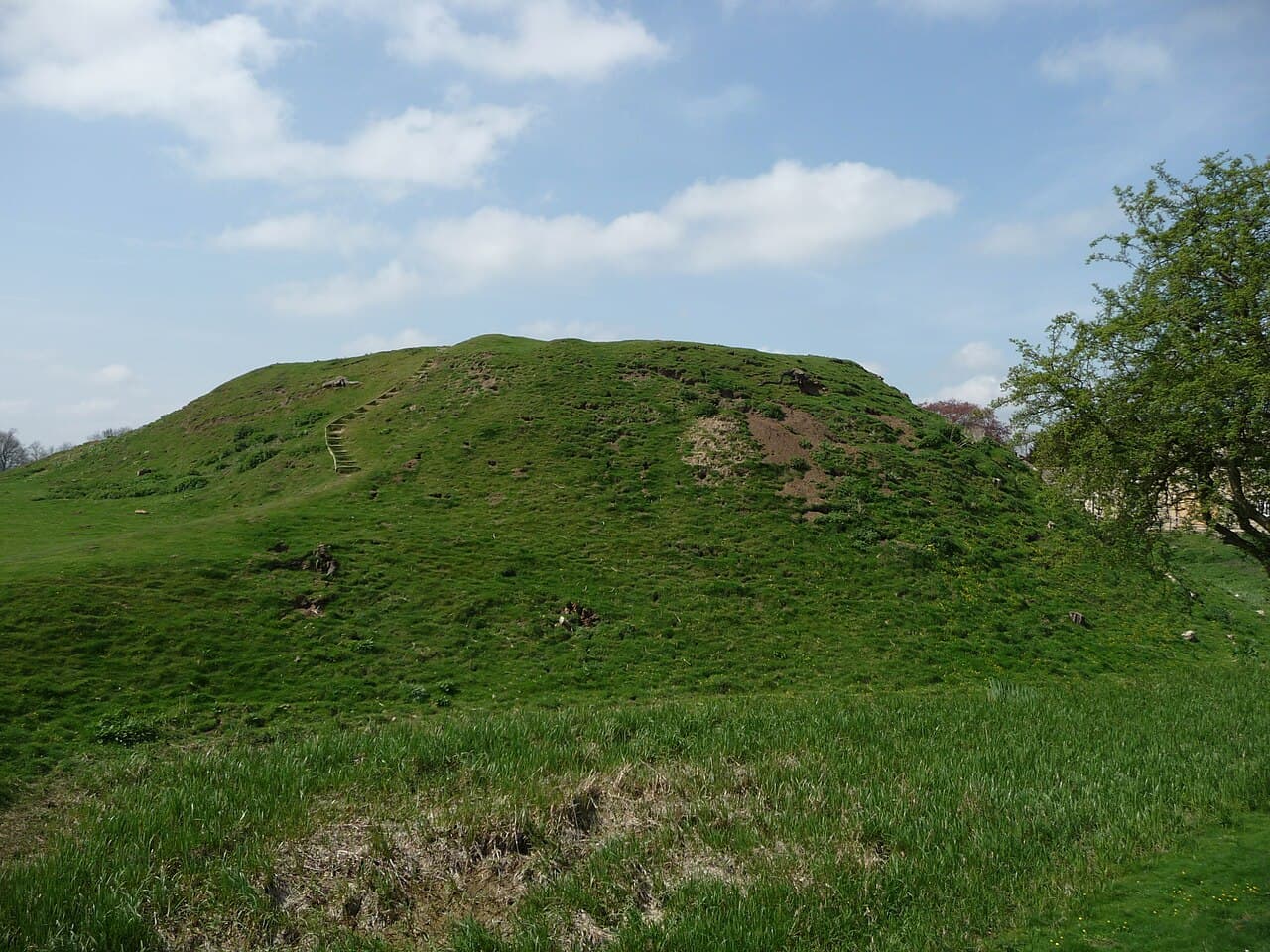
The castle's origins are rooted in the Norman practice of establishing motte-and-bailey fortifications to secure control over newly conquered territories. The motte at Fotheringhay is an impressive artificial mound approximately 70 meters across at its base and rising about 7 meters above the surrounding landscape, crowned by a polygonal stone keep. This keep served both defensive and residential purposes, commanding expansive views over the nene valley.
The inner bailey, an enclosed courtyard measuring roughly 50 by 65 meters, was fortified by earth ramparts and a ditch, housing essential domestic buildings including a large great hall used for administrative and social functions. Surrounding the inner bailey was the outer bailey, protected by curtain walls and featuring a gatehouse that controlled access to the castle. A man-made lake bordered the outer defenses, crossed by a bridge leading to the main entrance.
Ownership and political significance
Ownership of Fotheringhay Castle changed hands multiple times, reflecting the turbulent political landscape of medieval England and Scotland. After its initial construction by Simon de Senlis, the castle came under Scottish control when his widow married Prince David of Scotland by 1113. For much of the 12th century, it remained a Scottish possession, illustrating the complex cross-border dynamics of the period.
In the early 13th century, the castle was seized by King John around 1212 during his conflicts with rebellious barons. It briefly returned to rebel hands in 1215 but was reclaimed by the crown by 1219. During the reign of Henry III, it was held by prominent nobles such as Ranulf de Blondeville, Earl of Chester, and William II de Forz, who used it as a base during their uprisings. These episodes underscore the castle's strategic importance in controlling the region.
Association with the house of york and royal significance
Fotheringhay Castle became closely linked to the House of York when Edmund Langley, the first Duke of York, made it his principal residence in the late 14th century. Langley undertook significant modifications, including the construction of the outer bailey and alterations to the motte's eastern ditch, adapting the castle for both defense and comfortable living.
The castle holds particular historical importance as the birthplace of King Richard III in 1452, a key figure in the Wars of the Roses. This connection cements Fotheringhay's role in the dynastic struggles that shaped late medieval England.
Mary, queen of scots and the castle's decline
In the late 16th century, Mary, Queen of Scots, was imprisoned at Fotheringhay Castle. She was tried for treason in the castle's Great Hall in October 1586 and executed there in February 1587. The castle's small chapel served as the setting for her final night, adding a poignant and somber chapter to its history.
Following these events, the castle fell into disuse and neglect during the latter part of Queen Elizabeth I's reign. By the 1630s, it was dismantled, and much of its stonework was removed, marking the end of its function as a royal fortress. Today, only earthworks, fragments of masonry, and the remains of the chapel survive, preserving the memory of its medieval grandeur.
Architectural features and layout
Fotheringhay Castle exemplifies the Norman motte-and-bailey design, with its large motte topped by a polygonal stone keep. The motte's height and shape provided a commanding vantage point over the surrounding landscape, crucial for defense and surveillance.
The inner bailey, protected by earth ramparts and a ditch, contained the castle's primary domestic buildings, including the great hall, which was central to administrative and social life. The outer bailey, added in the 14th century, was fortified with curtain walls and a gatehouse, enhancing the castle's defensive capabilities.
The castle was surrounded by a moat and a man-made lake, which further strengthened its defenses and controlled access. The bridge spanning the water provided the main approach, emphasizing the castle's strategic planning and architectural sophistication.
The chapel and surviving remains
The small chapel on the castle grounds, known for its association with Mary, Queen of Scots, remains partially intact. It offers valuable insight into the religious practices and architectural styles of the period.
Today, the site is protected and managed as a historic monument. The visible earthworks and masonry fragments allow visitors to appreciate the castle's original layout and understand its historical significance.
Cultural heritage and tourism
Fotheringhay Castle is recognized for its rich historical associations and architectural significance. It attracts visitors interested in medieval history, the Wars of the Roses, and the dramatic story of Mary, Queen of Scots.
Interpretive signage and guided tours help bring the castle's history to life, highlighting its role in English and Scottish medieval politics, royal intrigue, and architectural evolution.
Its location in Northamptonshire makes it accessible for day trips from London and other parts of England, contributing to regional tourism and heritage education.
Frequently asked questions (FAQ)
- When was Fotheringhay Castle built and by whom?
- Fotheringhay Castle was likely built around 1100 by Simon de Senlis, the Earl of Northampton, as a Norman motte-and-bailey fortress.
- What is the historical significance of Fotheringhay Castle?
- The castle played a key role in medieval English and Scottish politics, was the birthplace of King Richard III, and the site of Mary, Queen of Scots' imprisonment and execution.
- What remains of Fotheringhay Castle can be seen today?
- Today, visitors can see the earthworks of the motte, fragments of masonry, the outline of the baileys, and the remains of the small chapel associated with Mary, Queen of Scots.
- Can I visit Fotheringhay Castle year-round?
- Fotheringhay Castle is managed by Historic England, and access to the site is generally open year-round, though specific visiting hours may vary and should be checked in advance.
- Is there an admission fee to visit Fotheringhay Castle?
- There is typically no admission fee to visit the earthworks and ruins of Fotheringhay Castle, but some guided tours or special events may have charges.
Photo gallery

Information
Current owner
Historic England
Loading map...
Visitor reviews
No reviews yet. Been here? Write the first review and help other travelers!
Write the first reviewVisited this castle? Share your experience
Your review helps other travelers and adds first-hand knowledge to our encyclopedia.