Fortaleza de Santa Teresa
The Fortaleza de Santa Teresa, also known as Fortaleza Santa Tereza, is a prominent 18th-century bastioned fortress situated in the Rocha Department of eastern Uruguay. Located approximately 36 km south of Chuy and about 305 km northeast of Montevideo along Route 9, the fortress stands near the Atlantic coast at Playa la Moza, roughly 800 meters from the shoreline. It is positioned nearly halfway between the small settlements of Angostura to the south and La Coronilla to the north, just north of Punta del Diablo and about 4 km northeast of Laguna Negra. The fortress lies within the boundaries of Santa Teresa National Park, a protected natural area renowned for its diverse landscapes and historical significance.
Historical context and construction
The fortress was constructed beginning in October 1762 by the Portuguese Empire during a period of territorial disputes in the region between Portugal and Spain. This era falls within the post-Renaissance period, characterized by advances in military architecture designed to withstand artillery sieges. The Portuguese initially abandoned plans to build a fort in Maldonado and also left the nearby Fuerte San Miguel, choosing instead to establish a stronger defensive position at Santa Teresa.
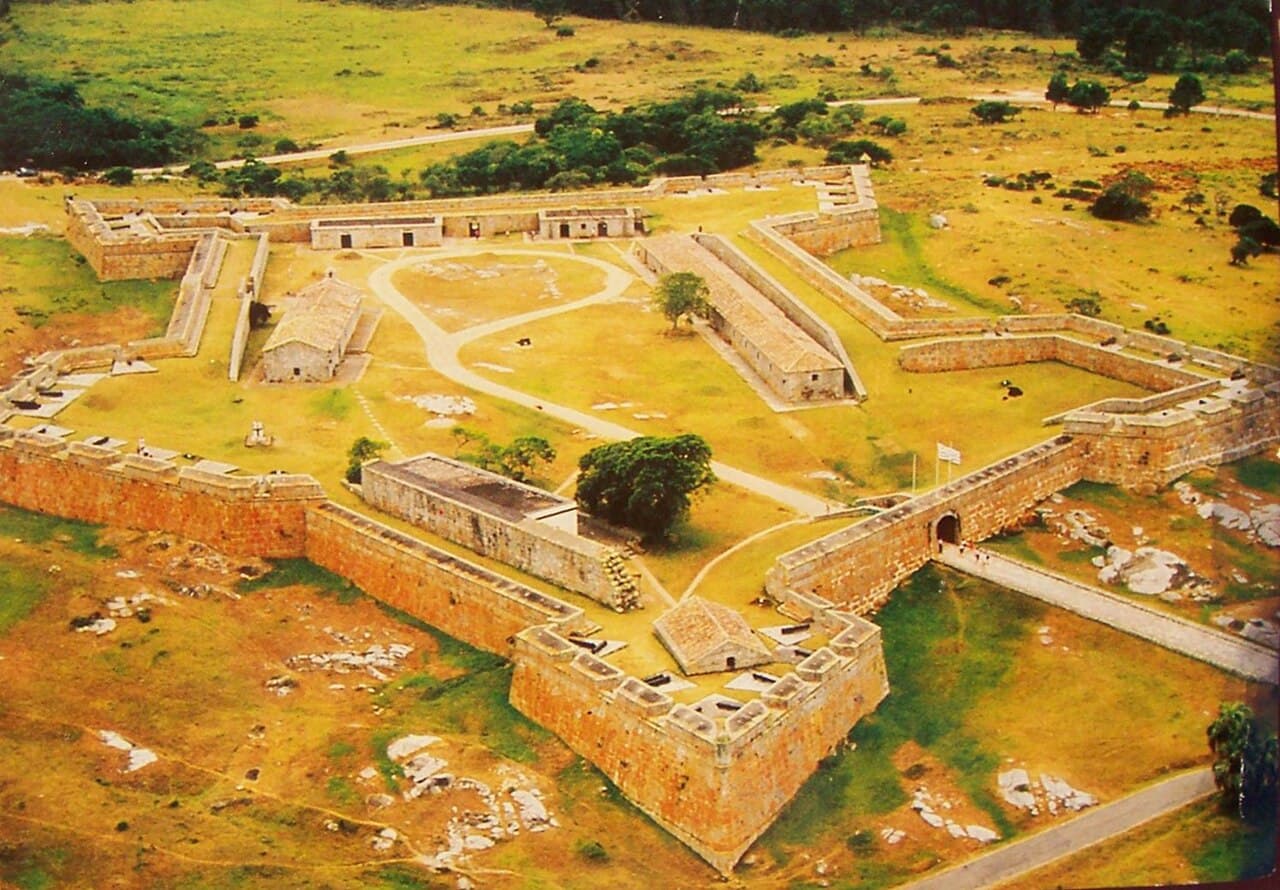
The design of Fortaleza de Santa Teresa reflects the bastioned fortress style, a military architectural form that emerged in response to the development of gunpowder artillery. This style features angular bastions projecting outward from the main walls, allowing defenders to cover adjacent walls with crossfire and eliminate blind spots. The fortress’s layout includes thick stone walls, corner bastions, and a moat to impede attackers.
Architectural features and defensive elements
The fortress is constructed primarily from stone masonry, incorporating local materials to ensure durability against both natural elements and military assault. Its bastioned design consists of four main bastions at the corners, connected by curtain walls forming a roughly square or polygonal shape. These bastions provided overlapping fields of fire, a critical defensive feature in 18th-century fortifications.
The moat surrounding the fortress further enhanced its defenses, making direct assaults more difficult. Access to the fortress was controlled by a drawbridge and a heavily fortified main gate, designed to withstand prolonged attacks. Inside, the fortress contained barracks, armories, magazines for storing gunpowder, and command quarters.
Strategic importance and military history
Fortaleza de Santa Teresa played a significant role in the struggle for control over the Banda Oriental region (modern-day Uruguay) between the Spanish and Portuguese empires. Its location near the Atlantic coast allowed it to serve as a defensive stronghold against naval incursions and land-based attacks. The fortress was part of a network of fortifications, including Fuerte San Miguel and others, aimed at securing Portuguese interests in the region.
Throughout the late 18th and early 19th centuries, the fortress witnessed several military engagements and changes in control, reflecting the broader geopolitical conflicts of South America. Eventually, it became part of Uruguay's national heritage and was preserved as a historical monument.
Preservation and current status
Today, Fortaleza de Santa Teresa is classified as a well-preserved bastioned fortress. It is maintained within the Santa Teresa National Park, which offers visitors not only a glimpse into colonial military architecture but also access to natural landscapes and recreational areas. The fortress is open to the public and serves as a cultural and historical site, attracting tourists interested in Uruguay's colonial past and military history.
The site includes interpretive displays and guided tours that explain the fortress's construction, strategic role, and architectural features. Its preservation allows for study and appreciation of 18th-century military engineering and the colonial history of the region.
Visiting information and cultural significance
Visitors to Fortaleza de Santa Teresa can explore the extensive grounds, including the bastions, walls, and internal buildings. The fortress's proximity to the coast and natural parks makes it a popular destination for combining historical exploration with outdoor activities. The site is accessible via Route 9 and is equipped with visitor facilities.
The fortress is recognized as a cultural heritage site, symbolizing the complex colonial history of Uruguay and the strategic military efforts of European powers in South America. Its architectural design is an excellent example of bastioned fortifications from the post-Renaissance period, reflecting the adaptation of European military engineering principles to the South American context.
Frequently asked questions (FAQ)
- How do I get to Fortaleza de Santa Teresa?
- Fortaleza de Santa Teresa is located in the Rocha Department of Uruguay along Route 9, about 36 km south of Chuy. Visitors can reach it by car or local transport from nearby towns.
- What is the historical significance of Fortaleza de Santa Teresa?
- The fortress was built by the Portuguese in the 18th century to defend their territorial claims in the region. It played a key role in colonial military conflicts between Portugal and Spain.
- Can I visit the interior of Fortaleza de Santa Teresa?
- Yes, the fortress is open to the public, and visitors can explore its bastions, walls, and internal structures, including barracks and armories.
- What architectural style is Fortaleza de Santa Teresa built in?
- Fortaleza de Santa Teresa is an example of a bastioned fortress, a military architectural style developed in the post-Renaissance period to counter artillery attacks.
- Is Fortaleza de Santa Teresa suitable for family visits?
- Yes, the site is family-friendly with open grounds and educational displays, making it suitable for visitors of all ages interested in history and architecture.
Photo gallery

Information
Loading map...
Visitor reviews
No reviews yet. Been here? Write the first review and help other travelers!
Write the first reviewVisited this castle? Share your experience
Your review helps other travelers and adds first-hand knowledge to our encyclopedia.