Fort Tidore
Fort Tidore is a significant bastioned fortress located in the Maluku Islands of Indonesia. This fortification played a crucial role in the region's maritime defense and colonial history, reflecting the strategic importance of Tidore as a center of spice trade and political power during the early modern period.
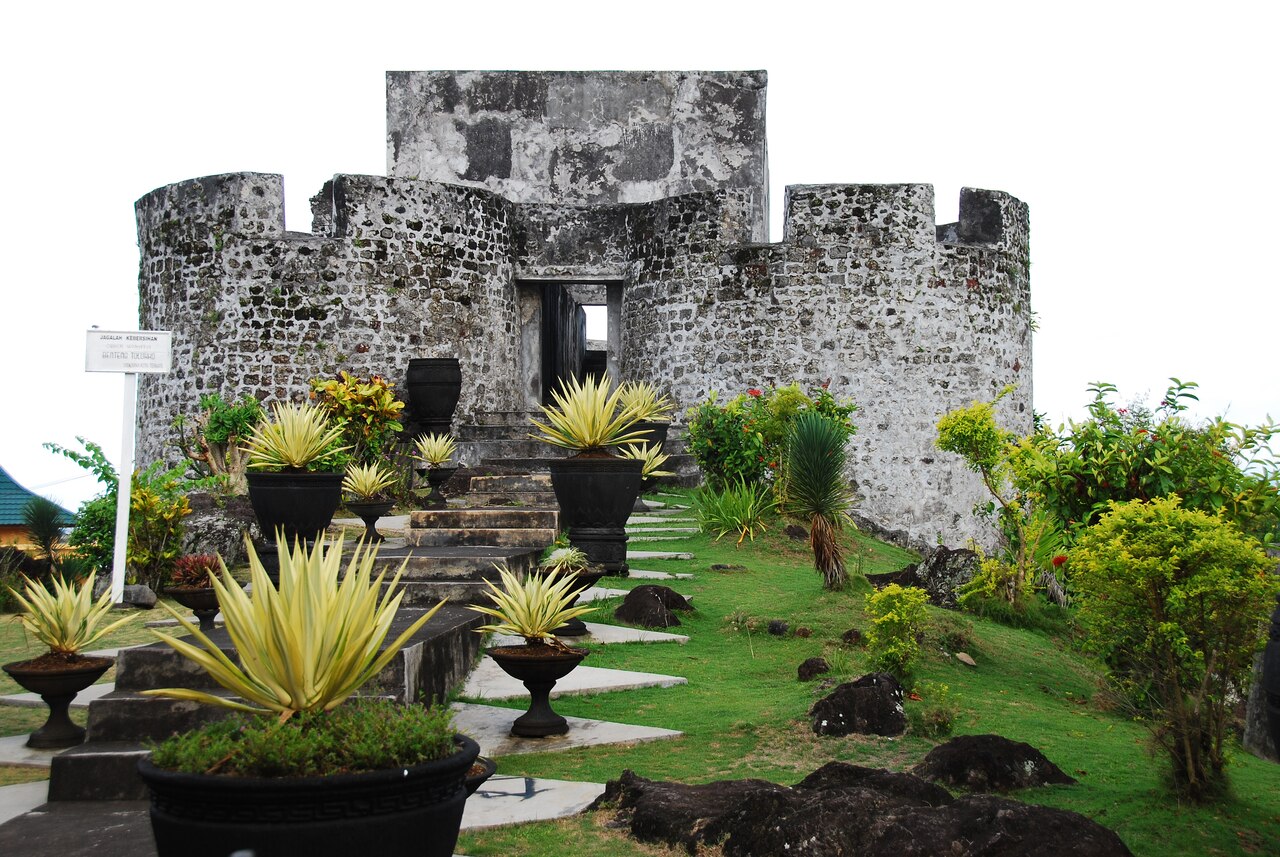
The fortress was constructed primarily by the Portuguese in the 16th century, with later modifications by the Dutch. Its design features characteristic bastions that allowed defenders to cover all approaches with cannon fire, a hallmark of European military architecture adapted to local conditions. The fort's robust thick walls, angled bastions, and strategic placement on elevated terrain provided commanding views over the surrounding sea routes, essential for controlling naval traffic and protecting the island's valuable resources.
Historical context and significance
Tidore was one of the key sultanates in the Maluku Islands, known as the "Spice Islands," famous for cloves and nutmeg. The arrival of European powers in the 16th century brought intense competition for control over these lucrative trade goods. The Portuguese established Fort Tidore around 1522 as part of their efforts to dominate the spice trade and to maintain influence over the local sultanate.
The fort served not only as a military stronghold but also as a symbol of colonial authority. After the Portuguese, the Dutch East India Company took control of the fort in the 17th century, reinforcing and adapting it to their military needs during their long tenure in the region. This layered history is evident in the architectural features that blend European bastioned fort design with local adaptations.
Architectural features and layout
The fort's layout is typical of bastioned fortresses designed during the Renaissance military revolution, featuring angular bastions that eliminate blind spots and allow overlapping fields of fire. The walls are constructed from coral stone and brick, materials locally available and resistant to tropical weather conditions.
Fort Tidore includes multiple bastions positioned at the corners of the fortification, connected by curtain walls. The entrance is fortified with a gatehouse designed to withstand direct assault. Inside, the fort contained barracks, storage rooms for munitions and provisions, and cisterns for collecting rainwater, essential for sustaining a garrison during sieges.
Defensive adaptations
The bastions were equipped with artillery placements, enabling defenders to repel attacks from both land and sea. The fort's elevated position allowed early spotting of approaching vessels, providing critical time to prepare defenses. The design reflects a combination of European military engineering principles adapted to the tropical island environment.
Current condition and cultural importance
Today, Fort Tidore remains a partially preserved historical site. While some sections of the walls and bastions have suffered from weathering and neglect, restoration efforts have been undertaken to preserve this important heritage landmark. The fort is a popular destination for visitors interested in colonial history and military architecture in Indonesia.
As a cultural monument, Fort Tidore represents the complex history of European colonization in Southeast Asia and the enduring legacy of the spice trade era. It stands as a testament to the strategic importance of the Maluku Islands and the interplay between indigenous powers and foreign colonizers.
Visiting Fort Tidore
Visitors to Fort Tidore can explore the remains of the bastioned walls and enjoy panoramic views of the surrounding sea and island landscape. The site offers insight into the military strategies employed by colonial powers and the historical significance of Tidore in regional trade networks.
Access to the fort is typically by boat from nearby towns on Tidore Island. Visitors are advised to check local travel information for opening hours and guided tours, which may provide additional context about the fort's history and architecture.
Frequently asked questions (FAQ)
- What is Fort Tidore and why is it historically significant?
- Fort Tidore is a bastioned fortress in the Maluku Islands of Indonesia, built by the Portuguese in the 16th century to control the spice trade. It later came under Dutch control and played a key role in regional maritime defense.
- Can visitors explore Fort Tidore today?
- Yes, Fort Tidore is partially preserved and open to visitors. Tourists can explore the remains of the bastioned walls and enjoy views of the surrounding sea and island.
- How was Fort Tidore designed for defense?
- The fort features angular bastions connected by curtain walls, allowing overlapping fields of cannon fire. Its elevated position provided early warning of approaching ships, making it a formidable maritime defense structure.
Photo gallery

Photo by Kemendikbud•Public domain
Information
Loading map...
Visitor reviews
No reviews yet. Been here? Write the first review and help other travelers!
Write the first reviewVisited this castle? Share your experience
Your review helps other travelers and adds first-hand knowledge to our encyclopedia.