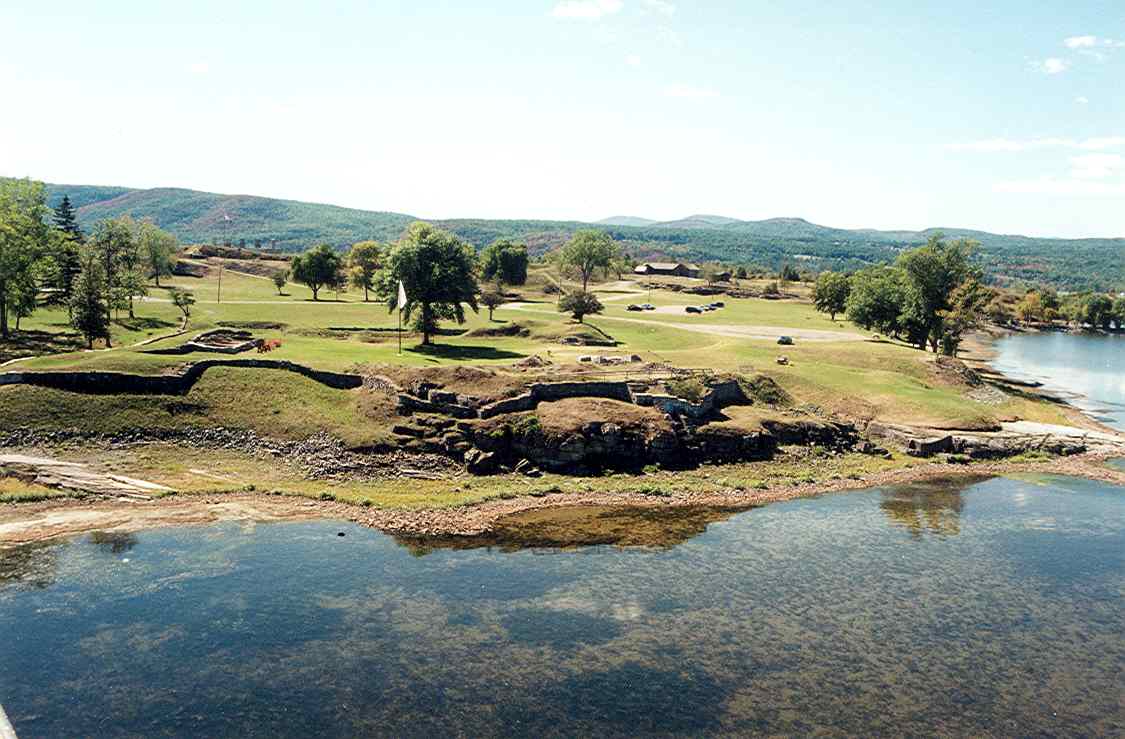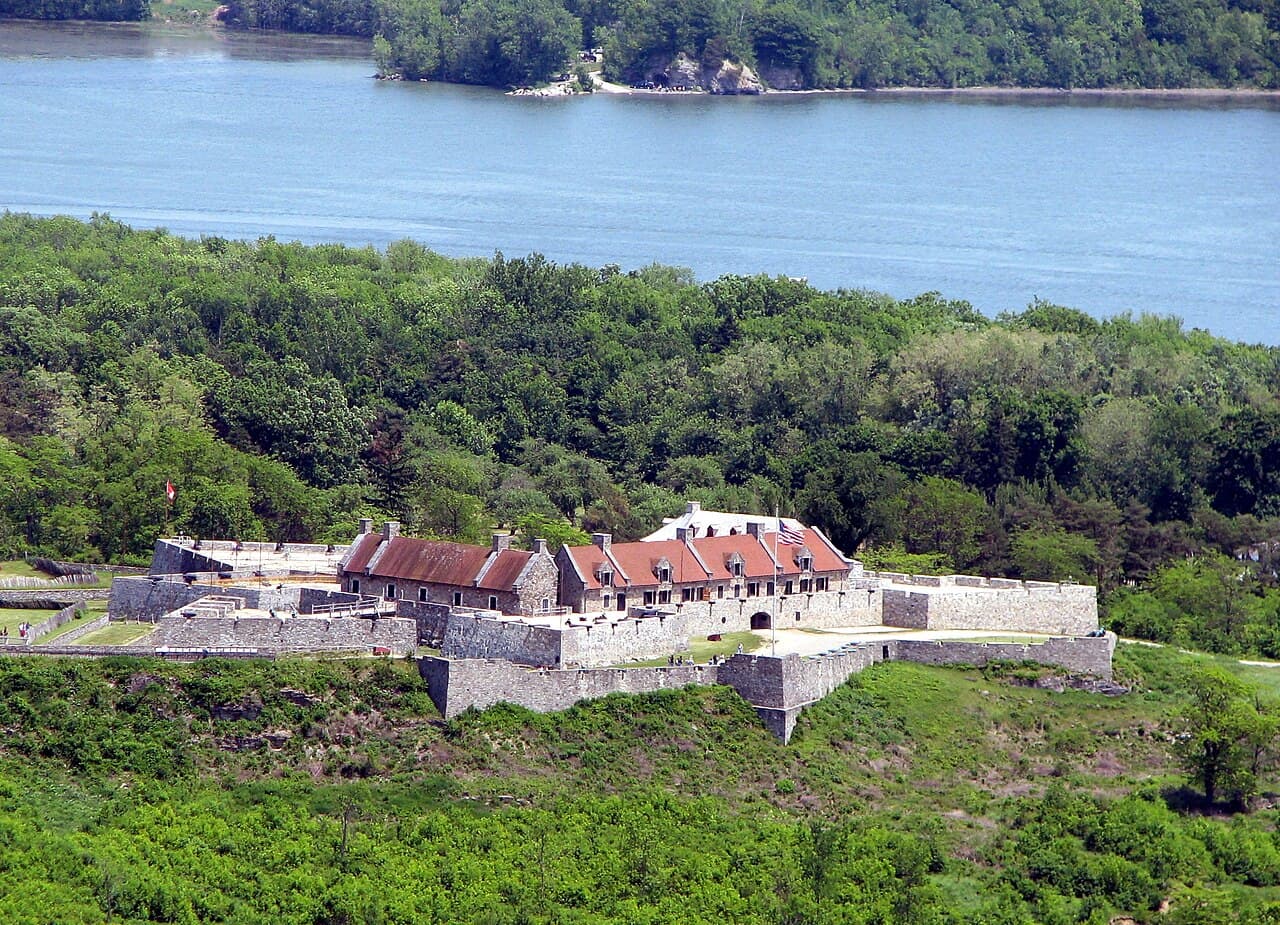
Fort Ticonderoga
Fort Ticonderoga, originally named Fort Carillon, is a prominent 18th-century star fort located near the southern end of Lake Champlain in northern New York. Constructed between October 1755 and 1757 by the French-Canadian military engineer Michel Chartier de Lotbinière, Marquis de Lotbinière, it played a crucial role in the French and Indian War, the North American theater of the Seven Years' War. The fort's design reflects the bastioned fortress style prevalent in the post-Renaissance period, featuring angled bastions optimized for defense against artillery.
The fort's strategic position controlled a vital river portage at the mouth of the rapid La Chute River, linking Lake Champlain and Lake George over a distance of approximately 3.5 miles (5.6 km). This location was essential for controlling trade and military movements between the British-controlled Hudson River Valley and the French-controlled Saint Lawrence River Valley. The surrounding Appalachian Mountains and the orientation of the lakes created natural barriers, making the narrow corridor commanded by Fort Ticonderoga a critical chokepoint in the region.
Architectural design and features
The fort exhibits the characteristics of a bastioned fortress, a design that emerged in Europe during the post-Renaissance era to counter the increasing power of cannon fire. Its layout includes star-shaped bastions that project outward from the main walls, allowing defenders to cover all approaches with overlapping fields of fire. The fort's walls were constructed with thick earthworks faced with stone, designed to absorb and deflect artillery bombardment.
The main fortification includes several bastions, curtain walls, and a well-planned network of internal structures such as barracks, magazines, and powder stores. The fort's design prioritized both defense and the accommodation of a sizable garrison, reflecting its importance as a military stronghold in the contested borderlands of colonial North America.
Historical significance in colonial conflicts
Fort Ticonderoga was central to several key military engagements during the mid-18th century. The Battle of Carillon in 1758 saw approximately 4,000 French defenders successfully repel a much larger British force of around 16,000 troops. This victory underscored the fort's formidable defenses and strategic value.
However, in 1759, the British returned with a reinforced army and captured the fort after the French garrison withdrew. The fort then became a British stronghold during the lead-up to the American Revolutionary War.
Role in the american revolutionary war
At the start of the Revolutionary War, Fort Ticonderoga was under British control. On May 10, 1775, it was seized by the Green Mountain Boys and other militia forces led by Ethan Allen and Benedict Arnold. This capture was significant for the American cause, as it provided a cache of artillery and a strategic position.
Henry Knox famously transported the fort's artillery overland to Boston during the winter of 1775-1776, enabling the Continental Army to force the British evacuation of the city in March 1776. The Americans held the fort until June 1777, when the British under General John Burgoyne occupied the high ground above it, compelling an American withdrawal.
In September 1777, a direct attack on the fort by about 500 American troops led by John Brown was unsuccessful against a smaller British garrison. Following the failure of the British Saratoga campaign, the fort was abandoned by the British and lost military importance.
Post-war history and preservation
After the Revolutionary War, Fort Ticonderoga fell into disuse and disrepair. Local residents scavenged building materials, and the fort was largely neglected. In 1820, it was purchased by a private family and gradually became a tourist destination, attracting visitors interested in its rich history.
During the early 20th century, private owners undertook significant restoration efforts to preserve the fort's structure and historical integrity. Today, the Fort Ticonderoga Association manages the site as a museum, research center, and tourist attraction, offering educational programs and maintaining the fort's legacy as a symbol of colonial and Revolutionary War history.
Geographical and cultural context
The name "Ticonderoga" derives from the Iroquois word tekontaró:ken, meaning "it is at the junction of two waterways," highlighting the site's importance as a crossroads between major water routes. The fort's location in the narrow corridor between Lake Champlain and Lake George made it a focal point for control over the surrounding region during the colonial era and beyond.
Today, Fort Ticonderoga stands as a well-preserved example of post-Renaissance military architecture in North America and remains a testament to the complex history of European colonization, indigenous presence, and the struggle for American independence.
Frequently asked questions (FAQ)
- How do I get to Fort Ticonderoga?
- Fort Ticonderoga is located near the southern end of Lake Champlain in northern New York. Visitors can reach the site by car via major highways or by regional bus services. It is advisable to check local transportation options and seasonal accessibility before planning your visit.
- What is the historical significance of Fort Ticonderoga?
- Fort Ticonderoga played a key role in the French and Indian War and the American Revolutionary War. Its strategic location controlled important trade routes between the Hudson River Valley and the Saint Lawrence River Valley, making it a focal point of military conflicts in the 18th century.
- When was Fort Ticonderoga built?
- The fort was constructed between October 1755 and 1757 by the French during the post-Renaissance period. It was designed by Michel Chartier de Lotbinière, Marquis de Lotbinière, as a bastioned fortress to withstand artillery attacks.
- Can I explore the interior of Fort Ticonderoga?
- Yes, Fort Ticonderoga is open to the public as a museum and historic site. Visitors can tour the fort's bastions, walls, barracks, and exhibits that showcase its military history and architectural features.
- Why is Fort Ticonderoga called a bastioned fortress?
- Fort Ticonderoga is classified as a bastioned fortress because of its star-shaped design featuring angled bastions. This architectural style was developed in the post-Renaissance era to improve defense against cannon fire by allowing overlapping fields of fire along the walls.
Photo gallery

Information
Architect
Michel Chartier de Lotbinière, Marquis de Lotbinière
Current owner
Fort Ticonderoga Association
Loading map...
Visitor reviews
No reviews yet. Been here? Write the first review and help other travelers!
Write the first reviewVisited this castle? Share your experience
Your review helps other travelers and adds first-hand knowledge to our encyclopedia.