Fort of Sacavém
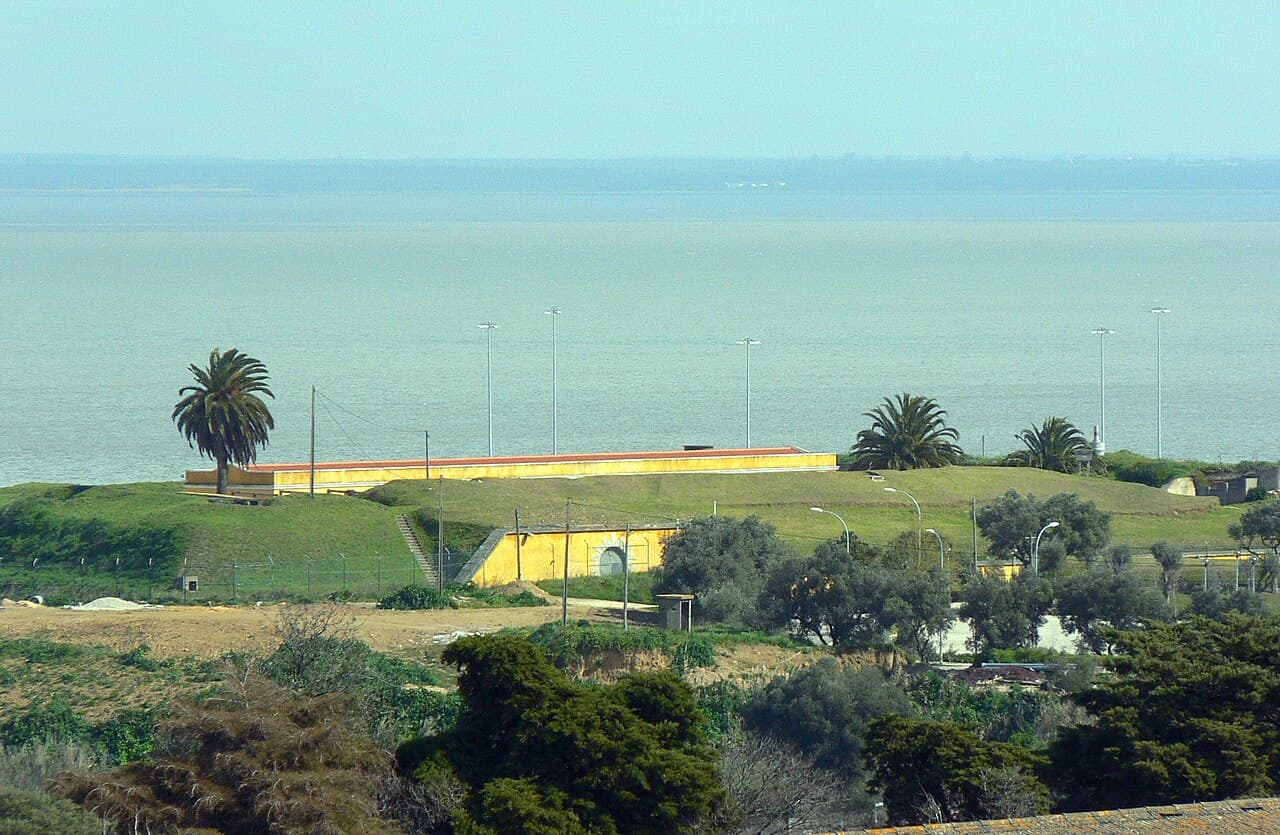
The Fort of Sacavém, also known historically as the Redoubt of Mount Cintra or Mount Sintra, is a significant example of a 19th-century bastioned fortress located in the town of Sacavém, within the municipality of Loures, in the Lisbon District of Portugal. Situated immediately to the north of Lisbon, this fort played an important role in the defensive network protecting the capital during a period of military modernization in the late 19th century.
Construction of the fort commenced in 1875 and was completed by 1892, reflecting the strategic military architectural trends of the Modern period. The design of the fort incorporates bastioned fortification elements, which were developed to withstand the increasing power of artillery and provide overlapping fields of fire. This kind of design was typical of the era's military engineering, focusing on angular bastions and thick walls to resist bombardment.
Architectural design and features
The Fort of Sacavém is classified as a bastioned fortress, a style characterized by projecting bastions at the corners of the fortification walls. These bastions allowed defenders to cover adjacent walls and approaches with gunfire, eliminating blind spots and enhancing the fort's defensive capabilities. The fort's layout is typically polygonal, optimizing fields of fire and minimizing vulnerable angles.
Constructed primarily from stone and brick, the fort features robust curtain walls and earthworks designed to absorb artillery impact. The walls are punctuated by casemates—vaulted chambers within the walls used for housing troops, ammunition, and artillery pieces safely. The fort also includes a moat and a fortified gatehouse that controlled access to the interior.
Defensive elements
The bastions are equipped with firing platforms for artillery and small arms. The fort's defensive perimeter is reinforced with ravelins and glacis—sloping embankments designed to expose attackers to defensive fire while providing additional protection to the walls. These features reflect the influence of the Vauban-style fortifications, adapted for the artillery technology of the late 19th century.
Historical context and military significance
The fort was part of a broader effort to modernize Portugal's coastal and inland defenses in response to evolving military threats and technological advances in artillery. Its strategic location near Lisbon made it a critical component of the capital's defensive ring, intended to protect against potential invasions or bombardments.
Throughout its active military use, the Fort of Sacavém served as a garrison and a stronghold, though it did not engage in major battles. Its presence contributed to the deterrence of hostile forces during periods of political instability in Portugal and Europe.
Post-military use and preservation
Since 2015, the fort has been repurposed to serve as the National Archive for Portugal's Directorate General of Cultural Heritage (DGPC). This adaptive reuse has preserved the fort's structural integrity while providing a valuable cultural and administrative function. The transformation into an archive highlights the fort's enduring significance as a historical monument and a symbol of Portugal's heritage.
Efforts to maintain and restore the fort have ensured that its well-preserved bastioned walls and architectural features remain intact for educational and cultural purposes. Visitors can appreciate the fort's imposing structure and learn about its role in Portugal's military history.
Visiting information and accessibility
The fort is accessible to the public during designated visiting hours, which are typically aligned with the operational schedule of the National Archive. Visitors interested in military architecture and Portuguese history can explore the exterior fortifications and participate in guided tours that explain the fort's design and historical context.
Its location near Lisbon makes the Fort of Sacavém an accessible destination for day trips from the capital, offering insight into 19th-century military engineering and Portugal's defensive strategies.
Frequently asked questions (FAQ)
- How do I get to the Fort of Sacavém?
- The Fort of Sacavém is easily accessible by public transportation, including buses and trains from Lisbon. If you prefer to drive, there is parking available nearby, making it convenient for visitors traveling by car.
- What is the historical significance of the Fort of Sacavém?
- The Fort of Sacavém was built in the late 17th century to protect the region from invasions, particularly during the War of Restoration. Its strategic location along the Tagus River made it a crucial military site in Portuguese history.
- When was the Fort of Sacavém constructed?
- Construction of the Fort of Sacavém began in 1690 and was completed in 1706. It was designed to strengthen the defense system of Lisbon against possible maritime attacks.
- Can I take guided tours of the Fort of Sacavém?
- Yes, guided tours are available for visitors interested in learning more about the fort's history and architecture. These tours are led by knowledgeable guides who provide insights into the fort's significance and its role in Portuguese history.
- Why is the architecture of the Fort of Sacavém noteworthy?
- The architecture of the Fort of Sacavém is noteworthy for its baroque style, which reflects the military architectural trends of the late 17th century. The fort features robust walls and bastions designed to withstand artillery fire, showcasing the engineering advancements of its time.
- Is it possible to visit the Fort of Sacavém year-round?
- Yes, the Fort of Sacavém is open to visitors year-round, although specific events or maintenance may affect accessibility. It is advisable to check the fort's official website for any updates regarding visits and special events.
- What are the opening hours for the Fort of Sacavém?
- The Fort of Sacavém typically opens its doors from 10 AM to 6 PM, with extended hours during the summer months. It is recommended to verify the hours on the day of your visit, as they may vary due to special events or holidays.
- What are the ticket prices for visiting the Fort of Sacavém?
- Ticket prices for the Fort of Sacavém are generally affordable, with discounts available for students and seniors. Check the official website for the most up-to-date pricing information and any special promotions.
- What are some nearby attractions to visit while at the Fort of Sacavém?
- Nearby attractions include the picturesque Tagus River waterfront and various parks that offer scenic views. Additionally, the city of Lisbon is just a short distance away, providing further cultural and historical sites to explore.
Photo gallery

Photo by No machine-readable author provided. Juntas assumed (based on copyright claims).•CC BY-SA 3.0
Information
Loading map...
Visitor reviews
No reviews yet. Been here? Write the first review and help other travelers!
Write the first reviewVisited this castle? Share your experience
Your review helps other travelers and adds first-hand knowledge to our encyclopedia.