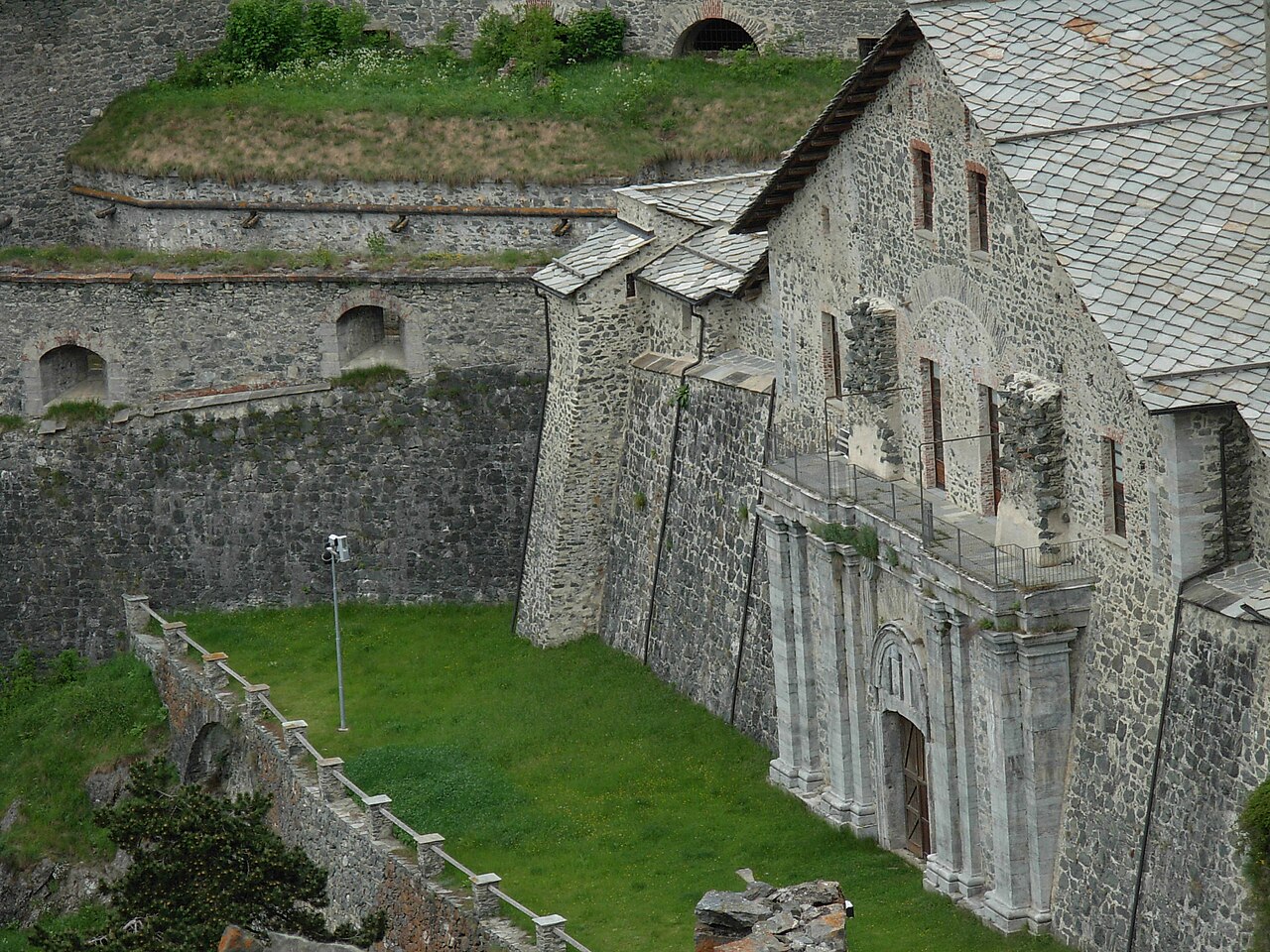
Fort of Exilles
The Fort of Exilles (Italian: Forte di Exilles) is a significant fortified complex located in the Susa Valley in northwestern Italy. This imposing fortress occupies a commanding position on a rocky spur overlooking one of the narrowest points of the valley, strategically placed along the historic route connecting Turin to France through the Monginevro Pass. Its location made it a critical military stronghold throughout history, particularly in controlling access between the territories of the House of Savoy and France.
The origins of fortifications at Exilles date back to at least the 7th century, as chronicled by the Abbey of Novalesa, which mentioned a fortification on the site that may have been destroyed during the Frankish expansions. The documented history of the current fortification begins in the 12th century, when from 1155 the site was held by the Bermond family of Besançon, counts of Albon, who controlled the vital road near the Monginevro Pass. The earliest detailed description of the castle dates to 1339, depicting a quadrangular plan with multiple towers, which contrasts with the massive, more complex structure visible today.
Medieval origins and strategic importance
During the late medieval period, the fort was a key defensive position in the ongoing conflicts between the Savoyard and French realms. In the late 15th century, specifically between 1494 and 1496, the fort was used as an ammunition depot by Charles VIII of France. During this time, the main entrance was enlarged and local peasants were conscripted to defend the fort, reflecting its military significance. The 16th century saw further enhancements under Charles II of Savoy, who added additional towers to strengthen its defenses.
Turbulent sixteenth and seventeenth centuries
The fort's control changed hands multiple times during the 16th century. It was under French rule in 1541 but was returned to the House of Savoy by the Treaty of Cateau-Cambrésis in 1559, under the leadership of Emmanuel Philibert of Savoy. However, the French captured it again in 1591 after a brief siege. Two years later, Charles Emmanuel I of Savoy recaptured the fort and undertook significant strengthening works, especially on the side facing the upper Susa Valley, to improve its defensive capabilities.
Despite these efforts, the French regained control in 1595 after a month-long siege. The fort remained under French control until 1708, when it was returned to the Savoyards following the War of the Spanish Succession. The 18th century saw extensive reconstruction by the French, who modernized the fortifications to adapt to evolving military technology and tactics. In 1720, the Piedmontese commissioned military engineer Ignazio Bertola to revise the fort's defenses, further enhancing its strategic resilience.
Military engagements and architectural evolution
In 1745, during the War of the Austrian Succession, the fort was attacked by French forces but successfully repelled the assault, demonstrating its formidable defenses. The Napoleonic era brought significant changes; after Napoleon Bonaparte's conquest of Italy in the early 19th century, the fort was deliberately demolished to prevent its use by opposing forces.
Between 1818 and 1829, the fort was rebuilt with updated designs reflecting contemporary military engineering principles. This reconstruction incorporated modern bastions and artillery placements to withstand advances in siege warfare. The fort remained under the control of the Italian Army until 1943, after which it was abandoned.
Restoration and cultural significance
In 1978, the Piedmontese Regional Authority acquired the fort and initiated a comprehensive restoration program. The restoration aimed to preserve the historical fabric while adapting the site for public access and cultural use. In 2000, the fort was opened to visitors and now houses the Museo Nazionale della Montagna (National Mountain Museum), which features exhibitions related to alpine history and culture.
One of the fort's most intriguing historical associations is with the enigmatic prisoner known as L'homme au masque de fer (The Man in the Iron Mask), who was held captive in the fortress jail for several years. This connection adds a layer of mystery and historical interest to the site.
Architectural features and layout
The current structure of the Fort of Exilles is a large, complex fortress with multiple defensive layers. It features massive stone walls, numerous towers, and a fortified gatehouse. The fort's position on a rocky spur provides natural defense on several sides, supplemented by man-made fortifications. Its design reflects the evolution of military architecture from medieval times through the 19th century, with adaptations to artillery warfare and siege tactics.
The fort includes bastions and curtain walls designed to provide overlapping fields of fire, and internal courtyards that once housed garrisons and supplies. The restoration preserved many original features while making the site accessible for educational and cultural purposes.
Visiting the fort today
Today, visitors to the Fort of Exilles can explore its extensive grounds, including the restored defensive works and the museum exhibitions. The site offers insights into alpine military history and the complex political struggles between France and Savoy. The fort's dramatic location and well-preserved architecture make it a notable destination for those interested in military history, architecture, and regional heritage.
Frequently asked questions (FAQ)
- How do I get to Fort of Exilles?
- Fort of Exilles is located in Susa, Italy, and can be easily accessed by car via the A32 motorway. Public transportation options include regional trains to Susa, followed by a short bus or taxi ride to the fort.
- What is the historical significance of Fort of Exilles?
- Fort of Exilles is a remarkable fortress that dates back to the 13th century and played a crucial role in the defense of the Susa Valley. It has witnessed numerous historical events, including conflicts between various European powers, making it an important site for understanding regional history.
- When was Fort of Exilles built?
- Construction of the Fort of Exilles began in the 13th century, with significant expansions and renovations occurring over the centuries. The fort's strategic location has made it a vital military installation throughout its history.
- Can I visit Fort of Exilles year-round?
- Yes, Fort of Exilles is open to visitors throughout the year, but it's best to check the official website for specific seasonal opening hours. Some areas may be restricted during winter months due to weather conditions.
- Why is the architecture of Fort of Exilles noteworthy?
- The architecture of Fort of Exilles is noteworthy for its impressive defensive structures, including thick walls and bastions designed to withstand sieges. Its design reflects a combination of medieval and Renaissance military architecture, showcasing the evolving techniques of fortification.
- Is it possible to take guided tours of Fort of Exilles?
- Yes, guided tours are available at Fort of Exilles, providing visitors with in-depth insights into its history and architecture. These tours are typically conducted in multiple languages and are highly recommended for a richer experience.
- What are the ticket prices for visiting Fort of Exilles?
- Ticket prices for Fort of Exilles vary, with discounts often available for students, seniors, and groups. It's advisable to check the official website for the latest pricing information and any special promotions.
- What is the best time to visit Fort of Exilles?
- The best time to visit Fort of Exilles is during the spring and fall when the weather is mild and pleasant. Summer months can be crowded, while winter may bring snow, which could affect accessibility.
- Are there any nearby attractions to Fort of Exilles?
- Yes, nearby attractions include the charming town of Susa, with its Roman ruins and medieval architecture, as well as the stunning Alpine scenery of the surrounding mountains. This makes Fort of Exilles a perfect base for exploring the rich cultural and natural heritage of the region.
- What are the opening hours for Fort of Exilles?
- Opening hours for Fort of Exilles can vary seasonally, so it's best to check the official website for the most current information. Generally, the fort is open daily, but hours may change during holidays or special events.
Information
Loading map...
Visitor reviews
No reviews yet. Been here? Write the first review and help other travelers!
Write the first reviewVisited this castle? Share your experience
Your review helps other travelers and adds first-hand knowledge to our encyclopedia.