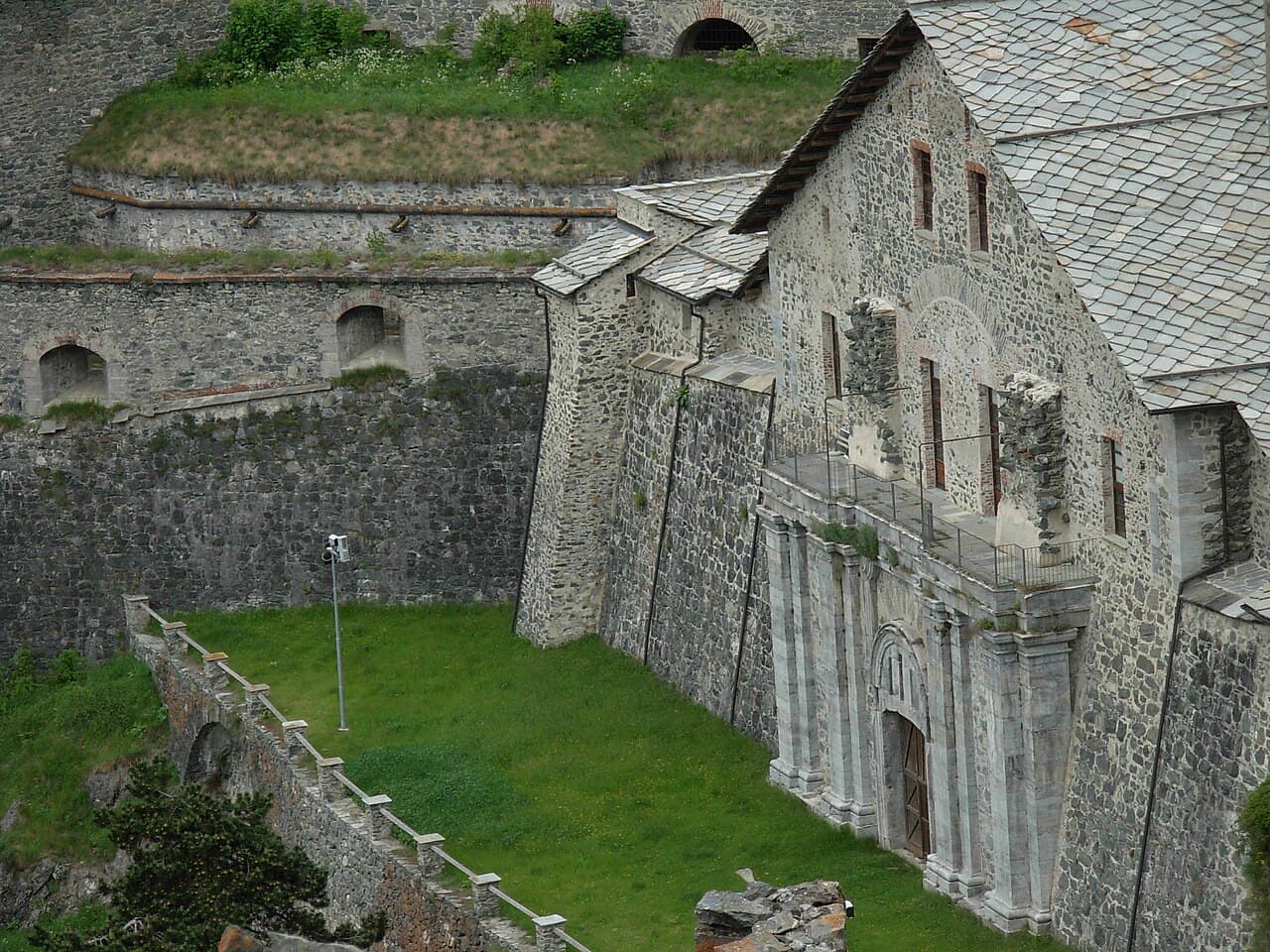
Fenestrelle Fort
The Fenestrelle Fortress, commonly known as the Fenestrelle Fort, is a monumental bastioned fortress located in the Piedmont region of northern Italy. It overlooks the town of Fenestrelle and serves as a prominent symbol of the Metropolitan City of Turin. Covering an expansive area of approximately 130 hectares (320 acres), it holds the distinction of being the largest alpine fortification in Europe.
Constructed over a lengthy period from 1728 to 1850, the fortress was commissioned by the House of Savoy as a strategic military installation. It was designed by the esteemed architect Ignazio Bertola, whose work reflects the advanced military architectural principles of the post-Renaissance era. The fortress was built to guard the vital access route to Turin through the Chisone valley, a key passage in the western Alps.
Strategic location and historical context
The Fenestrelle Fort is situated at altitudes ranging from 1,100 to 1,800 meters above sea level, strategically positioned to control the mountain passes leading to Turin. The site was acquired by the Duchy of Savoy in 1709 following their victory over the French forces at the nearby Fort Mutin, also known as Fenestrelle. This acquisition was part of the broader territorial conflicts during the War of the Spanish Succession, which shaped the political landscape of the region.
The fortress was intended to serve both defensive and deterrent functions, protecting the Duchy’s western borders and securing the important roadways through the Alps. Its construction spanned over a century, reflecting evolving military needs and technological advancements.
Architectural design and features
Fenestrelle Fort is classified as a bastioned fortress, a style characterized by angular bastions projecting from the walls to provide overlapping fields of fire and improved defensive capability against artillery. Its design incorporates multiple defensive layers, including massive stone walls, ramparts, bastions, and casemates for artillery placement.
The fortress complex extends over a vast area with a network of stairs, galleries, and tunnels connecting different sections, allowing for efficient movement of troops and supplies. One of its most remarkable features is the long fortified stairway, which climbs the steep hillside and connects the lower and upper parts of the fortress. This stairway is an engineering feat, demonstrating the adaptation of military architecture to the challenging alpine terrain.
Defensive structures
The bastions are designed to cover each other, eliminating blind spots and enabling defenders to repel attackers from multiple angles. The walls are thick and reinforced to withstand artillery bombardment, a necessity given the fortress’s role during a period of increasing use of gunpowder weaponry.
Additionally, the fortress includes moats and ditches carved into the rocky landscape, enhancing its defensive perimeter. The internal layout features casemates and barracks that housed soldiers and stored munitions, reflecting the fortress’s function as a self-sustaining military installation.
Role in military history and legacy
Throughout its operational history, Fenestrelle Fort played a significant role in the defense strategies of the Kingdom of Sardinia and later the unified Kingdom of Italy. It was a key stronghold during various conflicts, including the Napoleonic Wars and the Italian unification process.
The fortress also served as a prison for political detainees during the 19th century, adding a complex layer to its historical significance. Its remote and fortified location made it an ideal site for detaining prisoners considered threats to the state.
Current condition and cultural importance
Today, Fenestrelle Fort is well preserved and stands as a remarkable example of alpine military architecture. It attracts visitors interested in history, architecture, and mountain landscapes. Restoration efforts have helped maintain its extensive structures and made parts of the fortress accessible to the public.
The fortress is recognized for its cultural heritage value and is a prominent tourist attraction in the Piedmont region. Its vast scale and unique alpine setting offer insights into the military engineering challenges of the 18th and 19th centuries.
Visiting the fortress
Visitors can explore the extensive network of walls, bastions, and stairways, which provide panoramic views of the surrounding alpine environment. The site hosts guided tours and educational programs that highlight its historical and architectural significance.
Frequently asked questions (FAQ)
- How do I get to Fenestrelle Fort?
- Fenestrelle Fort is located in the Piedmont region of northern Italy. Visitors typically reach it by car or local transport from Turin, following the road through the Chisone valley.
- What is the historical significance of Fenestrelle Fort?
- Fenestrelle Fort was built by the House of Savoy in the 18th century to protect the western Alpine passes leading to Turin. It played important roles in regional military conflicts and served as a prison for political detainees.
- Can visitors explore the entire fortress?
- While much of Fenestrelle Fort is accessible to visitors, some areas may be restricted for safety or preservation reasons. Guided tours are available to help visitors experience the key parts of the fortress.
- When is the best time to visit Fenestrelle Fort?
- The best time to visit is during the warmer months from late spring to early autumn, when the alpine weather is more favorable and the fortress is fully accessible.
- Is Fenestrelle Fort suitable for families and children?
- Yes, Fenestrelle Fort offers educational tours and outdoor exploration suitable for families, though some steep stairways may require caution with young children.
Photo gallery

Information
Architect
Ignazio Bertola
Loading map...
Visitor reviews
No reviews yet. Been here? Write the first review and help other travelers!
Write the first reviewVisited this castle? Share your experience
Your review helps other travelers and adds first-hand knowledge to our encyclopedia.


