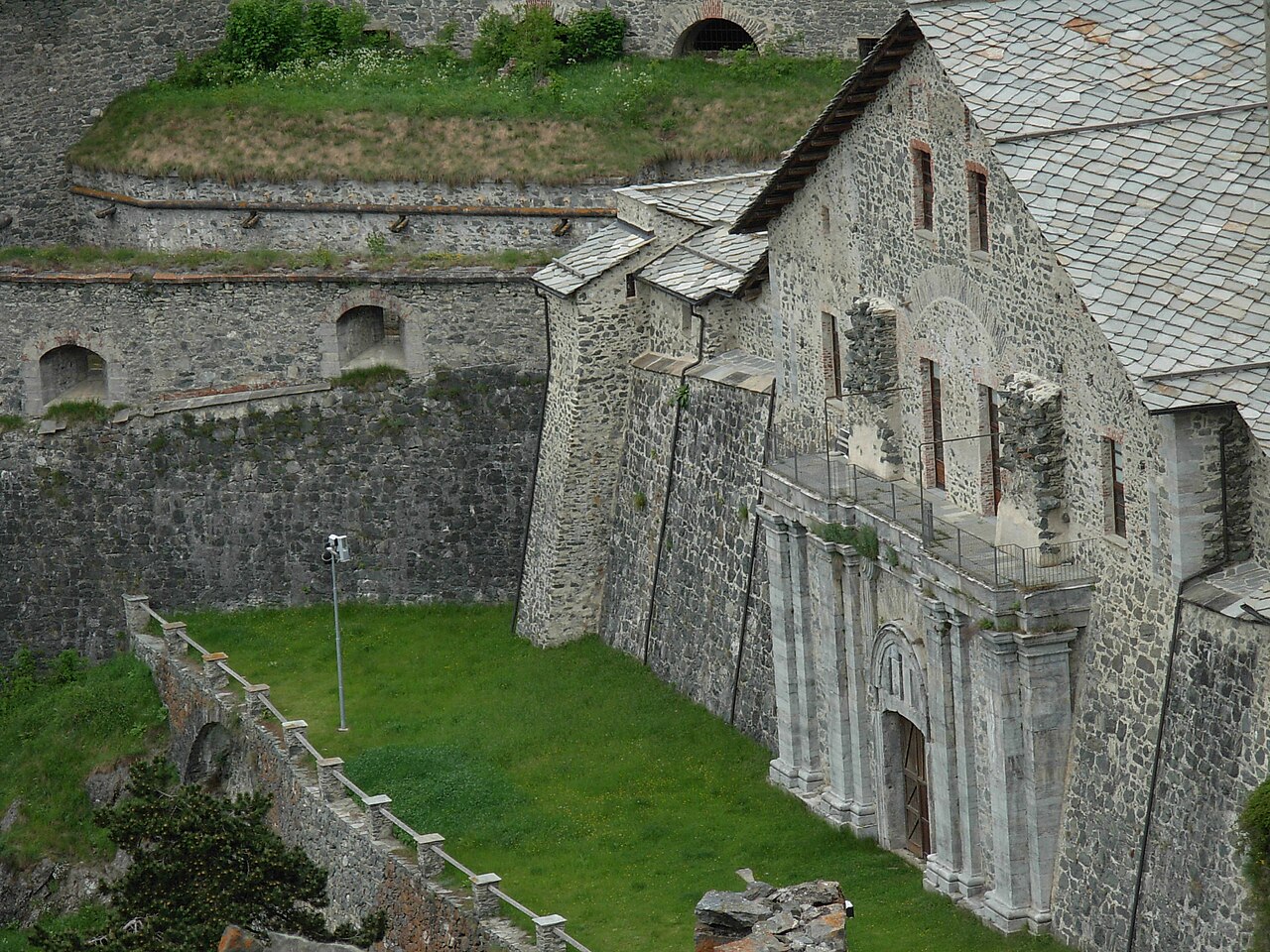
Fenestrelle Castle
Fenestrelle Castle, also known as the Fenestrelle Fortress, stands as a monumental testament to military architecture in the Italian Alps. Located in the Piemonte region of Italy, this vast fortification complex is renowned as the largest alpine fortress in Europe, sprawling over an impressive 1,350,000 square meters. Its construction, spanning from 1690 to 1793 with later enhancements until 1850, reflects the strategic military ambitions of the Kingdom of Sardinia during the Renaissance and post-Renaissance periods.
The fortress was conceived to guard the Chisone Valley, a crucial passageway vulnerable to foreign invasions. Its unique design features a continuous wall extending over 3 kilometers along the mountain ridge, with a remarkable elevation difference of about 600 meters between its lowest and highest points. This extraordinary scale and complexity distinguish Fenestrelle from traditional fortifications of its time.
Historical context and strategic importance
The origins of Fenestrelle Castle trace back to the late 17th century during the Nine Years' War when French King Louis XIV recognized the strategic significance of the Chisone Valley. In 1694, under the command of French general Nicolas Catinat, initial fortifications including Fort Mutin were established to secure the area. However, after the War of the Spanish Succession and the Treaty of Utrecht in 1713, the territory was ceded to the Duchy of Savoy, marking a shift in control and military strategy.
King Victor Amadeus II of Savoy, recognizing the inadequacy of existing defenses, commissioned military engineer Ignazio Bertola in 1727 to design a comprehensive fortification system. Bertola’s plan incorporated multiple forts connected by extensive walls and staircases, creating a formidable defensive barrier against potential invasions through the alpine passes.
Architectural features and construction
The fortress is not a single structure but a complex of eight interconnected defensive works, including large forts like Fort San Carlo and smaller redoubts such as the Reduced Santa Barbara. Each element served a specific tactical purpose within the overall defense strategy.
One of Fenestrelle’s most remarkable architectural features is the covered staircase, a protected passageway consisting of nearly 4,000 steps that ascend the mountain slope for over two kilometers. This covered stairway, with walls up to two meters thick, allowed for secure troop movements and communication between different parts of the fortress regardless of weather conditions.
Construction began in earnest in 1728 under Bertola’s supervision, assisted by engineer Varino de la Marche. The work was extensive and labor-intensive, involving thousands of workers at its peak. Although the main phase concluded in 1793, additional construction and upgrades continued intermittently until 1850, reflecting ongoing military needs and technological advancements.
Military use and prison function
Throughout its history, Fenestrelle Fortress functioned primarily as a military garrison, maintaining a vigilant presence over the alpine frontier. It also served as a state prison, housing a range of detainees from political prisoners to common criminals. Notable inmates included prominent figures such as Joseph de Maistre and Bartolomeo Pacca, as well as Pierre Picaud, whose life inspired the character Edmond Dantès in Alexandre Dumas’ "The Count of Monte Cristo."
During the Napoleonic era, the fortress was used by the French Empire for detention, and later by the Kingdom of Sardinia and unified Italy for imprisoning political dissidents, soldiers, and supporters of various factions, including those from the Kingdom of the Two Sicilies and the Papal States. This dual role as fortress and prison added to its historical significance.
Decline and restoration efforts
After World War II, Fenestrelle Castle fell into neglect and disrepair. The fortress was abandoned, and natural vegetation began to overgrow the structures, causing damage to the walls and threatening the integrity of the complex. Much of the original material was plundered, accelerating the decay.
In 1990, a dedicated volunteer group known as the Progetto San Carlo Association initiated a restoration campaign to preserve and rehabilitate the fortress. Their efforts have transformed Fenestrelle into a cultural and historical attraction, open to the public and drawing tourists and scholars interested in military history and alpine architecture.
Fenestrelle castle today
Today, Fenestrelle Castle stands as a remarkable example of alpine fortification engineering, combining military functionality with impressive architectural ingenuity. Visitors can explore the extensive network of walls, forts, and staircases, gaining insight into the fortress’s role in European military history. The site’s preservation allows for an immersive experience into the challenges of defending mountainous borders and the complex history of the Piedmont region.
The fortress’s unique scale, strategic design, and historical layers make it a significant cultural landmark. It offers educational opportunities about the evolution of fortifications from the late Renaissance through the 19th century, reflecting broader geopolitical shifts in Europe. Fenestrelle Castle remains a symbol of resilience and historical memory in the Italian Alps.
Frequently asked questions (FAQ)
- How do I get to Fenestrelle Castle?
- Fenestrelle Castle is located in the town of Fenestrelle in Piemonte, Italy. It is accessible by road, with parking available nearby. Visitors can reach the castle by car or local transport from Turin.
- What is the best time to visit Fenestrelle Castle?
- The best time to visit Fenestrelle Castle is during the late spring to early autumn months when the weather is milder and the outdoor staircases and pathways are more accessible.
- Can I explore the entire fortress complex?
- Visitors can explore most parts of Fenestrelle Castle, including the extensive walls, forts, and covered staircases. Some areas may be restricted for safety reasons, but guided tours often provide access to key sections.
- What historical periods does Fenestrelle Castle represent?
- Fenestrelle Castle represents fortification styles and military architecture from the Renaissance through the post-Renaissance periods, reflecting developments from the late 17th to the mid-19th century.
- Is Fenestrelle Castle wheelchair accessible?
- Due to the mountainous terrain and extensive staircases, Fenestrelle Castle is not fully wheelchair accessible. Visitors with mobility challenges should inquire in advance about available accommodations.
Information
Architect
Ignazio Bertola
Current owner
Progetto San Carlo Association
Loading map...
Visitor reviews
No reviews yet. Been here? Write the first review and help other travelers!
Write the first reviewVisited this castle? Share your experience
Your review helps other travelers and adds first-hand knowledge to our encyclopedia.