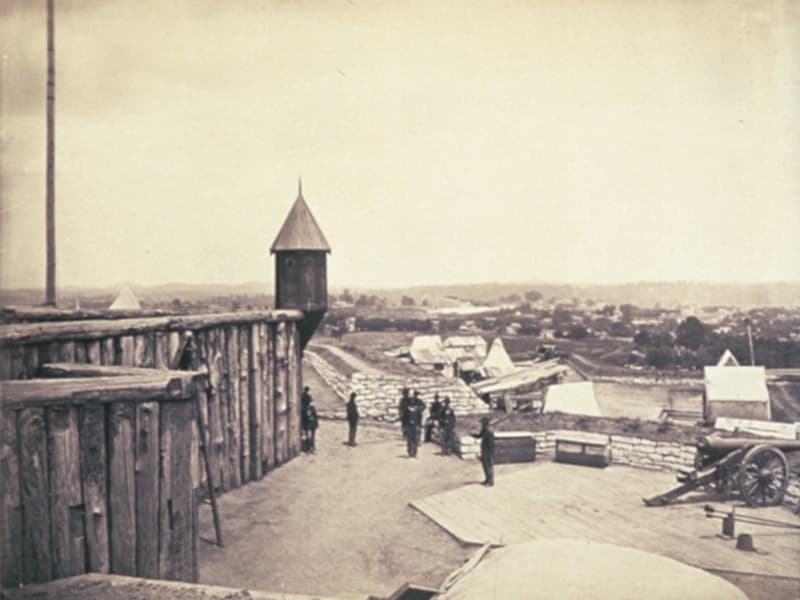
Fort Negley
Fort Negley is a significant bastioned fortress constructed by Union forces during the American Civil War following their capture of Nashville, Tennessee. Situated about 2 miles (3.2 km) south of downtown Nashville, it was the largest inland fortification built in the United States during the conflict, reflecting the strategic importance of Nashville as a transportation and supply hub.
Historical context and construction
After Union troops took control of Nashville in early 1862, Confederate forces were pushed out of the city, prompting the Union army to establish a strong defensive position to protect their hold. Fort Negley was constructed rapidly using mainly limestone and earthworks, with thousands of enslaved African Americans and free blacks forced to work on its building under harsh conditions. The fort was named after Union General James S. Negley, who played a prominent role in the early battles around Nashville.
The design of Fort Negley incorporated a bastioned fortress layout, which included angled walls and protruding bastions to allow defenders to cover all approaches with overlapping fields of fire. This design was typical of mid-19th-century military engineering aimed at countering artillery and infantry assaults. The fort's walls were reinforced with thick earthen embankments to absorb cannon fire, and it featured multiple artillery placements.
Architectural features and layout
Fort Negley was built primarily from local limestone and earth, forming a robust defensive structure. The fort's layout consisted of a large, irregular polygon with bastions at the corners, enabling enfilading fire along the walls. The interior contained barracks, powder magazines, and artillery platforms. The fort's walls varied in height but were generally substantial enough to provide effective protection against enemy attack.
The fort was surrounded by a ditch or moat, adding an additional obstacle for any attacking forces. Access was controlled through fortified gates, and the interior space was organized to support a garrison of several hundred soldiers. The artillery placements included positions for large-caliber cannons capable of defending the approaches to Nashville.
Military significance and use
Fort Negley served as a key defensive stronghold for Union forces in the Nashville area throughout the Civil War. Its strategic location allowed Union troops to control vital railroads and supply lines, preventing Confederate attempts to retake the city. The presence of the fort helped secure Nashville as a major Union base of operations in the Western Theater.
Although the fort never faced a direct assault, its mere existence as a formidable fortification deterred Confederate forces from launching significant attacks in the immediate vicinity. It also functioned as a training and staging area for Union troops preparing for campaigns further south.
Post-war history and preservation
After the Civil War ended in 1865, Fort Negley fell into disuse and gradually deteriorated. Over time, much of the fort was buried or obscured by urban development as Nashville expanded. In the 20th century, efforts were made to preserve and restore parts of the fort as a historic site.
Today, Fort Negley is managed as a public park and historic landmark. Archaeological excavations and restoration projects have uncovered portions of the walls and bastions, allowing visitors to gain insight into Civil War military engineering. Interpretive signage and guided tours help explain the fort's history and significance.
The site also serves as a memorial to the enslaved African Americans who were forced to build the fort under brutal conditions, highlighting an important and often overlooked aspect of Civil War history.
Visiting Fort Negley
Visitors to Fort Negley can explore the remains of the fort's walls, bastions, and earthworks. The park features walking trails, informational exhibits, and panoramic views of Nashville. It offers a unique opportunity to connect with the city's Civil War heritage and understand the military architecture of the period.
Fort Negley is accessible year-round, with no admission fee. The site is suitable for history enthusiasts, students, and families interested in American Civil War history and military fortifications.
Frequently asked questions (FAQ)
- How do I get to Fort Negley from downtown Nashville?
- Fort Negley is located about 2 miles south of downtown Nashville and can be reached by car, bike, or public transportation. It is accessible via local roads with parking available nearby.
- What is the historical significance of Fort Negley?
- Fort Negley was the largest inland fort built by Union forces during the Civil War, serving as a key defensive position to secure Nashville and its vital railroads.
- Can I explore the entire fort today?
- Visitors can explore the remaining walls, bastions, and earthworks of Fort Negley. While some areas have been restored, parts of the fort remain ruins or archaeological sites.
- Is there an admission fee to visit Fort Negley?
- No, Fort Negley is open to the public free of charge year-round, making it accessible for all visitors interested in Civil War history.
- What are the best times to visit Fort Negley?
- The fort is open from dawn to dusk daily. Spring and fall offer pleasant weather for walking the trails and exploring the historic site.
Photo gallery

Photo by Photographed by George Barnard (1819–1902)•Public domain
Information
Opening hours
Dawn to dusk, daily
Ticket prices
Free
Current owner
City of Nashville
Loading map...
Visitor reviews
No reviews yet. Been here? Write the first review and help other travelers!
Write the first reviewVisited this castle? Share your experience
Your review helps other travelers and adds first-hand knowledge to our encyclopedia.



