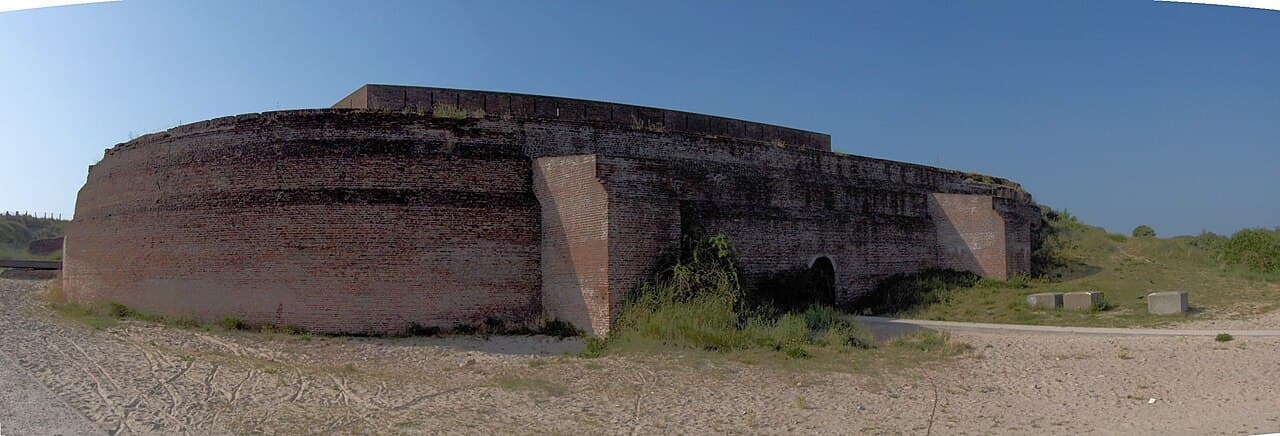
Fort Napoleon is a 19th-century bastioned fortress located on the east side of Ostend, in the province of West Flanders, within the Flemish region of Belgium. This historic fortification was constructed during the Napoleonic era to defend the strategically important harbor city of Ostend from an anticipated British naval assault.
Construction and design
The fort was built between 1811 and 1814 under the orders of Napoleon Bonaparte, who personally visited Ostend several times during the French occupation of the Southern Netherlands. Originally named Fort Impérial, the fort was designed as a pentagonal bastioned fortress nestled within the sand dunes east of the city. Its defensive layout included a scarp and counterscarp protected by caponiers, which allowed defenders to fire along the ditch to repel attackers.
The fort was surrounded by a moat and the dunes' sand would have covered the counterscarp up to the top, making only the fort and moat visible from a distance. It was armed with 36 cannons and 10 mortars and garrisoned by 141 soldiers, reflecting its role as a significant coastal defense installation.
Historical context and military use
During the early 19th century, the Southern Netherlands (present-day Belgium) were under French control. Napoleon anticipated a British attack from the sea, prompting the construction of Fort Impérial to protect the vital port of Ostend. However, the expected British assault never occurred.
Following Napoleon's defeat in 1815, French forces withdrew, and the British took control of the fort, renaming it Fort William. It became part of the Wellington Line, a defensive network along the coast. As the threat of sea invasion diminished, the fort's military importance declined.
After Belgium gained independence in 1830, the fort was renamed Fort Napoleon and re-garrisoned by Belgian troops. Over the decades, its garrison was gradually reduced, and the fort suffered from theft and vandalism. The Wellington Line was abolished in 1847, but the fort remained under military ownership.
In 1870, the fort was used to detain around 100 French soldiers who fled to neutral Belgium after the Battle of Sedan. The fort was decommissioned in 1887, its armaments removed, and its entrance sealed.
20th-century history and restoration
During World War I, German forces occupied Fort Napoleon, using it as a headquarters for a nearby artillery battery. Notably, the fort was visited by German Emperor Wilhelm II and Field Marshal Paul von Hindenburg. The heavy coastal artillery battery, known as the Hindenburg battery, was stationed nearby, equipped with four 280 mm guns mounted in armored turrets on concrete platforms.
After the German withdrawal in 1918, the fort was looted and partially destroyed by local residents of Ostend. Between 1929 and 1932, restoration efforts converted the fort into a local history museum.
During World War II, German forces again used the fort as an artillery headquarters. Following liberation, the fort was once more looted and damaged. Subsequently, it served briefly as a military magazine and even a children's playground before being abandoned and left to nature, gradually being covered by dunes.
Renewed interest in the fort emerged in 1995, leading to extensive restoration work completed by 2012. Today, Fort Napoleon operates as a museum open to the public, offering visitors insight into its military history and architectural features. While the museum includes exhibits aimed at children, it also provides valuable historical context for all visitors.
Architectural features and significance
Fort Napoleon is a notable example of a polygonal bastioned fortress from the Napoleonic period. Its design reflects advances in military architecture intended to resist artillery bombardment and improve defensive firepower coverage. The use of caponiers and the covered counterscarp demonstrate sophisticated defensive planning to protect the fort's moat and walls.
The fort's location within the dunes provided natural camouflage and additional protection, with the sandy terrain concealing much of the counterscarp and moat from enemy observation. The fort's armament of cannons and mortars was typical for coastal defenses of the era, intended to repel naval and land-based attacks.
Visiting fort napoleon today
Visitors to Fort Napoleon can explore the restored interior and learn about its complex history through exhibits and displays. The fort's layout, including its bastions, walls, and defensive structures, remains largely intact, offering a tangible connection to early 19th-century military engineering.
The museum provides educational opportunities about the region's history during the Napoleonic Wars, World War I, and World War II. The site is accessible for tours, and visitors can appreciate the unique setting of a fortress embedded within coastal dunes.
Frequently asked questions (FAQ)
- How do I get to Fort Napoleon in Ostend?
- Fort Napoleon is located on the east side of Ostend, Belgium, easily accessible by local public transport or car. It lies near the coastal dunes east of the city center.
- What is the historical significance of Fort Napoleon?
- Fort Napoleon was built during the Napoleonic era to defend Ostend from a potential British naval attack. It later served various military roles through World War I and II, reflecting the region's strategic importance.
- When was Fort Napoleon built and by whom?
- The fort was constructed between 1811 and 1814 under the orders of Napoleon Bonaparte during the French occupation of the Southern Netherlands.
- Can I visit the interior of Fort Napoleon?
- Yes, Fort Napoleon is open to the public as a museum. Visitors can explore its bastioned walls, defensive structures, and exhibitions detailing its military history.
- What architectural style is Fort Napoleon built in?
- Fort Napoleon is a bastioned fortress reflecting early 19th-century military architecture with polygonal design and caponiers for defense.
- Is Fort Napoleon wheelchair accessible?
- The fort's historic structure and terrain may pose challenges for wheelchair users. It is advisable to check with the museum for specific accessibility information before visiting.
Photo gallery

Photo by No machine-readable author provided. JoJan assumed (based on copyright claims).•CC BY-SA 3.0
Information
Current owner
Municipality
Loading map...
Visitor reviews
No reviews yet. Been here? Write the first review and help other travelers!
Write the first reviewVisited this castle? Share your experience
Your review helps other travelers and adds first-hand knowledge to our encyclopedia.