Fort Morgan
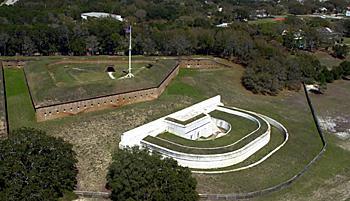
Fort Morgan is a significant example of a 19th-century bastioned fortress located at the strategic mouth of Mobile Bay, Alabama. It was constructed to protect the vital port and bay entrance, playing a crucial defensive role in American coastal fortifications. The fort's pentagonal layout and robust masonry walls exemplify the military architectural principles of the era, designed to withstand artillery assaults and provide overlapping fields of fire.
Historical background and construction
The site of Fort Morgan holds a layered military history. It was built on the location of the earlier Fort Bowyer, an earthen and stockade fortification that saw action during the War of 1812. Fort Bowyer was notable for its defense against British forces in 1814, marking one of the final land battles of the war. Recognizing the strategic importance of this location, the United States government initiated construction of a more permanent fortification to secure Mobile Bay.
Construction of Fort Morgan began in the early 19th century and was completed in 1834. The fort was named in honor of Daniel Morgan, a celebrated hero of the American Revolutionary War, reflecting the tradition of commemorating military leaders in fort names. The fort's design incorporated a pentagonal bastioned layout, a style derived from European military engineering principles intended to maximize defensive capabilities.
Architectural features and defensive design
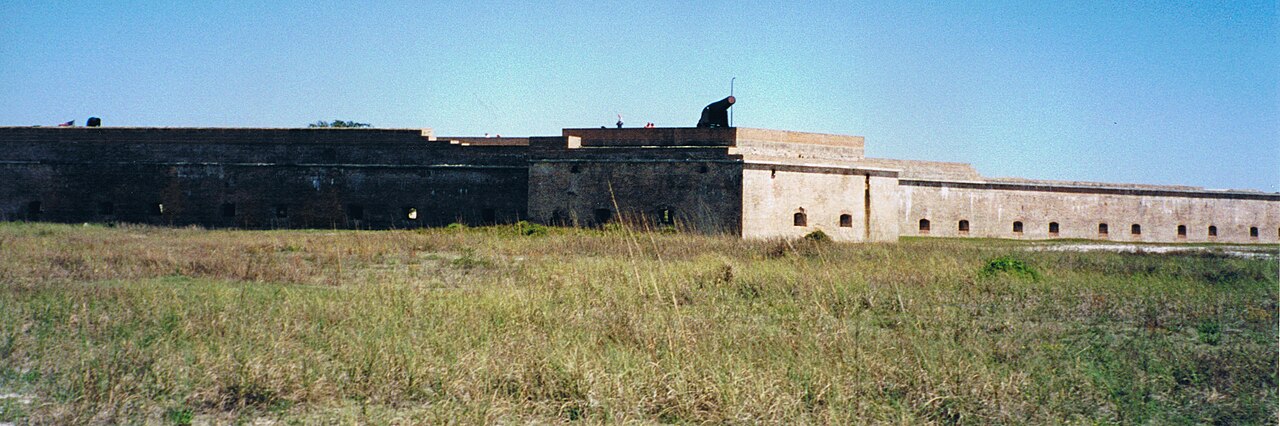
Fort Morgan's architecture is characterized by its masonry construction and pentagonal shape, which allowed for comprehensive coverage of the surrounding area. The bastions at each corner provided platforms for heavy artillery, enabling defenders to cover all approaches to the fort with overlapping fields of fire. The thick walls and angled bastions were designed to deflect and absorb cannon fire, enhancing the fort's resilience.
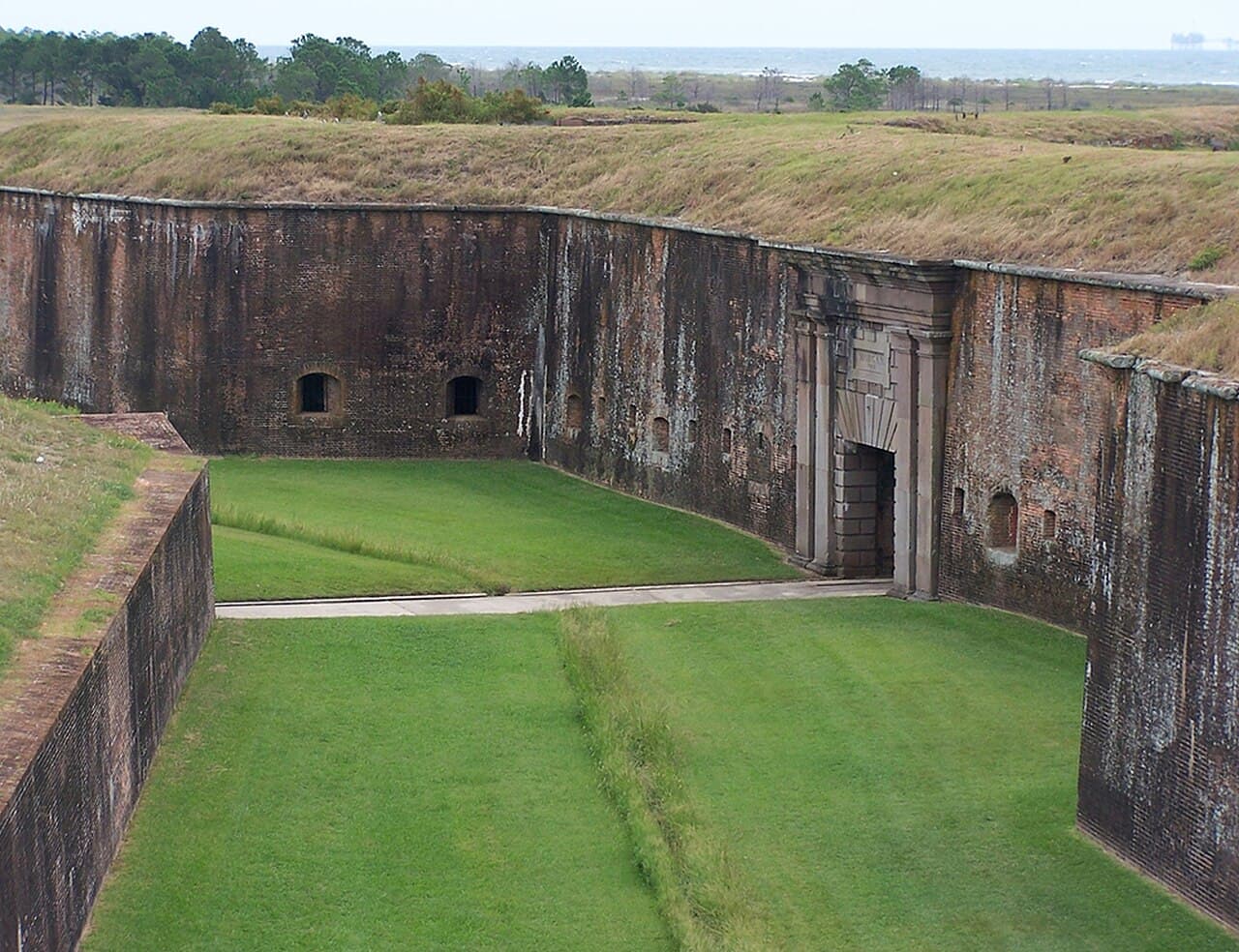
The fort’s layout includes multiple defensive elements such as curtain walls connecting the bastions, moats or ditches surrounding the structure, and a main gate fortified with additional defensive works. Inside, the fort contained barracks, powder magazines, and officer quarters, arranged to support sustained military operations.
Strategic importance and military use
Fort Morgan served as a critical defense point controlling access to Mobile Bay, a key harbor on the Gulf Coast. Its position at the tip of Mobile Point allowed it to work in conjunction with Fort Gaines on nearby Dauphin Island to create a crossfire zone that deterred enemy ships from entering the bay.
The fort was actively used during several conflicts, including the American Civil War, where it was a site of significant battles. It was held by Confederate forces and subjected to a prolonged siege by Union troops during the Battle of Mobile Bay in 1864. The fort's robust construction and strategic placement made it a formidable obstacle.
Preservation and current status
Today, Fort Morgan is maintained by the Alabama Historical Commission and is recognized as a site of considerable historical and architectural value. It is classified as a well-preserved bastioned fortress, with much of its original masonry and structural elements intact. Visitors can explore the extensive fortifications, including the bastions, walls, and interior buildings, gaining insight into 19th-century coastal defense architecture.
The fort is accessible via State Route 180 at the western end of Mobile Point. It forms part of a defensive system with Fort Gaines, together enclosing the entrance to Mobile Bay. The site offers educational programs and interpretive exhibits that highlight its historical significance and architectural features.
Architectural legacy and influence
Fort Morgan represents the evolution of American coastal fortifications during the post-War of 1812 period, reflecting advances in military engineering and the adaptation of European bastion fort designs to the American context. Its enduring masonry construction contrasts with earlier wooden or earthwork forts, illustrating a shift towards more permanent and formidable defensive structures.
The fort’s design influenced subsequent coastal defenses and remains a valuable example for the study of 19th-century military architecture. Its preservation allows historians and architects to examine the practical applications of bastion fort principles in the United States, contributing to a broader understanding of military heritage.
Frequently asked questions (FAQ)
- How do I get to Fort Morgan?
- Fort Morgan is located at the tip of Mobile Point in Alabama and can be reached via State Route 180. It is accessible by car, and there is parking available near the site.
- What is the historical significance of Fort Morgan?
- Fort Morgan played a key role in defending Mobile Bay, especially during the War of 1812 and the Civil War. It was built on the site of Fort Bowyer and named after Revolutionary War hero Daniel Morgan.
- Can I tour the interior of Fort Morgan?
- Yes, visitors can explore the well-preserved bastioned fortress, including its bastions, walls, and interior buildings. Guided tours and educational programs are often available.
- When was Fort Morgan built?
- Construction of Fort Morgan was completed in 1834 during the 19th century as a permanent masonry fortification to defend Mobile Bay.
- Is Fort Morgan open year-round?
- Fort Morgan is generally open to visitors year-round, but it is advisable to check current visiting hours with the Alabama Historical Commission before planning a visit.
Photo gallery

Photo by Altairisfar•Public domain
Information
Address
Mobile Point, Alabama, United States
Loading map...
Visitor reviews
No reviews yet. Been here? Write the first review and help other travelers!
Write the first reviewVisited this castle? Share your experience
Your review helps other travelers and adds first-hand knowledge to our encyclopedia.