Fort McHenry
Fort McHenry is a significant bastioned fortress located on Locust Point in Baltimore, Maryland. Constructed in the late 18th century beginning in 1798, it was designed as a coastal defense fortification to protect the vital Baltimore Harbor from naval attacks. The fort's pentagonal shape and star-shaped bastions are characteristic of the post-Renaissance military architecture that emphasized angled walls to deflect cannon fire and provide overlapping fields of defensive fire.
Architectural design and construction
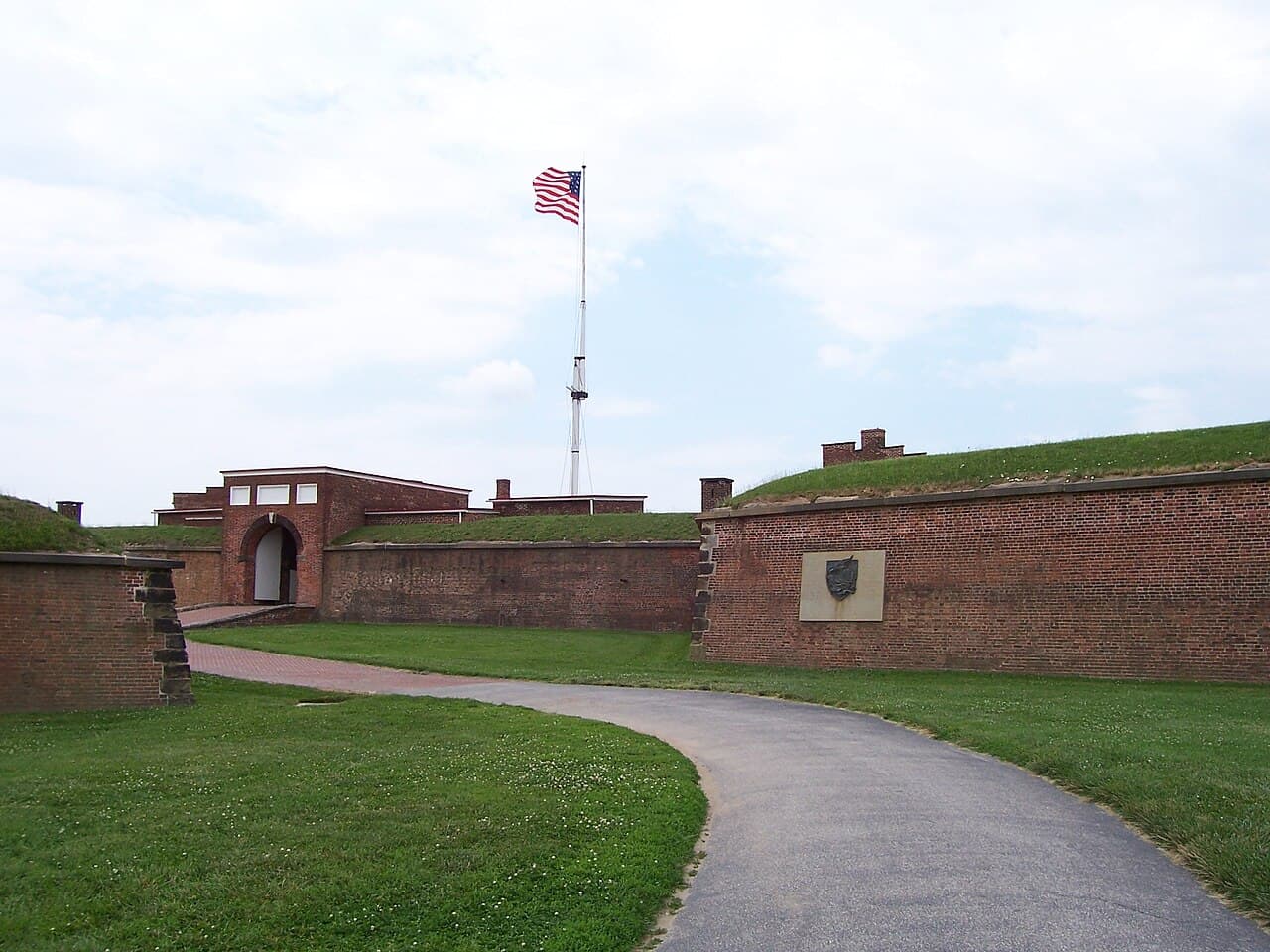
The design of Fort McHenry reflects the principles of Vauban-style fortifications, a European military engineering approach that influenced American coastal forts of the era. Its earthen walls reinforced with brick and stone formed a robust barrier against bombardment. The fort features ramparts equipped with numerous cannon embrasures, allowing defenders to fire on approaching enemy ships effectively. The moat surrounding the fort added an additional layer of defense, making direct assaults difficult.
Inside, the fort contains barracks, powder magazines, and officers' quarters, arranged around a central parade ground. The layout was practical for the garrison's needs, balancing defensive capabilities with living and operational spaces.
Historical significance and the war of 1812
Fort McHenry is most renowned for its crucial role in the War of 1812, particularly during the Battle of Baltimore on September 13–14, 1814. British forces launched a heavy naval bombardment intending to capture Baltimore, a strategic American port city. Despite sustained shelling, the fort's defenses held firm, preventing the British fleet from advancing into the harbor.
A pivotal moment was the flying of the American flags over the fort during the bombardment. Initially, a storm flag measuring 17 by 25 feet was raised, signaling American resilience. Early on September 14, this was replaced by a larger garrison flag, 30 by 42 feet, visible from miles away. The sight of the flag still flying at dawn inspired Francis Scott Key, who was witnessing the battle from a nearby ship, to compose the poem "Defence of Fort M'Henry." This poem was later set to music and became known as "The Star-Spangled Banner," adopted as the national anthem of the United States.
Use and preservation through the centuries
After the War of 1812, Fort McHenry continued to serve as an active military installation. It was garrisoned and updated through the 19th century, including during the American Civil War, when it was used as a prison for Confederate prisoners. The fort remained in military use through World War I and was utilized by the United States Coast Guard during World War II.
Recognizing its historic importance, the fort was designated a national park in 1925 and later a U.S. National Monument in 1939. Today, Fort McHenry is preserved as a well-preserved historic site and museum, offering visitors insight into early American military architecture and the nation's struggle for independence and defense.
Cultural legacy and visitor experience
Fort McHenry's enduring legacy is closely tied to its symbolic importance in American history. The fort is a popular destination for tourists and history enthusiasts, featuring exhibits on its military history, the War of 1812, and the story behind "The Star-Spangled Banner." Visitors can explore the bastions, ramparts, and historic buildings, and participate in reenactments and educational programs.
The site also hosts ceremonies and events commemorating American heritage. Its location on the waterfront provides scenic views of the Chesapeake Bay and Baltimore Harbor, enhancing the visitor experience.
Frequently asked questions (FAQ)
- What is the historical significance of Fort McHenry?
- Fort McHenry is famous for its role in the War of 1812, where it successfully defended Baltimore Harbor from British attack, inspiring the U.S. national anthem.
- Can I visit Fort McHenry year-round?
- Yes, Fort McHenry is open year-round with visitor facilities including a museum and guided tours. Check the official website for seasonal hours and special events.
- What architectural style characterizes Fort McHenry?
- Fort McHenry features post-Renaissance bastioned fortress architecture, designed with star-shaped bastions and angled walls for improved defense.
- Are there guided tours available at Fort McHenry?
- Guided tours are offered regularly, providing detailed insights into the fort's history, architecture, and role in American military defense.
- Is Fort McHenry accessible for visitors with disabilities?
- The site has made accommodations for visitors with disabilities, including accessible paths and facilities, though some historic areas may have limited access.
Photo gallery

Information
Address
2400 East Fort Avenue, Baltimore, MD 21230, United States
Loading map...
Visitor reviews
No reviews yet. Been here? Write the first review and help other travelers!
Write the first reviewVisited this castle? Share your experience
Your review helps other travelers and adds first-hand knowledge to our encyclopedia.