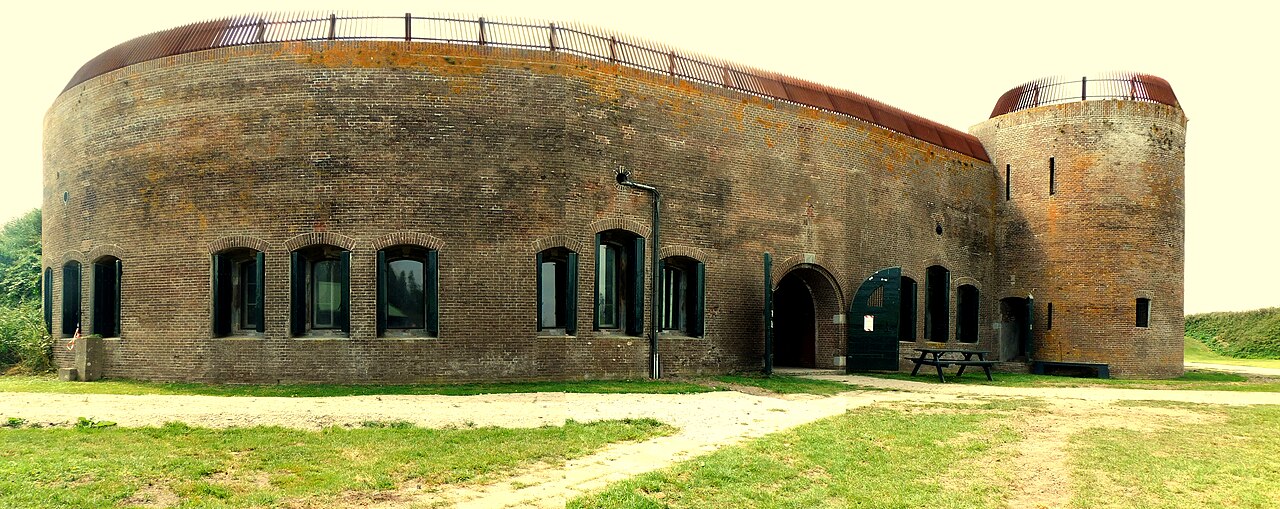
Fort Hell
Fort Hell, locally known as Fort de Hel, is a historic fortification located just south of the fortified town of Willemstad in the province of North Brabant, Netherlands. This fort is an example of post-medieval military architecture that reflects the strategic importance of the region in controlling waterways and protecting Dutch territory from foreign invasion.
The origins of Fort Hell date back to 1748 when the first fortification on the site was constructed as an earthen fort named Fort Anna. This initial structure was part of the broader defensive system aimed at securing the Southern Waterline, a network of fortifications designed to protect the Dutch heartland by controlling access through rivers and canals. By 1793, the fort had fallen into disrepair and was then known as Fort Carolina.
The French reconstruction and the Model Tower
During the Napoleonic era, in 1809, fears of a British invasion prompted the French to strengthen defenses in the region. In 1811, the French rebuilt the fort and renamed it Fort l'Enfer ("Fort the Hell"), constructing a small earthen fortification surrounded by a moat. At the heart of this fort stood a square Model Tower of the 1811 type, model 3, designed to house 14 men. This tower type is significant because it is one of only three such Model Towers built in the Netherlands, with the other two located at nearby Fort Sabina and Fort Prins Frederik. These towers, also known as Empire or Napoleon Towers, were the French counterpart to the British Martello Towers, both designed for coastal and river defense with thick walls and a compact footprint to resist artillery fire.
19th-century modernization and military role
After the French withdrew in 1813, the fort was renamed Fort de Hel. In 1874, it became part of the Position at the Hollands Diep and Volkerak, a defensive line that included Fort Sabina, Fort Prins Frederik, and Fort Buitensluis. Between 1882 and 1884, the fort underwent modernization efforts. The Model Tower was partially buried under earthworks, increasing its defensive capacity and allowing it to accommodate up to 118 men. The fort's primary role during this period was to provide supporting cover to Fort Sabina and to strengthen the overall defensive position of the waterline.
20th-century use and wartime history
During World War I, Fort Hell was mobilized as a precautionary measure, although it did not see combat. Its strategic location remained important for controlling access to the waterways and nearby air bases. By 1926, the fort was officially taken out of active military use. However, during World War II, the fort was occupied by the German army. On November 5, 1944, infantry soldiers from the South Wales Borderers approached the fort, mistakenly believing it to be abandoned. The Germans inside opened mortar fire, causing casualties before retreating by nightfall, allowing the fort to be captured.
In 1957, a microwave transmitter was installed on the fort to serve the nearby Woensdrecht Air Base. The fort was finally demilitarized in 1961, after which it stood empty for several decades.
Restoration and current status
In 1994, the fort was rented by the Friends of the Hell Foundation, who undertook restoration efforts to preserve this unique piece of Dutch military heritage. Today, Fort Hell is open to the public free of charge and is used for cultural events and group activities. While the fort's small Model Tower is well-preserved and notable, the rest of the fort's grounds are somewhat cluttered and less maintained.
Architectural significance and defensive features
Fort Hell exemplifies the post-Renaissance military architectural style, combining traditional earthen fortifications with the innovative Model Tower design introduced by the French during the Napoleonic Wars. The fort's moat and earthen ramparts provided protection against artillery, while the tower's compact structure allowed for effective defense with a small garrison. The fort's integration into the Southern Waterline and later the Hollands Diep and Volkerak defensive position highlights its role in controlling key waterways and supporting a network of fortifications.
Model Tower design
The Model Tower at Fort Hell is a rare surviving example of the French Empire's approach to fortification. Its square shape, thick walls, and limited garrison capacity reflect a design optimized for rapid response and resistance to naval bombardment. The tower's partial earth covering after the 19th-century modernization enhanced its defensive capabilities by absorbing artillery impacts.
Strategic location
Situated near the confluence of important rivers and close to the fortified town of Willemstad, Fort Hell's position allowed it to serve as a forward defensive post and a protective barrier for the surrounding region. Its proximity to other forts in the defensive line created overlapping fields of fire and mutual support.
Frequently asked questions (FAQ)
- How do I get to Fort Hell?
- Fort Hell is located at Helsedijk 85 in the Netherlands, easily accessible by car and public transport. If you're traveling by train, the nearest station is a short bus ride away, making it convenient for visitors. There is also ample parking available for those arriving by vehicle.
- What is the historical significance of Fort Hell?
- Fort Hell was built in the late 19th century as part of the Dutch water defense system. It played a crucial role during various military conflicts and is a testament to the strategic military architecture of its time. Today, it stands as a monument to the region's rich history and military heritage.
- When was Fort Hell constructed?
- Construction of Fort Hell began in 1880 and was completed by 1895. It was designed to protect the area from potential invasions and has been preserved as a historical site ever since. Visitors can explore its history through informative exhibits and guided tours.
- Can I visit Fort Hell with my family?
- Absolutely! Fort Hell is family-friendly and offers activities suitable for all ages. Children will enjoy exploring the grounds and learning about the fort's intriguing past through interactive displays.
- Why is Fort Hell an architectural marvel?
- Fort Hell is an exceptional example of late 19th-century military architecture, featuring thick walls and moats designed for defense. Its unique design reflects the advancements in military engineering of its time, making it a fascinating site for architecture enthusiasts. The fort's preservation allows visitors to appreciate its historical structure firsthand.
- Is it possible to take guided tours of Fort Hell?
- Yes, guided tours are available and highly recommended for a more in-depth understanding of the fort's history and architecture. Knowledgeable guides lead the tours, sharing fascinating stories and insights. Check the official website for tour schedules and special events.
- What are the opening hours of Fort Hell?
- Fort Hell is open to visitors from Tuesday to Sunday, with varying hours depending on the season. Typically, the fort opens at 10 AM and closes at 5 PM. It's advisable to check the website for any seasonal changes or special closures before planning your visit.
- What are the ticket prices for visiting Fort Hell?
- Ticket prices for Fort Hell are quite reasonable, with discounts available for children, students, and seniors. General admission is priced at €10, while family tickets offer a better value for groups. Be sure to check for any special promotions or events that may affect pricing.
- What nearby attractions can I visit after Fort Hell?
- After visiting Fort Hell, you can explore other nearby attractions such as the beautiful Helsedijk park and local museums that highlight the region's history. There are also charming cafes and restaurants where you can enjoy a meal. Make a day of it by combining your visit with these activities for a fuller experience.
Loading map...
Visitor reviews
No reviews yet. Been here? Write the first review and help other travelers!
Write the first reviewVisited this castle? Share your experience
Your review helps other travelers and adds first-hand knowledge to our encyclopedia.