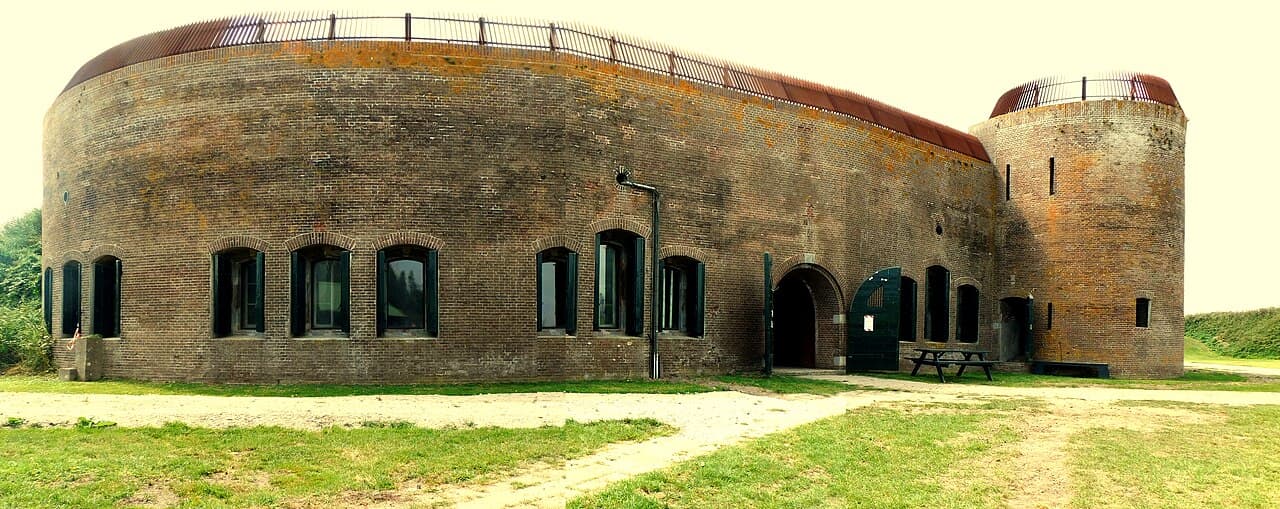
Fort Buitensluis
Fort Buitensluis is a historic military fortification located south of the village of Numansdorp, in the province of South Holland, Netherlands. This fort occupies a strategic position on the north bank of the Hollands Diep waterway, directly opposite the fortified town of Willemstad, guarding the entrance to the harbor of Numansdorp. Its location was chosen to control naval access and protect the surrounding region from potential maritime threats.
Origins and initial construction
Constructed in 1793, Fort Buitensluis was originally built as a purely earthen fort, a common defensive style of the late 18th century. The fort was named after the old name for Numansdorp, "Buitensluis," reflecting its local significance. The initial design focused on earthworks that could absorb artillery fire better than stone walls, which were vulnerable to cannon bombardment at the time.
19th-century enhancements and military role
In 1862, the fort underwent significant strengthening. Stone buildings were added, including bomb-proof powder magazines and barracks to accommodate troops stationed there. These improvements reflected advances in military engineering and the increasing importance of the fort within the regional defense network.
By 1874, Fort Buitensluis became part of a larger defensive system known as the Position at the Hollands Diep and Volkerak. This network included Fort Sabina, Fort Prins Frederik, and Fort Hell, forming a coordinated line of defense to secure the waterways and surrounding lands.
20th-century modernization and wartime use
During World War I in 1915, the fort was mobilized and further modernized with the addition of reinforced concrete cannon positions and bunkers. These upgrades were designed to withstand the more powerful artillery and explosive shells developed during this period.
At the start of World War II, Fort Buitensluis was armed with 21 cannons, although these weapons dated back to 1887. The fort was occupied by the German army during the war, serving as a strategic military post. After the war ended, the fort was repurposed as a prison camp for collaborators and former members of the National Socialist Movement until 1949.
Post-war use and current status
Fort Buitensluis remained under military control until 2013. During this time, it was used for military exercises and also functioned as a caravan park for military personnel. Today, a small caravan park still operates within the fort's grounds.
The fort is accessible to the public free of charge but only opens on a limited number of days each year. There are hopes that visiting opportunities will increase in the future to allow more people to explore this piece of Dutch military heritage.
Architectural features and fortifications
The original earthen construction of Fort Buitensluis was typical of late 18th-century fortifications designed to absorb artillery impact. The later addition of stone bomb-proof buildings in the 19th century introduced more durable and protective structures for ammunition storage and troop accommodation.
The 20th-century enhancements with reinforced concrete bunkers and cannon positions reflect the evolution of military architecture responding to new artillery technology. These concrete structures provided better protection against explosive shells and allowed the fort to remain a viable defensive position into the modern era.
Strategic importance in Dutch defense
Fort Buitensluis played a key role in the defense of the Hollands Diep waterway, a crucial maritime route in the Netherlands. Its integration into the Position at the Hollands Diep and Volkerak linked it with other forts to create a layered defense system protecting inland waterways and settlements.
Throughout its history, the fort adapted to changing military needs and technologies, illustrating the broader trends in Dutch coastal and river defense from the late 18th century through the 20th century.
Frequently asked questions (FAQ)
- How do I visit Fort Buitensluis?
- Fort Buitensluis is open to the public free of charge but only on a few days each year. Visitors should check local listings or official websites for the exact opening dates.
- What is the historical significance of Fort Buitensluis?
- Fort Buitensluis was built in 1793 to protect the harbor of Numansdorp and later became part of a regional defense system. It was used in both World Wars and served as a prison camp after WWII.
- Can I explore the fort's architectural features?
- Visitors can see the fort's original earthen walls, 19th-century stone bomb-proof buildings, and 20th-century reinforced concrete bunkers, showcasing military architectural evolution.
- Is Fort Buitensluis accessible year-round?
- No, the fort is only open to visitors on limited days annually, so planning ahead is necessary to ensure access.
- Are there any facilities inside Fort Buitensluis?
- There is a small caravan park within the fort grounds, which was historically used for military personnel and still operates today.
Photo gallery

Information
Address
Fortlaan 10, Netherlands
Loading map...
Visitor reviews
No reviews yet. Been here? Write the first review and help other travelers!
Write the first reviewVisited this castle? Share your experience
Your review helps other travelers and adds first-hand knowledge to our encyclopedia.


