Fort du Portalet
Fort du Portalet stands as a remarkable example of 19th-century military architecture in the French Pyrenees, strategically positioned in the Aspe Valley to guard the border and control access to the Col du Somport. Constructed between 1842 and 1870 by order of King Louis Philippe I, this bastioned fortress was designed to replace an earlier defensive installation further north, reflecting advances in military engineering and the evolving geopolitical landscape of the era.
Location and strategic importance
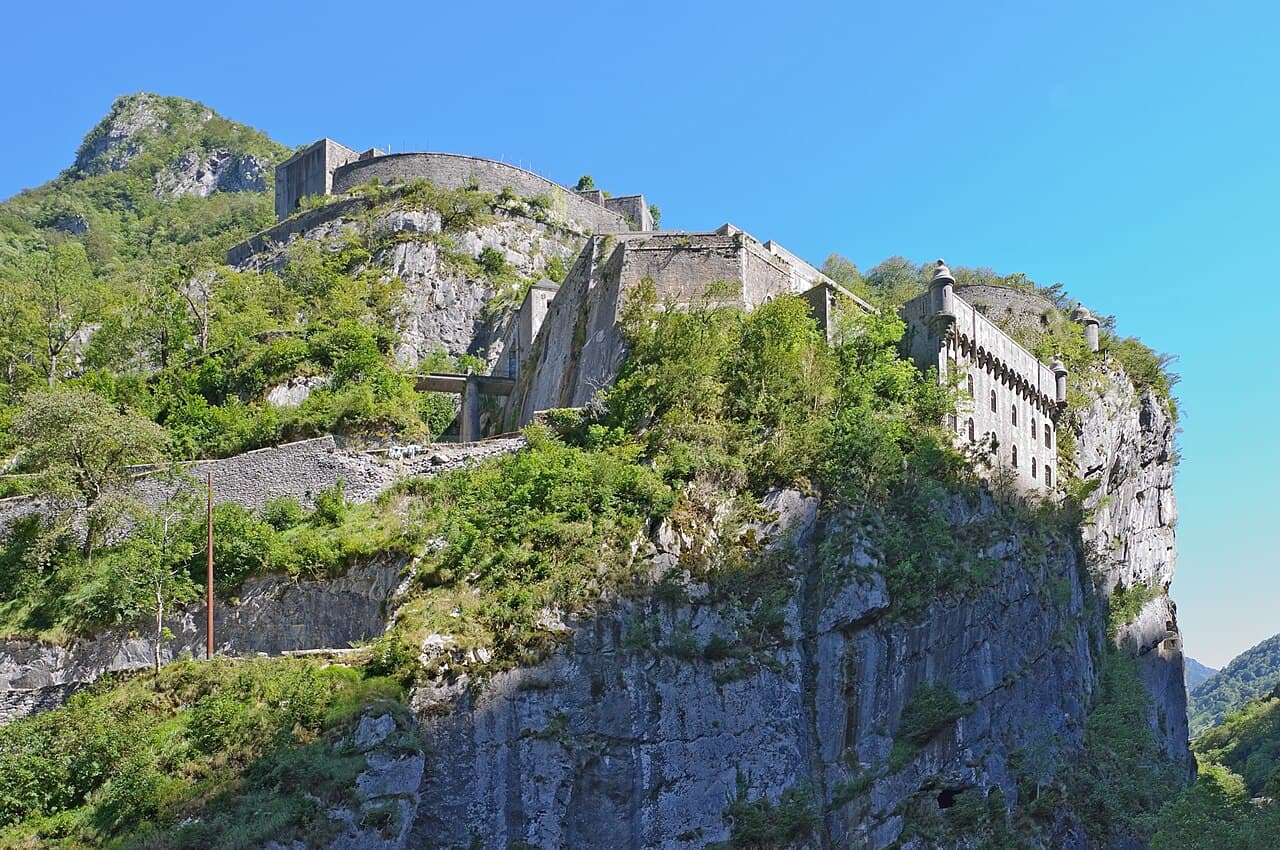
The fort is uniquely perched on a cliff face beneath the Chemin de la Mâture, an old mule path carved into the rock known for its dramatic setting and historical significance. Overlooking the torrential Gave d'Aspe river, the location allowed for commanding views and control of the valley's main transit routes. The position was critical for monitoring movements through the Pyrenees mountain passes, particularly the Col du Somport, a vital corridor linking France and Spain.
Architectural features and design
Fort du Portalet exemplifies the bastioned fortress type, a style that emerged to counter advances in artillery technology by incorporating angled bastions that allowed defenders to cover all approaches with interlocking fields of fire. The fort's construction utilized robust stone masonry anchored into the cliff, integrating natural rock formations to enhance its defensive capabilities. The design included barracks, storage depots, defensive walls, and artillery placements capable of housing approximately 400 soldiers.
The fort’s layout was adapted to the steep and rugged terrain, with terraces and platforms connected by stairways and ramps. Defensive features included thick curtain walls, bastions with cannon embrasures, and fortified gates. The integration of the fort into the natural cliff face made it difficult to assault and provided protection from direct artillery fire.
Military use and historical events
Following its completion in 1870, Fort du Portalet served primarily as a depot and barracks for the 18th Regiment of Infantry from 1871 until 1925. During this period, it functioned as a key military installation in the region, although it did not see active combat. After 1925, the fort ceased to be a full-time military facility but retained strategic importance.
During World War II, the fort was repurposed by the Vichy regime as a prison for prominent political figures. Notable detainees included Léon Blum, Édouard Daladier, Paul Reynaud, Georges Mandel, and Maurice Gamelin. These men were held as political prisoners amid the turbulent events surrounding the Riom Trials and the German occupation of France. Paul Reynaud was eventually transferred to German custody, while Georges Mandel was executed by the Milice in Paris in retaliation for Resistance activities. After the war, the fort also held Philippe Pétain, the head of the Vichy government, from August to November 1945.
Post-military history and restoration efforts
Following its abandonment by the government, the fort fell into disuse until it was acquired by local authorities in 1999. Restoration efforts began with clearing the access road to ensure safe visitation. In 2006, significant work was undertaken to remove overgrown vegetation and repair the roofs and terraces, protecting the structure from water damage. Ongoing restoration and safety projects continue as funding allows, aiming to preserve this historic military monument and open it to the public.
Architectural significance and cultural heritage
Fort du Portalet is an important example of 19th-century bastioned fortress architecture adapted to mountainous terrain. Its construction reflects military engineering principles of the period, emphasizing defensive geometry and integration with natural features. The fort’s role in both peacetime military organization and wartime political imprisonment adds layers to its historical significance.
Today, the fort attracts visitors interested in military history, architecture, and the dramatic landscapes of the Pyrenees. Its preservation contributes to understanding the region's strategic importance and the broader history of French fortifications.
Frequently asked questions (FAQ)
- How do I visit Fort du Portalet?
- Fort du Portalet is accessible via a hiking trail in the Aspe Valley. Visitors should prepare for a steep climb and check local tourism information for access details and guided tours.
- What is the historical significance of Fort du Portalet?
- The fort guarded the Pyrenean border and served as a prison for notable political figures during World War II, highlighting its military and political importance.
- When was Fort du Portalet built?
- Construction began in 1842 and was completed in 1870, replacing an earlier fortification in the region.
- Can I explore the interior of Fort du Portalet?
- Access to the interior may be limited due to ongoing restoration, but visitors can view the exterior and surrounding landscape. Check with local authorities for current visiting conditions.
- Why was Fort du Portalet built on a cliff face?
- The cliff location provided strategic defensive advantages, allowing control over the valley and protection from direct artillery assault.
Photo gallery

Information
Current owner
Local authorities
Loading map...
Visitor reviews
No reviews yet. Been here? Write the first review and help other travelers!
Write the first reviewVisited this castle? Share your experience
Your review helps other travelers and adds first-hand knowledge to our encyclopedia.