Fort d'Évegnée
Fort d'Évegnée is a significant example of late 19th-century military architecture located near Liège, Belgium. It is one of the twelve forts forming the Fortified Position of Liège, which was a key element of Belgium's National Redoubt defense strategy. Constructed between 1881 and 1884, the fort reflects the military engineering innovations of its time, designed by the renowned Belgian military engineer General Henri Alexis Brialmont.
Design and construction
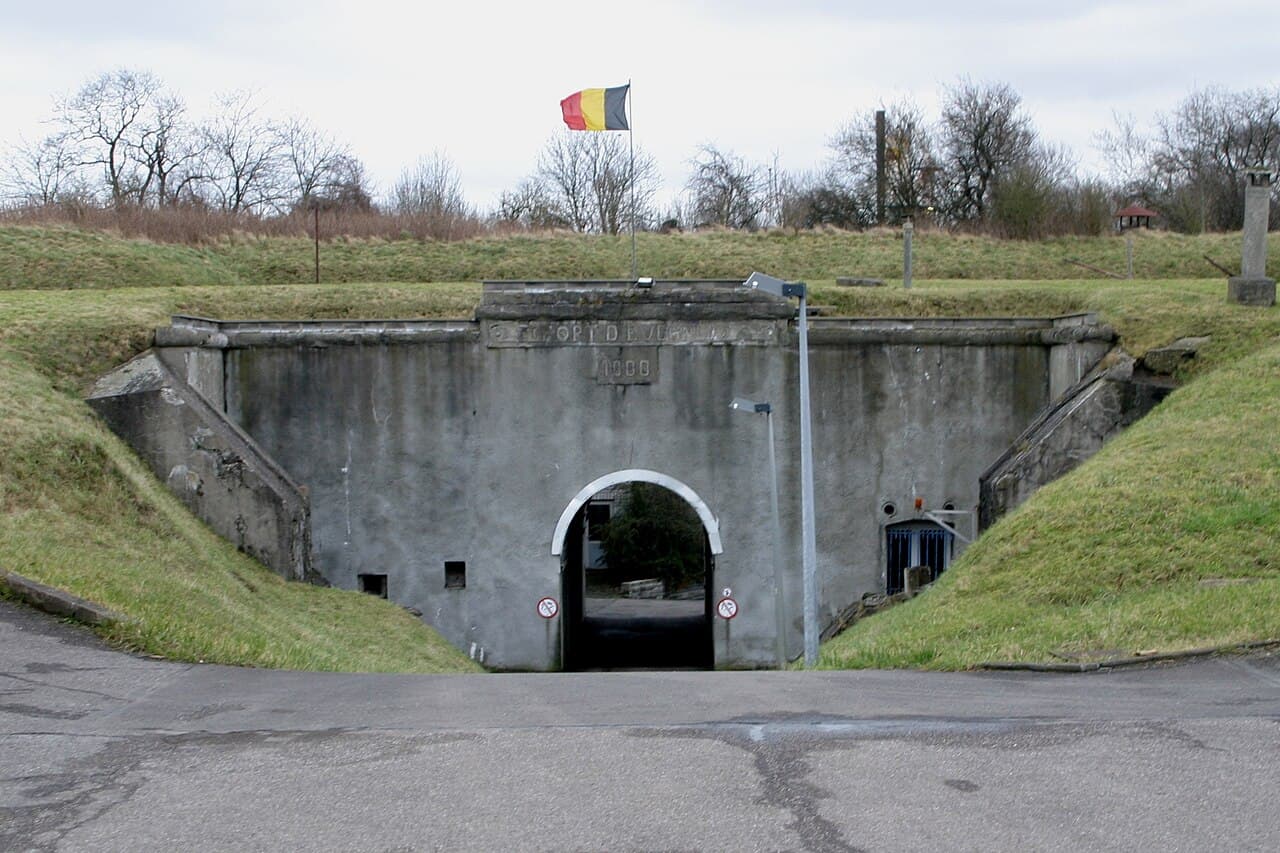
The fort was conceived as a bastioned fortress, a type of fortification characterized by angular bastions projecting outward from the main enclosure to provide defensive fire in multiple directions. Unlike many contemporary French forts built under the direction of Raymond Adolphe Séré de Rivières, which primarily used masonry, Fort d'Évegnée was constructed exclusively of unreinforced concrete. This choice marked a pioneering use of concrete in military fortifications, as it was a relatively new construction material at the time. The fort's layout includes thick concrete walls and underground chambers designed to protect its garrison and artillery from bombardment.
Architectural features
The fort's design incorporates a central massif housing the main artillery batteries, surrounded by a ditch and defended by a series of bastions and caponiers. The use of concrete allowed for robust protection against the increasingly powerful artillery of the late 19th century. The fort's defensive structures include observation posts, gun turrets, barracks, ammunition magazines, and ventilation systems, all integrated to sustain prolonged defense.
Military history and engagements
Fort d'Évegnée played a notable role during the Battle of Liège in World War I. During the German invasion in 1914, the fort was subjected to intense bombardment by heavy German artillery, including the famous Big Bertha howitzers. Despite its robust concrete construction, the fort suffered significant damage but managed to delay the German advance, contributing to the overall resistance of the Liège forts.
In World War II, the fort again faced bombardment during the early stages of the conflict. Although military technology had advanced, rendering such forts less strategically vital, Fort d'Évegnée's defenses were tested once more under German attack.
Post-military use and current status
After its military use ended, Fort d'Évegnée was repurposed as an industrial site. It is currently used for the storage and testing of rocket propellant, a function that utilizes the fort's robust and secure underground spaces. While the fort is no longer accessible to the public as a historical monument, its preservation as an industrial facility has prevented total decay.
Context within Belgian fortifications
The fort is part of a broader system of fortifications around Liège, which were among the first to incorporate concrete in their construction. This system was designed to protect Belgium's eastern frontier and delay invasions from Germany. The innovations seen at Fort d'Évegnée influenced later fortification designs and reflect the transitional period in military architecture between traditional masonry forts and modern concrete bunkers.
General Henri Alexis Brialmont's legacy
Brialmont was a pioneering figure in military engineering, and his designs at Fort d'Évegnée and other Liège forts exemplify his approach to fortress construction. His use of concrete and strategic layout aimed to maximize defensive capabilities against evolving artillery threats. These forts represent some of the most advanced defensive works of the late 19th century in Europe.
Frequently asked questions (FAQ)
- What is the historical significance of Fort d'Évegnée?
- Fort d'Évegnée was part of the Fortified Position of Liège, a key element of Belgium's National Redoubt, and played a role in delaying German advances during World War I and II.
- Can I visit Fort d'Évegnée today?
- Fort d'Évegnée is currently used as an industrial site for rocket propellant storage and testing, so it is not open to the public for visits.
- Who designed Fort d'Évegnée?
- The fort was designed by General Henri Alexis Brialmont, a prominent Belgian military engineer known for his innovative use of concrete in fortifications.
- What materials were used to build Fort d'Évegnée?
- Unlike many forts of its era, Fort d'Évegnée was constructed exclusively of unreinforced concrete, marking an early use of this material in military architecture.
- When was Fort d'Évegnée built?
- Construction of Fort d'Évegnée took place between 1881 and 1884 as part of Belgium's efforts to strengthen its eastern defenses.
Photo gallery

Information
Architect
General Henri Alexis Brialmont
Loading map...
Visitor reviews
No reviews yet. Been here? Write the first review and help other travelers!
Write the first reviewVisited this castle? Share your experience
Your review helps other travelers and adds first-hand knowledge to our encyclopedia.