Fort de Shinkakasa
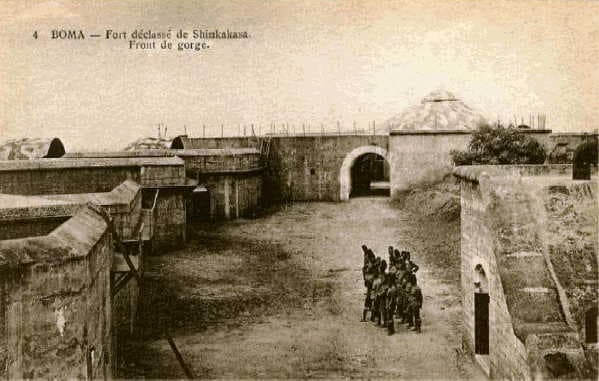
Fort de Shinkakasa, also known as Fort Boma, is a 19th-century bastioned fortress constructed in the Congo Free State to secure strategic control over access to the Congo River. Located approximately 1.5 kilometres west of Boma, the former capital of the Congo Free State and later the Belgian Congo from 1886 to 1926, the fort played a significant role in the colonial military defenses of the region.
Design and architectural features
The fort was designed in a distinctive two-sided arrow shape by the Belgian engineer Émile Wangermée, who was trained under the renowned Belgian military architect Henri Alexis Brialmont. This design reflects the influence of late 19th-century European military engineering principles, emphasizing strong bastioned defenses to maximize fields of fire and protection against naval and land assaults.
The fortress's layout incorporated thick walls and bastions arranged to cover the approaches to the Congo River, which was a vital artery for trade and colonial administration. The fort's artillery placements were carefully positioned to command the river and deter any hostile naval forces.
Historical context and strategic purpose
Constructed in 1891 during the Modern period of colonial expansion, Fort de Shinkakasa was built primarily to defend the Congo Free State's access to the Atlantic Ocean via the Congo River. This was particularly important because neighboring colonial powers, notably the Portuguese who controlled Angola and Cabinda, posed a potential threat of cutting off the Congo Free State's maritime access.
Although tensions existed between the Congo Free State and Portuguese forces, actual combat was limited to exchanges of fire between light batteries and Portuguese ships, with no large-scale battles recorded at the fort.
Military garrison and armament
The fort was garrisoned by approximately 200 soldiers from the Compagnie d'Artillerie et de Génie (Artillery and Engineers Company) of the Force Publique, the colonial military force. These troops operated the fort's artillery, which included eight 160-millimetre ship guns. These heavy guns were capable of engaging enemy vessels attempting to navigate the river.
In addition to the professional artillerymen, the fort could call upon local auxiliaries in times of emergency, enhancing its defensive capabilities.
Role in colonial military and internal security
Fort de Shinkakasa also served as a military assembly point for troops from various ethnic groups, particularly those from distant regions. This strategy aimed to prevent mutinies by deploying soldiers away from their home areas, especially in the wake of the Batetela rebellion of 1885–87, which had shaken the colonial administration.
Despite these precautions, a significant mutiny occurred at the fort on 17 April 1900, involving Tetela soldiers. This event underscores the complex dynamics of colonial military forces and the challenges faced in maintaining control over diverse troops.
Preservation and current status
The fort remains a notable example of bastioned fortress architecture from the Modern period in Central Africa. While detailed information about its current condition is limited, its historical significance as a colonial military installation and its architectural design continue to attract interest from historians and military architecture enthusiasts.
Frequently asked questions (FAQ)
- What is the historical significance of Fort de Shinkakasa?
- Fort de Shinkakasa was built in 1891 to defend the Congo Free State's access to the Congo River and the Atlantic Ocean, particularly against Portuguese colonial forces. It played a key role in regional military strategy during the colonial period.
- How is the fort designed architecturally?
- The fort features a two-sided arrow shape designed by Belgian engineer Émile Wangermée, influenced by military architect Henri Alexis Brialmont. Its bastioned layout was intended to maximize defensive coverage of the river approach.
- Can visitors access Fort de Shinkakasa today?
- Information on public access to Fort de Shinkakasa is limited. Visitors interested in military architecture or colonial history should check local sources or tour operators in Boma for current visiting opportunities.
- Who manned the fort during its operational period?
- The fort was garrisoned by about 200 soldiers from the Compagnie d'Artillerie et de Génie of the Force Publique, supported by local auxiliaries when needed. Troops from various ethnic groups were assembled there to prevent mutinies.
- When was the major mutiny at Fort de Shinkakasa?
- A major mutiny involving Tetela soldiers occurred at Fort de Shinkakasa on 17 April 1900, reflecting tensions within the colonial military forces.
Photo gallery

Public domain
Information
Architect
Émile Wangermée
Loading map...
Visitor reviews
No reviews yet. Been here? Write the first review and help other travelers!
Write the first reviewVisited this castle? Share your experience
Your review helps other travelers and adds first-hand knowledge to our encyclopedia.