Fort de La Prée — France castle

Fort de La Prée

Fort de La Prée: a bastioned fortress on Île de Ré
La Flotte, France
Renaissance (15th–17th c.)

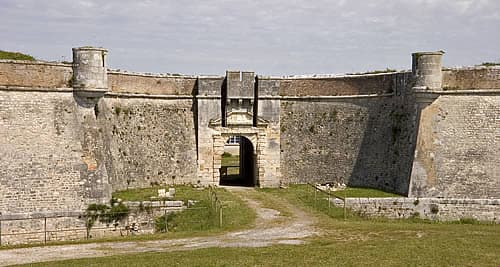
Fort de La Prée is a historic bastioned fortress located near the eastern end of the Île de Ré in La Flotte, France. Constructed in 1625 during the Renaissance period, the fort was originally built by the Royalist Army after they recaptured the island from the Huguenots during the French Wars of Religion. The fort’s construction utilized materials salvaged from the ruins of the nearby Romanesque abbey of the Châteliers, integrating historical masonry into its structure.

Historical significance and military role

The strategic importance of Fort de La Prée was demonstrated during the 1627 siege of Saint-Martin-de-Ré, when the Duke of Buckingham led an English siege against the island. Buckingham notably ignored Fort de La Prée in his campaign, a critical oversight. This allowed the French commander Toiras to land troops at the fort, from which he was able to break the English siege and force their withdrawal. This event underscored the fort's tactical value in controlling access to the island and defending it from naval assaults.

Architectural evolution and modifications

Following its initial construction, the fort underwent several significant modifications overseen by prominent military engineers. In 1664, François Blondel contributed to its redesign, followed by works from Louis-Nicolas de Clerville in 1672. Later, engineers Le Favolière and Sainte-Colombe (in 1676) added important features including a fortified gate and an external barracks capable of housing 200 soldiers. These enhancements improved the fort's defensive capabilities and accommodation capacity.

In 1685, the renowned military engineer Vauban ordered parts of the original fort to be demolished, particularly the keep and the extensive outworks that enclosed the fort. This was part of a broader effort to modernize fortifications across France, adapting to evolving artillery technology and siege tactics.

Later history and 20th-century use

After a period of abandonment, the fort was reactivated in 1793 during the turbulent years of the French Revolution. In the latter half of the 19th century, the external barracks were demolished, and in 1875, the fort's covered way was enhanced with the addition of sheltered passages to protect troops from enemy fire. The fort was eventually decommissioned around 1900.

During World War II, the German occupying forces utilized the fort, constructing blockhouses on the ramparts and seafront to strengthen coastal defenses. Post-war, starting in 1948, the fort served as an administrative center for a vacation home development project, although it was closed in 1977.

Architectural features and layout

Fort de La Prée exemplifies the bastioned fortress design typical of the Renaissance military architecture in France. Its layout was adapted over time to incorporate advances in fortification, including angled bastions designed to deflect cannon fire and provide overlapping fields of fire. The fort's walls, gates, and barracks reflect the functional requirements of a coastal defense installation, balancing protection with accommodation for a sizeable garrison.

The use of salvaged Romanesque stonework from the abbey of the Châteliers adds a unique historical layer to the construction, blending medieval materials with early modern military design. The later additions by engineers like Blondel and Vauban demonstrate the evolution of military engineering in response to changing warfare technology.

Visiting Fort de La Prée today

Today, Fort de La Prée remains a site of historical interest on the Île de Ré, attracting visitors interested in military history and Renaissance architecture. While the fort no longer serves a defensive purpose, its preserved walls and bastions offer insight into 17th-century fortification techniques. The surrounding area of La Flotte provides a picturesque setting with coastal views and access to other heritage sites on the island.

Frequently asked questions (FAQ)

How do I get to Fort de La Prée?
Fort de La Prée is located in La Flotte, France, and is accessible by car or public transportation. If you're coming by car, there is parking available nearby. For those using public transport, check local bus schedules for routes that service La Flotte.
What is the historical significance of Fort de La Prée?
Fort de La Prée was built in the 17th century to protect the harbor of La Flotte and has played a vital role in the region's maritime history. It served as a military stronghold during various conflicts, showcasing the strategic importance of this coastal area. Today, it stands as a testament to France's rich military history.
When was Fort de La Prée constructed?
Construction of Fort de La Prée began in 1666 and was completed in 1680. The fortification was designed to enhance naval defense against potential invasions. Its architecture reflects the military engineering of the era, making it a fascinating site for history enthusiasts.
Can I visit Fort de La Prée year-round?
Yes, Fort de La Prée is open to visitors throughout the year, but it's best to check ahead for any seasonal hours or special events. During the summer months, the fort may have extended hours to accommodate more visitors. Always verify the schedule on the official website before planning your visit.
Why is Fort de La Prée an important architectural site?
Fort de La Prée is an exemplary model of 17th-century military architecture, showcasing the defensive strategies of the time. Its robust design and strategic positioning offer insights into historical military practices and the evolution of fortifications. The fort's unique structure also provides a beautiful vantage point of the surrounding coastline.
Is it possible to explore the inside of Fort de La Prée?
Yes, visitors are welcome to explore various parts of Fort de La Prée, including its interior spaces. Guided tours are often available to provide deeper insights into its history and architecture. Make sure to check if any areas are restricted or under renovation at the time of your visit.
What are the opening hours for Fort de La Prée?
The opening hours for Fort de La Prée can vary by season, with longer hours during the summer months. Typically, it opens around 10 AM and closes by 6 PM, but it’s advisable to confirm specific hours on the official website before your visit. Special events may also affect regular hours.
What are the ticket prices for visiting Fort de La Prée?
Ticket prices for Fort de La Prée are generally affordable, with discounts available for children, students, and senior citizens. Adult tickets usually cost around €5, while children may enter for free or at a reduced rate. Check the official website for the most current pricing and any special promotions.
What nearby attractions can I visit while in La Flotte?
While visiting La Flotte, you can explore the charming village, known for its beautiful harbor and historic buildings. Nearby attractions include the local market, the Abbey of Châteliers, and stunning beaches that are perfect for a leisurely day out. The area also offers various restaurants and shops to enhance your visit.

Photo gallery

Fort de La Prée
Click to view

Photo by Original uploader was Pep.per at fr.wikipedia•CC BY-SA 1.0

1 photo • Click any image to view in full screen

Information

Bastioned Fortress

Loading map...

Visitor reviews

No reviews yet. Been here? Write the first review and help other travelers!

Write the first review

Visited this castle? Share your experience

Your review helps other travelers and adds first-hand knowledge to our encyclopedia.

Write a review

(5/5)

0/2000 characters

Your review will be visible after admin approval

Nearby castles

20 km

Île-d'Aix Fortifications

Île-d'Aix, France

Île-d'Aix is a small island located off the west coast of France in the Atlantic Ocean. It is renowned for its historic fortifications dating primarily from the early 19th century, constructed under the orders of Napoleon Bonaparte as part of coastal defenses against British naval threats. The island remains a popular destination for tourists, especially during the summer months, due to its rich history and well-preserved military architecture. Napoleon's influence and fortification efforts In 1808, Napoleon visited Île-d'Aix and directed significant enhancements to its defenses. Recognizing the strategic importance of the island in controlling access to the nearby naval base of Rochefort, he ordered the construction of several military structures. Among these was a residence for the commander of the stronghold, which today serves as the Musée Napoléon. This building provides insight into the military administration of the era and Napoleon's personal involvement in fortification planning. Napoleon also commissioned the building of Fort Liedot, named in honor of Colonel Liedot, who died during the Russian campaign. This fortification was designed to strengthen the island's defenses against naval attacks and featured robust walls, artillery placements, and barracks for troops. The fort's construction reflects the modern military engineering principles of the Napoleonic era, emphasizing both offensive and defensive capabilities. Strategic naval battles near Île-d'Aix The waters surrounding Île-d'Aix were the scene of significant naval engagements during the Napoleonic Wars. Most notably, the Battle of the Basque Roads in 1809 took place just off the island. This battle involved the British Royal Navy launching a daring fireship attack led by Captain Thomas Cochrane against the French Atlantic Fleet anchored in the Basque Roads. The attack occurred on the night of April 11, 1809, and resulted in most of the French ships being driven ashore. Although the subsequent three-day engagement did not completely destroy the French fleet, it severely weakened French naval power in the region. This battle underscored the strategic importance of Île-d'Aix and its fortifications in protecting French maritime interests. Napoleon's final days in France on Île-d'Aix Following his defeat at the Battle of Waterloo in June 1815, Napoleon Bonaparte spent his last days in France on Île-d'Aix from July 12 to 15. During this time, he attempted to evade capture by the British Royal Navy blockade with plans to escape to North America. Realizing that escape was impossible, Napoleon ultimately surrendered to the British aboard HMS Bellerophon. He was subsequently transported to Torbay and Plymouth before his exile to Saint Helena. The island thus holds a significant place in Napoleonic history as the site of his final moments on French soil. Architectural features of the fortifications The fortifications on Île-d'Aix exhibit characteristics typical of early 19th-century military architecture. Fort Liedot includes thick stone walls designed to withstand artillery bombardment, bastions for mounting cannons, and strategically placed embrasures for firing upon enemy ships. The island's defensive system also incorporated natural features, using the surrounding waters as a moat-like barrier. The compact layout of the fortifications allowed for efficient troop movement and communication between defensive positions. The commander’s house, now the Musée Napoléon, features period military architectural elements and serves as a cultural monument preserving the island's history. Current status and tourism Today, the Île-d'Aix fortifications are well preserved and accessible to visitors. The Musée Napoléon offers exhibitions on the island's military history and Napoleon's time there. Visitors can explore the remains of Fort Liedot and other defensive structures, gaining insight into the strategic importance of the island during the Napoleonic Wars. The island is reachable by ferry from the mainland and is a favored day-trip destination. Its combination of historical significance, military architecture, and scenic coastal environment makes it a unique site for those interested in French history and early 19th-century fortifications.

Modern (19th–20th c.)
Details
21 km
Fort Boyard — France castle

Fort Boyard

Île-d'Aix, France

Fort Boyard is a remarkable sea fortification situated on a shoal known as the "longe de Boyard," a sandbank exposed at low tide between the Île-d'Aix to the northeast and Île d'Oléron to the southwest, within the Charente archipelago on France's west coast. This strategic location in the Pertuis d'Antioche straits was chosen to protect the important harbor and naval base at Rochefort, a key maritime arsenal during the 17th to 19th centuries. The concept of fortifying the Boyard bank dates back to the reign of Louis XIV in the late 17th century, as part of a broader effort to strengthen coastal defenses against the English Royal Navy. Initially planned between 1661 and 1667, the fort was intended to fill a critical gap in artillery coverage between existing fortifications on the islands of Aix and Oléron. Despite early designs by the engineer Descombs in 1692, the project was abandoned due to the high cost and technical challenges of building on a submerged sandbank. Historical context and military significance The need for a fort on Boyard bank resurfaced after a British raid on Île-d'Aix in 1757, prompting renewed but ultimately unsuccessful planning attempts. It was not until the early 19th century, under Napoleon Bonaparte, that serious construction efforts began. In 1801, engineers including Ferregeau, Armand Samuel de Marescot, and Vice-Admiral François Étienne de Rosily-Mesros designed a fortification to secure the mouth of the Charente River and protect Rochefort's arsenal from naval assault. However, the project was suspended in 1809 due to shifting priorities and logistical difficulties. Construction recommenced in 1837 during the reign of Louis-Philippe amidst renewed tensions with the United Kingdom. The fort was completed in 1857, featuring a robust stone structure capable of housing a garrison of approximately 250 men. Its design included thick walls, multiple artillery platforms, and a central courtyard, all optimized for coastal defense. Architectural features and design Fort Boyard is a water castle built on a submerged sandbank, making it a unique example of maritime military architecture. The fort is roughly rectangular with rounded corners and features a two-level stone construction. The lower level housed ammunition magazines and storage rooms, while the upper level contained artillery batteries arranged to provide 360-degree coverage of the surrounding waters. The fort's walls are remarkably thick, designed to withstand bombardment from naval guns. Its isolated position required self-sufficiency, including quarters for the garrison, a cistern for fresh water, and storage for provisions. The central courtyard served as a functional space for troop movement and equipment handling. Challenges of construction Building on a shifting sandbank presented significant engineering challenges. Workers had to contend with tides, storms, and the unstable foundation. The fort's foundations were reinforced with wooden piles driven deep into the seabed, a pioneering technique at the time. Construction spanned several decades, reflecting the complexity and expense of the project. Decline and transformation By the time Fort Boyard was completed, advances in artillery technology had extended the range of naval guns, rendering the fort strategically obsolete. The gap it was meant to cover was now protected by longer-range batteries on the nearby islands. Consequently, Fort Boyard never saw active combat. After 1871, the fort was briefly repurposed as a military prison. However, it was abandoned by 1913 and left to deteriorate. Over the decades, exposure to harsh marine conditions caused significant structural damage, leading locals to nickname it the "strong of the useless." Preservation and cultural significance Recognizing its historical and architectural value, Fort Boyard was designated a historical monument in 1950. Ownership transferred to the Charente-Maritime department in 1961, which undertook restoration efforts starting in 1989. These included clearing thick layers of guano, rebuilding artillery platforms, and stabilizing the outer walls. The fort gained international fame as the filming location for the popular television game show "Fort Boyard," which began production in 1990. This exposure helped fund further restoration and increased public interest in the site. Recent restoration efforts Restoration work in the late 1990s and early 2000s focused on cleaning the stonework, sealing terraces against water ingress, and refurbishing the central courtyard. Despite ongoing challenges posed by its marine environment, these efforts have preserved Fort Boyard as a unique example of 19th-century coastal fortification. Visiting Fort Boyard and its surroundings While the fort itself is not open to the public due to its isolated location and preservation concerns, it remains a popular subject for boat tours departing from nearby ports such as Île-d'Aix and Oléron. Visitors can appreciate its imposing silhouette against the seascape and learn about its fascinating history through guided excursions. The surrounding Charente-Maritime region offers rich cultural heritage, including the maritime arsenal of Rochefort, historic forts like Fort Enet, and picturesque islands. Fort Boyard's dramatic setting and storied past make it an enduring symbol of France's coastal defense legacy.

Modern (19th–20th c.)
Details
22.7 km

Fort Énet

Fouras, France

Fort Énet is a historic coastal fortification located near the town of Fouras in the Charente-Maritime department of Nouvelle-Aquitaine, France. Constructed in the early 19th century, it played a key role in the defense system protecting the strategic naval arsenal of Rochefort from British naval attacks during the Napoleonic Wars. The fort is situated on the Pointe de la Fumée, a rocky outcrop accessible on foot at low tide from Fouras, positioned between the mainland and the Île-d'Aix island. This location was chosen for its strategic vantage point controlling the maritime approaches to Rochefort, a vital naval base and shipbuilding center of the French Navy. Historical context and strategic importance Construction of Fort Énet began in 1810 under the orders of Napoleon I, following the significant naval engagement known as the Battle of the Basque Roads in 1809. This battle exposed vulnerabilities in the coastal defenses protecting Rochefort, prompting the Emperor to strengthen the fortifications guarding the harbor and naval installations. Fort Énet formed an integral part of a defensive triad along with Fort Boyard and Fort de la Rade on Île-d'Aix. Together, these forts created overlapping fields of fire to control access to the harbor and deter incursions by the British Royal Navy, which was the dominant naval power at the time. Architectural features and construction The fort is classified as a water castle due to its position surrounded by tidal waters and its role in maritime defense. Built during the Modern period, its design reflects early 19th-century military engineering adapted to coastal conditions. Fort Énet is constructed primarily from robust stone masonry, designed to withstand naval bombardment and harsh marine weather. Its layout includes thick defensive walls, bastions for artillery placement, and internal chambers for garrison quarters and ammunition storage. The fort's low profile and compact shape allowed it to present a minimal target while maximizing its defensive capabilities. Access and current condition Today, Fort Énet remains well preserved and is accessible to visitors on foot during low tide, offering a unique experience of walking across the sand and rocky causeway to reach the fort. Its preservation allows visitors to explore its ramparts, artillery platforms, and internal spaces, providing insight into Napoleonic coastal defense strategies. Role in French military history Although the fort never faced a major siege or battle after its construction, it served as a deterrent and a symbol of French naval strength during a turbulent period of European conflict. Its presence helped secure Rochefort's naval facilities, which were critical for France's maritime operations throughout the 19th century. Fort Énet also illustrates the evolution of military architecture transitioning from traditional medieval castles to modern coastal fortifications designed to counter naval artillery and amphibious assaults. Visiting Fort Énet Visitors to Fort Énet can explore the fort during low tide when the causeway is exposed, making it a popular destination for history enthusiasts and tourists interested in military architecture. The site offers panoramic views of the surrounding coastline, the Atlantic Ocean, and nearby islands. Its proximity to other historical sites such as Fort Boyard and the town of Fouras makes it part of a broader itinerary for exploring France's coastal defenses and naval heritage.

Modern (19th–20th c.)
Details