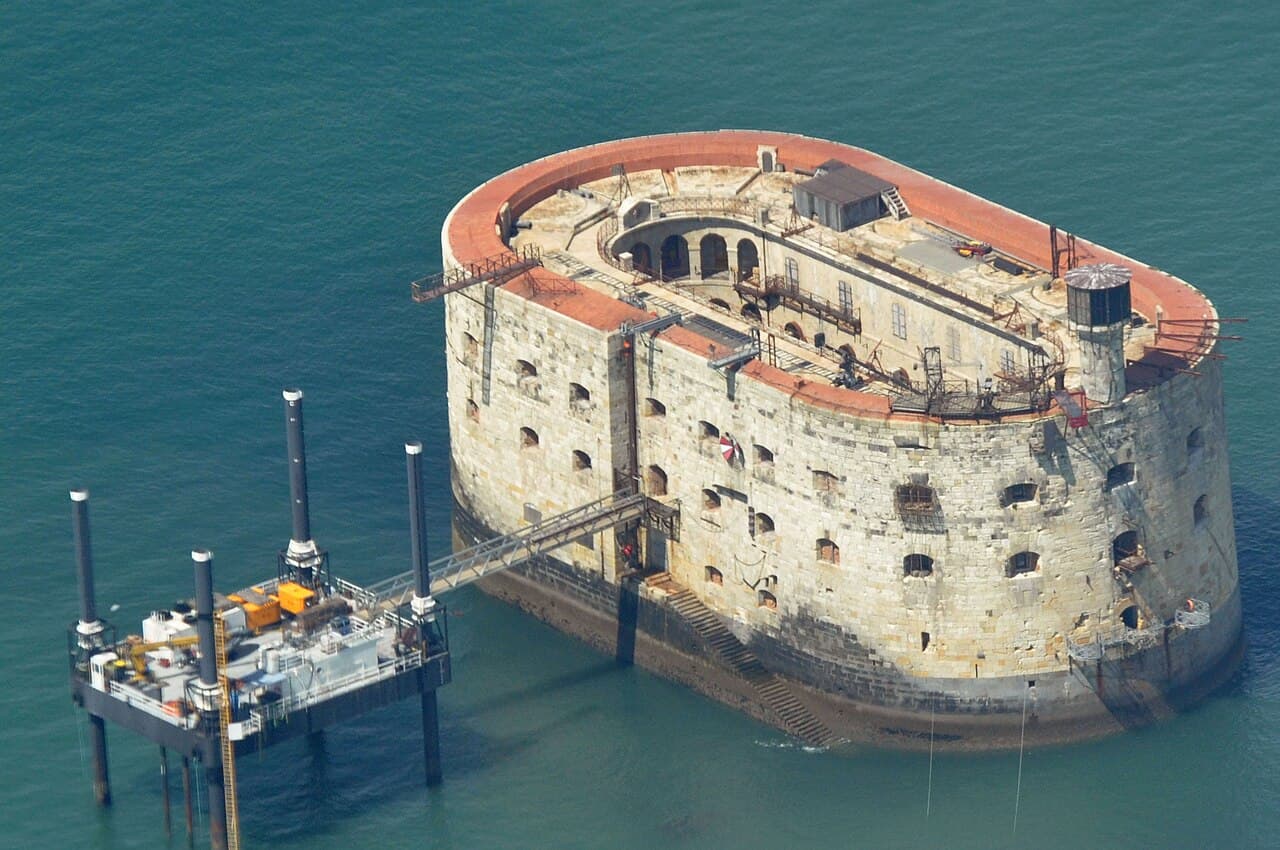
Fort Boyard
Fort Boyard is a remarkable sea fortification situated on a shoal known as the "longe de Boyard," a sandbank exposed at low tide between the Île-d'Aix to the northeast and Île d'Oléron to the southwest, within the Charente archipelago on France's west coast. This strategic location in the Pertuis d'Antioche straits was chosen to protect the important harbor and naval base at Rochefort, a key maritime arsenal during the 17th to 19th centuries.
The concept of fortifying the Boyard bank dates back to the reign of Louis XIV in the late 17th century, as part of a broader effort to strengthen coastal defenses against the English Royal Navy. Initially planned between 1661 and 1667, the fort was intended to fill a critical gap in artillery coverage between existing fortifications on the islands of Aix and Oléron. Despite early designs by the engineer Descombs in 1692, the project was abandoned due to the high cost and technical challenges of building on a submerged sandbank.
Historical context and military significance
The need for a fort on Boyard bank resurfaced after a British raid on Île-d'Aix in 1757, prompting renewed but ultimately unsuccessful planning attempts. It was not until the early 19th century, under Napoleon Bonaparte, that serious construction efforts began. In 1801, engineers including Ferregeau, Armand Samuel de Marescot, and Vice-Admiral François Étienne de Rosily-Mesros designed a fortification to secure the mouth of the Charente River and protect Rochefort's arsenal from naval assault. However, the project was suspended in 1809 due to shifting priorities and logistical difficulties.
Construction recommenced in 1837 during the reign of Louis-Philippe amidst renewed tensions with the United Kingdom. The fort was completed in 1857, featuring a robust stone structure capable of housing a garrison of approximately 250 men. Its design included thick walls, multiple artillery platforms, and a central courtyard, all optimized for coastal defense.
Architectural features and design
Fort Boyard is a water castle built on a submerged sandbank, making it a unique example of maritime military architecture. The fort is roughly rectangular with rounded corners and features a two-level stone construction. The lower level housed ammunition magazines and storage rooms, while the upper level contained artillery batteries arranged to provide 360-degree coverage of the surrounding waters.
The fort's walls are remarkably thick, designed to withstand bombardment from naval guns. Its isolated position required self-sufficiency, including quarters for the garrison, a cistern for fresh water, and storage for provisions. The central courtyard served as a functional space for troop movement and equipment handling.
Challenges of construction
Building on a shifting sandbank presented significant engineering challenges. Workers had to contend with tides, storms, and the unstable foundation. The fort's foundations were reinforced with wooden piles driven deep into the seabed, a pioneering technique at the time. Construction spanned several decades, reflecting the complexity and expense of the project.
Decline and transformation
By the time Fort Boyard was completed, advances in artillery technology had extended the range of naval guns, rendering the fort strategically obsolete. The gap it was meant to cover was now protected by longer-range batteries on the nearby islands. Consequently, Fort Boyard never saw active combat.
After 1871, the fort was briefly repurposed as a military prison. However, it was abandoned by 1913 and left to deteriorate. Over the decades, exposure to harsh marine conditions caused significant structural damage, leading locals to nickname it the "strong of the useless."
Preservation and cultural significance
Recognizing its historical and architectural value, Fort Boyard was designated a historical monument in 1950. Ownership transferred to the Charente-Maritime department in 1961, which undertook restoration efforts starting in 1989. These included clearing thick layers of guano, rebuilding artillery platforms, and stabilizing the outer walls.
The fort gained international fame as the filming location for the popular television game show "Fort Boyard," which began production in 1990. This exposure helped fund further restoration and increased public interest in the site.
Recent restoration efforts
Restoration work in the late 1990s and early 2000s focused on cleaning the stonework, sealing terraces against water ingress, and refurbishing the central courtyard. Despite ongoing challenges posed by its marine environment, these efforts have preserved Fort Boyard as a unique example of 19th-century coastal fortification.
Visiting Fort Boyard and its surroundings
While the fort itself is not open to the public due to its isolated location and preservation concerns, it remains a popular subject for boat tours departing from nearby ports such as Île-d'Aix and Oléron. Visitors can appreciate its imposing silhouette against the seascape and learn about its fascinating history through guided excursions.
The surrounding Charente-Maritime region offers rich cultural heritage, including the maritime arsenal of Rochefort, historic forts like Fort Enet, and picturesque islands. Fort Boyard's dramatic setting and storied past make it an enduring symbol of France's coastal defense legacy.
Frequently asked questions (FAQ)
- What is the historical significance of Fort Boyard?
- Fort Boyard was built in the 19th century to protect the Rochefort naval arsenal and the Charente estuary from British naval attacks. Though it never saw combat, it represents a unique maritime fortification designed to fill a gap in coastal defenses.
- Can visitors tour Fort Boyard?
- The fort itself is not open to the public due to its isolated location and preservation needs. However, boat tours from nearby ports like Île-d'Aix offer views of the fort and informative commentary about its history.
- When was Fort Boyard constructed and completed?
- Construction began in the early 19th century under Napoleon Bonaparte and was completed in 1857 during the reign of Louis-Philippe after several interruptions.
- Why was Fort Boyard nicknamed the 'strong of the useless'?
- The fort earned this nickname because by the time it was completed, advancements in artillery made it strategically obsolete, so it never engaged in military action and was eventually abandoned.
- What architectural features make Fort Boyard unique?
- Built on a submerged sandbank, Fort Boyard features thick stone walls, multiple artillery platforms, a central courtyard, and self-sufficient facilities designed for a garrison of 250 men, showcasing innovative maritime fortification techniques.
- How has Fort Boyard been preserved and restored?
- Designated a historical monument in 1950, the fort has undergone restoration since 1989, including cleaning, structural repairs, and sealing against sea damage, supported partly by its fame from the TV game show filmed there.
Photo gallery

Information
Current owner
Charente-Maritime department
Loading map...
Visitor reviews
No reviews yet. Been here? Write the first review and help other travelers!
Write the first reviewVisited this castle? Share your experience
Your review helps other travelers and adds first-hand knowledge to our encyclopedia.



