Fort de Kock
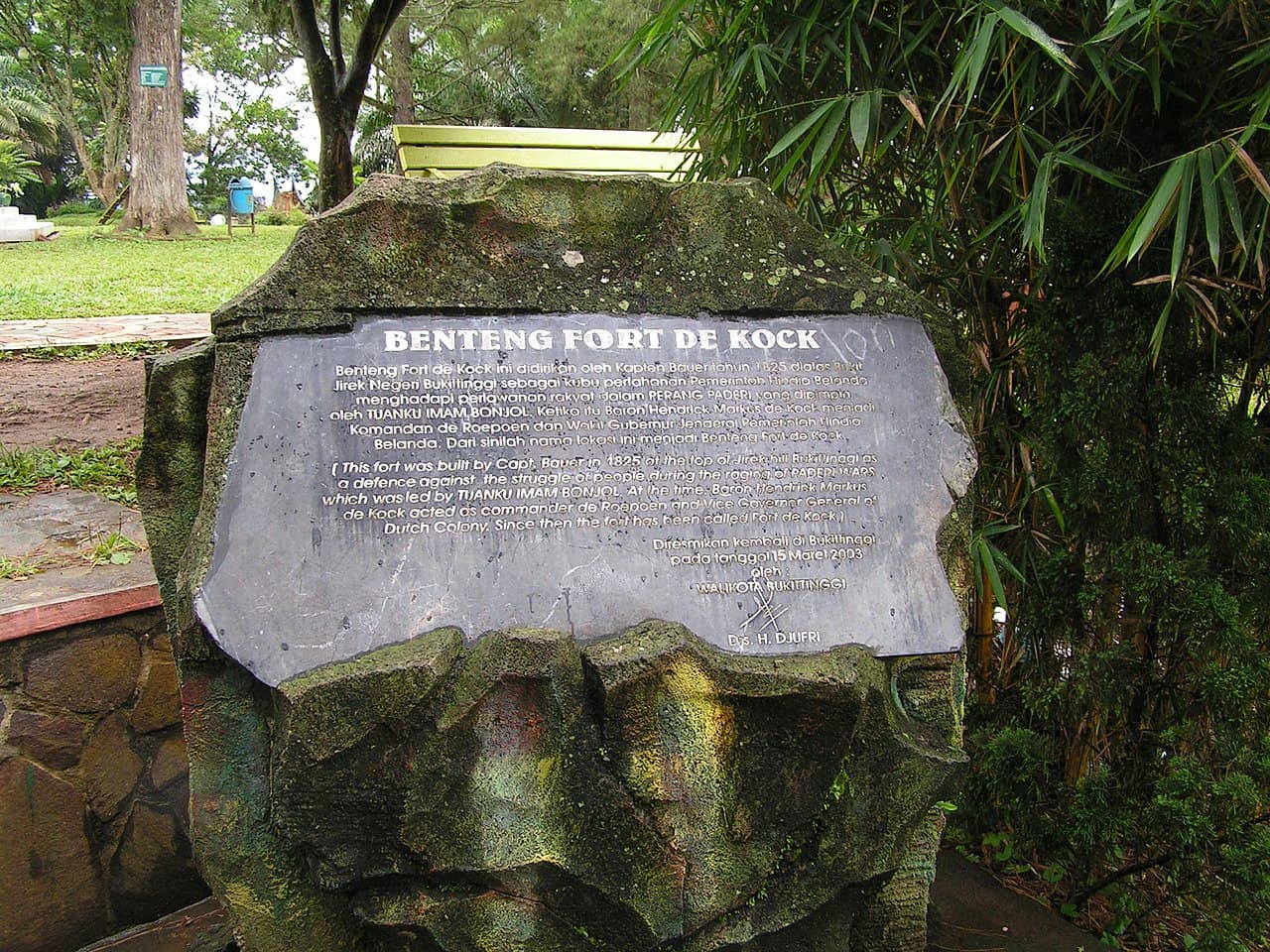
Fort de Kock is a notable 19th-century bastioned fortress built by the Dutch colonial administration in what is now Bukittinggi, West Sumatra, Indonesia. Constructed as a sconce fortification on a prominent hill, it played a significant role in the Dutch efforts to control the region during the Padri War in the early 1800s. The fort's strategic location allowed the Dutch to oversee and secure the surrounding highlands, which were then inhabited by local Minangkabau communities resisting colonial rule.
The fortress was named after General Hendrik Merkus de Kock, a key figure in the Dutch military campaign in Sumatra. Fort de Kock's design follows the principles of bastioned fortifications, which were prevalent in European military architecture from the Renaissance through the 19th century. These fortifications featured angular bastions projecting from the main walls, enabling defenders to cover all approaches with overlapping fields of fire and minimizing blind spots.
Architectural features and layout
The fort was constructed primarily of stone and earthworks, designed to withstand artillery attacks and provide a defensible position on the hilltop. Although the original buildings have been demolished, the earthen mound forming the bastions and ramparts remains visible, along with several historic cannons positioned around the site. The fort's layout included multiple bastions arranged to cover the slopes, a central courtyard, and barracks to house troops during the conflict.
Defensive design elements
The bastioned design allowed defenders to fire upon attackers from multiple angles, a key advancement over earlier medieval castle designs. The fort's elevated position enhanced its defensive capabilities, providing clear sightlines over the surrounding valleys and roads leading into the highlands. The use of thick earthworks absorbed cannon fire, while the stone walls offered protection against infantry assaults.
Historical context and significance
Fort de Kock was established during the Padri War (1821–1837), a conflict between the Dutch colonial forces and local Islamic reformists known as the Padris. The fort served as a military base and administrative center, facilitating Dutch control over the region. Its presence encouraged the growth of a settlement around the fort, which eventually developed into the modern city of Bukittinggi, now the second largest city in West Sumatra.
Throughout the colonial period, Fort de Kock remained a symbol of Dutch authority and military presence in Sumatra. After Indonesian independence, the fort's military function ceased, and much of the original structure was dismantled or repurposed. Today, the remnants of the fort, including the mound and several cannons, serve as historical landmarks reflecting the colonial past and military architecture of the period.
Current condition and cultural heritage
Currently, Fort de Kock is classified as a ruins site, with only the earthworks and some artillery pieces preserved. The original buildings on the hilltop have been demolished, but the site remains accessible to visitors interested in the colonial history of Indonesia and military architecture. The fort is an important cultural heritage site for the city of Bukittinggi and the wider West Sumatra region.
Efforts to maintain and promote the site focus on preserving the visible remains and educating the public about the fort's historical role. The location offers panoramic views of the surrounding landscape, enhancing its appeal as a tourist destination and a place of historical reflection.
Legacy and influence on bukittinggi
The establishment of Fort de Kock was a catalyst for the urban development of Bukittinggi. The military settlement that grew around the fort attracted traders, administrators, and settlers, forming the nucleus of the modern city. Today, Bukittinggi's urban layout and cultural identity are partly shaped by its origins as a Dutch military outpost.
The fort's legacy is also reflected in local museums and cultural institutions that preserve artifacts and stories from the colonial period. It remains a point of interest for historians, architects, and tourists who seek to understand the complex history of colonialism and resistance in Indonesia.
Frequently asked questions (FAQ)
- What is the historical significance of Fort de Kock?
- Fort de Kock, built in the 19th century, played a vital role during the colonial period in Indonesia. It was constructed by the Dutch to defend against local uprisings and to maintain control over the region, making it an important site for understanding Indonesia's colonial history.
- When was Fort de Kock built?
- Fort de Kock was built in 1825 and served as a military fortification during the Dutch colonial era. The fort's construction was part of the Dutch efforts to secure their influence in West Sumatra.
- What are the opening hours of Fort de Kock?
- Fort de Kock is open to visitors daily from 8:00 AM to 6:00 PM. It is advisable to check for any special hours during holidays or local events before planning your visit.
- Can I access Fort de Kock easily?
- Yes, Fort de Kock is accessible to visitors, with paths and walkways leading to the fort. However, some areas may have steep inclines, so visitors with mobility issues should plan accordingly.
- What is the best time to visit Fort de Kock?
- The best time to visit Fort de Kock is during the dry season, which typically runs from May to September. During this period, the weather is more favorable for exploring the fort and enjoying the surrounding landscapes.
- Is there an admission fee to enter Fort de Kock?
- Yes, there is a small admission fee to enter Fort de Kock, which typically helps maintain the site. The ticket prices are affordable, making it accessible for most visitors.
- What nearby attractions can I explore after visiting Fort de Kock?
- After visiting Fort de Kock, you can explore other attractions like the Bukittinggi Clock Tower and the Ngarai Sianok canyon. These sites offer additional insight into the rich cultural and natural beauty of the Bukittinggi area.
- How do I get to Fort de Kock from Bukittinggi city center?
- Fort de Kock is located just a short distance from Bukittinggi city center, making it easily reachable by foot or a short taxi ride. Many visitors enjoy walking to the fort, taking in the scenic views along the way.
Photo gallery

Information
Loading map...
Visitor reviews
No reviews yet. Been here? Write the first review and help other travelers!
Write the first reviewVisited this castle? Share your experience
Your review helps other travelers and adds first-hand knowledge to our encyclopedia.