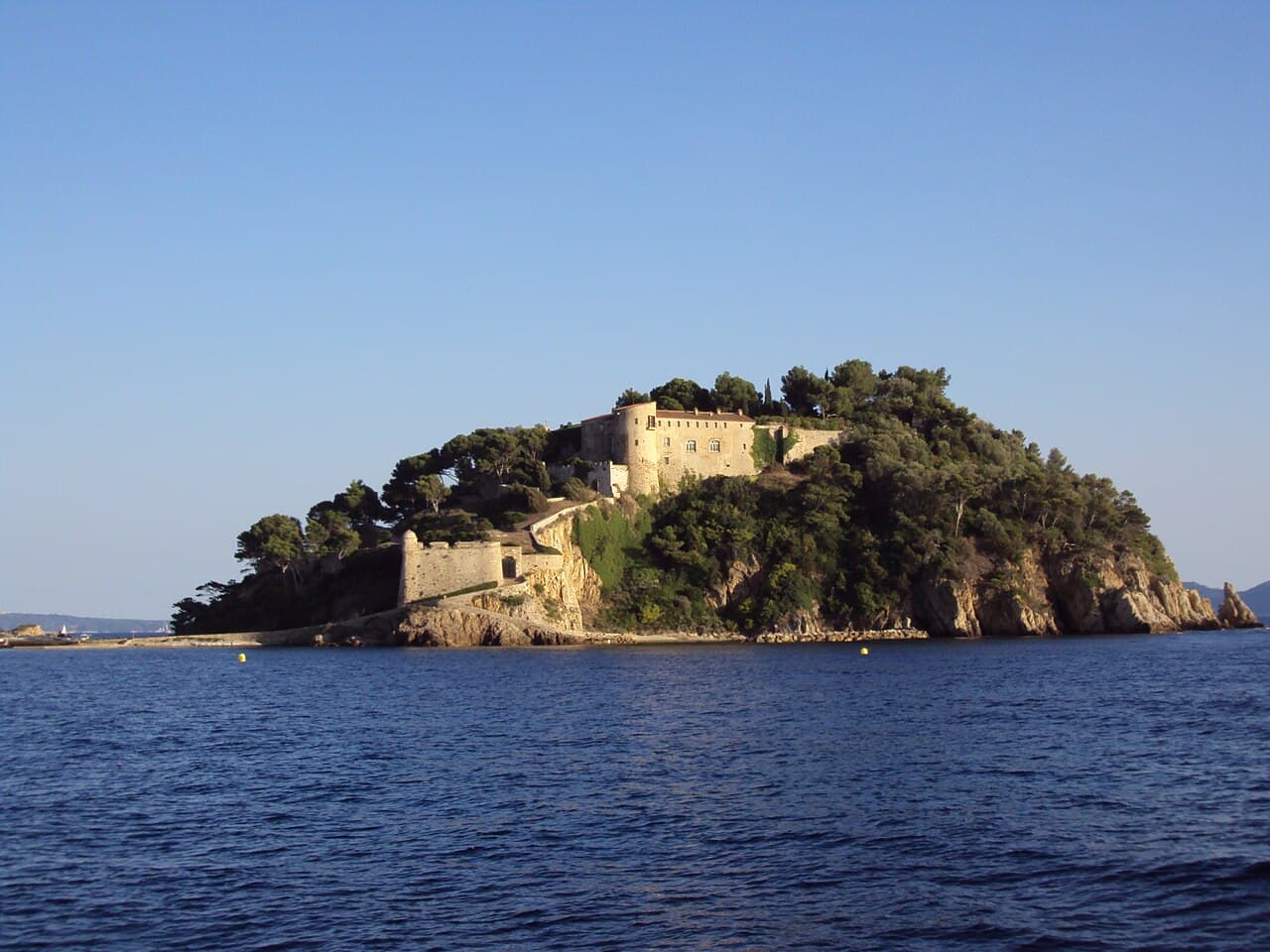
Fort de Brégançon
Fort de Brégançon stands prominently on a rocky outcrop 35 metres above sea level, situated on a small island just off the coast of the French Riviera. This strategic location in the commune of Bormes-les-Mimosas, in the Var department of the Provence-Alpes-Côte d'Azur region, has made it a significant military and political site for centuries. Connected to the mainland by a short causeway, the fort's position allowed it to control maritime approaches and protect the coastline from naval threats.
The site has a long history of occupation dating back to the 2nd century AD, with archaeological evidence indicating early settlement on the islet. The initial fortifications likely began during the Merovingian period, reflecting the area's early medieval strategic importance. The present structure, however, primarily dates from the 13th century, marking its development into a formidable bastioned fortress designed to withstand the evolving nature of warfare during the High Medieval period.
Medieval origins and architectural features
The 13th-century fortifications of Fort de Brégançon were constructed to defend the coast and serve as a military stronghold during a turbulent era marked by feudal conflicts and external threats. Its bastioned fortress design incorporates thick stone walls, angular bastions for improved defensive coverage, and a compact layout optimized for the rocky islet terrain. The fort includes key architectural elements such as ramparts, watchtowers, and a main gatehouse that controlled access to the interior.
The fortress's bastions allowed defenders to cover adjacent walls with crossfire, a significant advancement in military architecture at the time. The use of bastions was particularly important given the fort's coastal position, enabling it to repel attacks from both land and sea. The interior of the fort contained living quarters, storerooms, and a chapel, reflecting its dual function as a military installation and noble residence.
Historical significance and notable occupants
Throughout its history, Fort de Brégançon was controlled by various noble families, each leaving their mark on its development and use. The fort was besieged multiple times, testifying to its strategic importance in regional power struggles. One of its most notable historical occupants was Queen Jeanne Ire of Naples, who sought refuge there in 1348 after fleeing an invasion by her cousin. Her stay marked the fort's role as a sanctuary during periods of political upheaval.
The fort remained a military asset through the centuries, including during the French Revolution, when it came under state ownership. Although it escaped major damage during the revolution, some local plundering occurred. The fort's military relevance continued into the Napoleonic era, with Napoleon Bonaparte himself staying there during the winter of 1793-94. As Emperor, Napoleon invested in strengthening the garrison, underscoring the fort's ongoing strategic value.
19th and 20th-century military use
Following the Franco-Prussian War of 1870, the French War Ministry allocated funds to modernize the fort's artillery capabilities. Despite these upgrades, the external appearance of the fortress remained largely unchanged, and over time, the structure began to deteriorate. It continued to serve as a minor garrison during World War I until it was decommissioned in 1919.
Presidential retreat and modern legacy
In 1968, under the direction of General Charles de Gaulle, Fort de Brégançon was transformed into one of the official residences of the President of the French Republic. This marked a new chapter in the fort's history, shifting from a military fortress to a symbol of the French state and its executive power. The fort served as the official presidential retreat for decades, hosting numerous heads of state and dignitaries.
The residence houses an extensive collection of gifts received by French presidents during the Fifth Republic, reflecting its diplomatic significance. Although it ceased to be the official retreat in 2013, Fort de Brégançon remains an important cultural and historical monument, emblematic of both medieval military architecture and modern French political history.
Architectural conservation and public access
Today, Fort de Brégançon is classified as a well-preserved bastioned fortress. Its robust stone construction and strategic location have helped it withstand the test of time. Conservation efforts have focused on maintaining its structural integrity and preserving its historical features, including the bastions, walls, and internal chambers.
Visitors to the fort can explore its defensive structures and gain insight into its layered history, from medieval times through to its role as a presidential residence. The fort's unique setting on a rocky island connected by a causeway offers spectacular views of the Mediterranean coastline and enhances its appeal as a heritage site.
Frequently asked questions (FAQ)
- How do I visit Fort de Brégançon?
- Fort de Brégançon is located on a small island accessible via a causeway from Bormes-les-Mimosas. Visitors should check for public opening times as access may be restricted due to its status as a former presidential residence.
- What is the historical significance of Fort de Brégançon?
- Fort de Brégançon has served as a military fortress since the 13th century and was an official retreat for French presidents from 1968 to 2013, reflecting its strategic and political importance.
- When was Fort de Brégançon built?
- The current fortress was constructed in the 13th century, although the site has been inhabited since the 2nd century AD with earlier fortifications from the Merovingian period.
- Can I explore the architectural features of the fort?
- Yes, visitors can see the bastioned walls, ramparts, watchtowers, and internal chambers that showcase medieval military architecture adapted to coastal defense.
- Is Fort de Brégançon open year-round?
- Opening times vary, and the fort may be closed during certain periods due to maintenance or official use. It is advisable to check ahead before planning a visit.
Photo gallery

Information
Sources & official resources
Verify the information above using these authoritative references.
Loading map...
Visitor reviews
No reviews yet. Been here? Write the first review and help other travelers!
Write the first reviewVisited this castle? Share your experience
Your review helps other travelers and adds first-hand knowledge to our encyclopedia.



