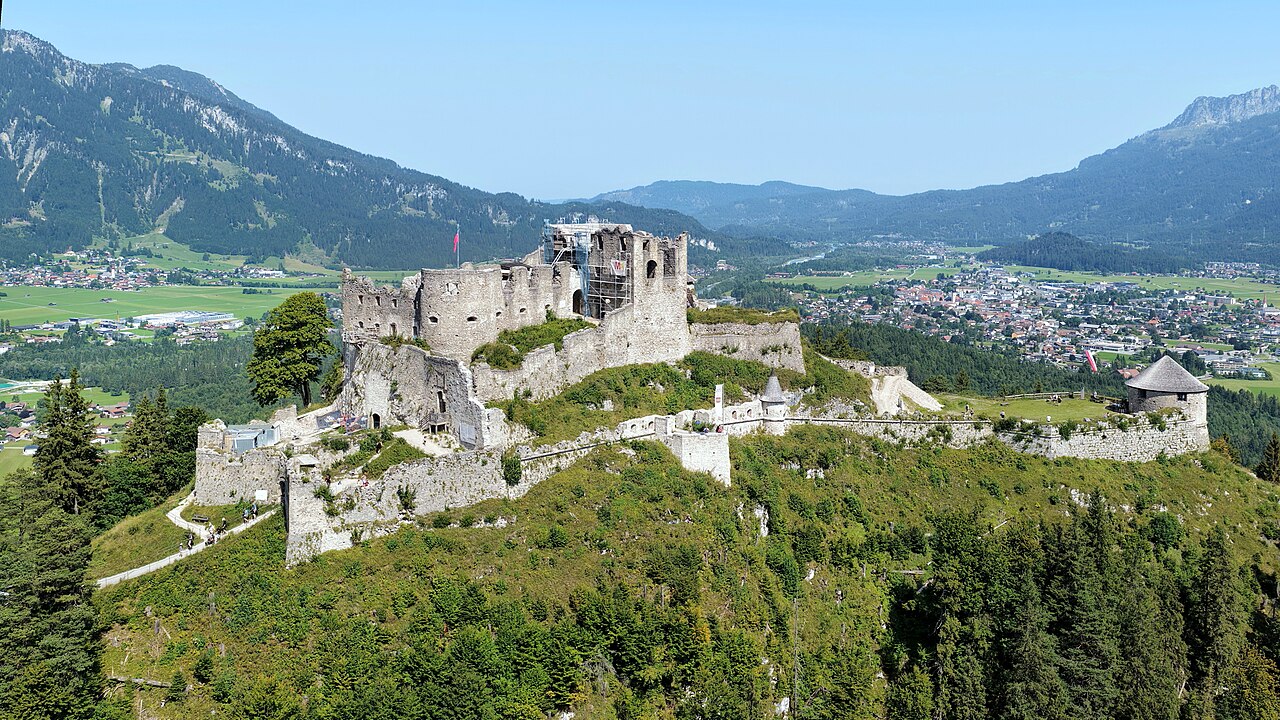
Fort Claudia
Fort Claudia is a notable Renaissance fortress located in Reutte, Austria, constructed between 1639 and 1645. It occupies a commanding position on a mountain crest opposite the Ehrenberg Castle ruins, controlling a strategic mountain pass that has been of military importance for centuries.
Historical background and strategic significance
The location of Fort Claudia was recognized for its strategic value long before its construction. The mountain crest it occupies overlooks the crucial route through the Tyrolean Alps, making it a key defensive point. In 1632, during the Thirty Years' War, Swedish forces advanced to the gates of Ehrenberg Castle, highlighting the vulnerability of the region's defenses. This event underscored the need for a stronger fortification in the area.
Construction of Fort Claudia began in 1639 under the direction of the Tyrolean regent, Archduchess Claudia of Austria, after whom the fortress was named. The fortress was part of a broader effort to strengthen Tyrol's defenses against incursions by foreign armies, particularly during the turbulent period of the Thirty Years' War.
Architectural features and design
Fort Claudia exemplifies Renaissance military architecture, designed to withstand the evolving artillery technology of the 17th century. The fortress was constructed with robust stone walls and bastions that allowed for effective defense and artillery placement. Its layout was carefully planned to maximize control over the surrounding terrain and the mountain pass below.
The fortress includes several key features typical of Renaissance fortifications, such as angled bastions to deflect cannon fire, thick defensive walls, and a secure gatehouse. The design reflects the transition from medieval castle architecture to modern bastioned fortresses capable of resisting gunpowder weapons.
Military history and later use
In 1703, during the War of the Spanish Succession, Fort Claudia was captured by Bavarian forces. From this stronghold, the Bavarians initiated their occupation of the nearby Ehrenberg Castle, demonstrating Fort Claudia's ongoing military importance in regional conflicts.
The fortress remained active until 1782, when it was officially decommissioned. Despite its closure, parts of Fort Claudia continued to be inhabited through the 19th century. Over time, however, the fortress was largely abandoned and fell into a state of decay.
Modern significance and preservation
Today, Fort Claudia stands as a partially preserved Renaissance fortress and a cultural landmark in the Tyrol region. Its ruins offer insight into 17th-century military architecture and the historical conflicts that shaped the region.
A significant modern development is the construction of the Highline 179 pedestrian suspension bridge in 2014, which connects the ruins of Ehrenberg Castle and Fort Claudia. This bridge, at 403 meters in length and 110 meters in height, is the world's longest pedestrian suspension bridge. It spans the strategic mountain pass that both fortresses were designed to guard, symbolically linking these historic sites and enhancing their accessibility for visitors.
Visiting fort claudia today
Visitors to Fort Claudia can explore the fortress ruins and enjoy panoramic views of the surrounding alpine landscape. The site offers a tangible connection to the military history of the Tyrol region and the architectural evolution of fortifications during the Renaissance.
The proximity of the Highline 179 bridge provides a unique experience, allowing visitors to traverse the impressive suspension bridge and appreciate the strategic geography that made Fort Claudia a key defensive position.
Information
Loading map...
Visitor reviews
No reviews yet. Been here? Write the first review and help other travelers!
Write the first reviewVisited this castle? Share your experience
Your review helps other travelers and adds first-hand knowledge to our encyclopedia.