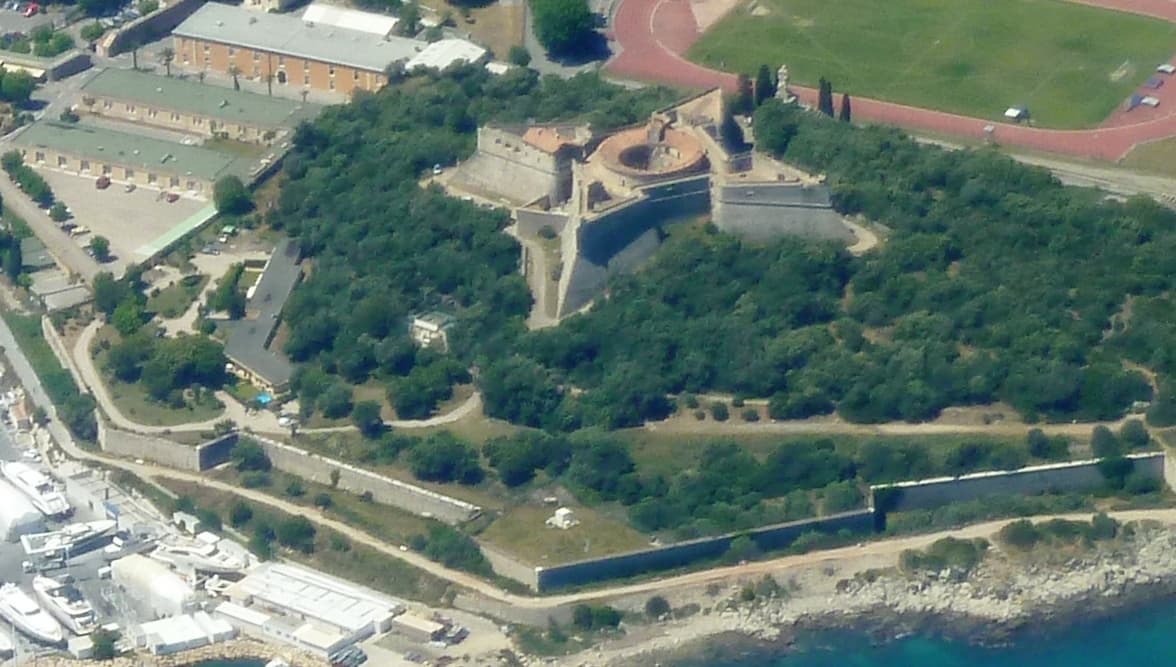
Fort Carré
Fort Carré, located on a 26-meter high promontory overlooking the Mediterranean Sea in Antibes, France, is a remarkable example of a 16th-century bastioned fortress. Its distinctive star-shaped design with four arrowhead-shaped bastions reflects the military architectural innovations of the Renaissance period, emphasizing both defense and strategic control of the coastline. The fort's origins trace back to earlier Roman fortifications, underscoring the long-standing military importance of Antibes as a border town.
Early history and construction
The site where Fort Carré now stands was originally fortified by the Romans, who recognized its strategic position. In the mid-16th century, during a period of tension along the border with the Duchy of Savoy, Henry II of France ordered the construction of new fortifications to strengthen the town's defenses. Around 1553, a tower known as la tour Saint-Florent was built, incorporating a pre-existing chapel. This tower formed the nucleus of what would become Fort Carré.
In 1565, under the reign of Henry III, the fort was significantly expanded with the addition of four bastions, giving it the distinctive square star-shaped layout that inspired its name, Fort Carré (meaning "square fort"). These bastions were designed in the arrowhead style, a hallmark of Renaissance military architecture aimed at deflecting cannon fire and providing overlapping fields of fire.
Vauban's enhancements and 17th-century modifications
In the late 17th century, the renowned military engineer Sébastien Le Prestre de Vauban undertook extensive improvements to Fort Carré. Vauban's work included the addition of traverses to protect defenders from ricochet fire, replacing the original stone parapets with brick parapets to prevent dangerous splintering when struck by cannonballs. He also enlarged the embrasures to accommodate more effective artillery deployment and constructed outer walls to further strengthen the fort's defenses.
Vauban's modifications allowed the fort to mount up to eighteen cannons, enhancing its firepower considerably. He also fortified the town of Antibes itself, adding a land front with four arrowhead bastions and fortifications along the harbor, including a bastion on the breakwater. These improvements reflected the evolving military strategies of the period and underscored Antibes' role as a key defensive position on the French Mediterranean coast.
Architectural features and layout
The entrance to Fort Carré is through a triangular bastion projecting from the main walls, equipped with loopholes for muskets and a heavy wooden door for security. A narrow bridge leads visitors into the interior, passing along the flank of one of the arrowhead bastions. Inside the fort, there are barrack buildings for officers and soldiers, as well as the ancient chapel that predates the fort's military expansions and has been preserved through the site's various phases of development.
The fort's design demonstrates the principles of bastioned fortification, emphasizing angled walls and bastions that allow defenders to cover all approaches with overlapping fields of fire. The star-shaped plan reduces blind spots and enhances the fort's ability to withstand artillery sieges.
Historical significance and notable events
Fort Carré has played a role in several key historical events. During the French Revolution, the fort served as a prison for a young Napoleon Bonaparte. In July 1794, following the fall of Robespierre, Bonaparte was detained here for ten days as a suspected Jacobin sympathizer. His release was secured by his friend and political ally, Antoine Christophe Saliceti.
In the 19th century, Fort Carré was involved in the events surrounding the French annexation of Nice in 1860, highlighting its continued strategic importance. The fort was eventually decommissioned in the early 20th century as military technology and tactics evolved beyond the capabilities of traditional bastioned fortresses.
Present day and visitor experience
Today, Fort Carré is open to the public and stands as a well-preserved example of Renaissance military architecture with subsequent enhancements by Vauban. Visitors can explore the fort's bastions, barracks, and chapel, gaining insight into the defensive strategies of the period and the fort's role in regional history. Its position on a promontory offers panoramic views of the Mediterranean and the town of Antibes, making it a popular destination for history enthusiasts and tourists alike.
Fort Carré's preservation allows for educational tours and cultural events, contributing to the appreciation of France's coastal defenses and military heritage. The fort's architecture, combined with its rich history, provides a compelling narrative of the evolution of fortification design from the Renaissance through the early modern period.
Frequently asked questions (FAQ)
- What is the best time to visit Fort Carré in Antibes?
- The best time to visit Fort Carré is during the spring and autumn months when the weather is mild and the crowds are smaller. Summer can be hot and busy, so visiting early in the morning or late afternoon is advisable for a more comfortable experience.
- Is Fort Carré accessible to visitors with mobility challenges?
- Fort Carré has some uneven surfaces and narrow passageways typical of historic fortifications, which may pose challenges for visitors with mobility issues. It is recommended to check with the site management in advance regarding accessibility accommodations.
- Can visitors explore the interior buildings of Fort Carré?
- Yes, visitors can explore the interior of Fort Carré, including the barracks and the ancient chapel. Guided tours often provide detailed information about the fort's history and architectural features.
- How did Vauban's modifications improve Fort Carré's defenses?
- Vauban enhanced Fort Carré by adding traverses to protect against ricochet fire, replacing stone parapets with brick to prevent splintering, enlarging embrasures for artillery, and constructing outer walls. These improvements significantly increased the fort's resilience and firepower.
- What role did Fort Carré play during the French Revolution?
- During the French Revolution, Fort Carré was used as a prison for Napoleon Bonaparte, who was detained there for ten days in 1794 as a suspected Jacobin sympathizer. This event highlights the fort's use beyond purely military functions.
Photo gallery

Information
Loading map...
Visitor reviews
No reviews yet. Been here? Write the first review and help other travelers!
Write the first reviewVisited this castle? Share your experience
Your review helps other travelers and adds first-hand knowledge to our encyclopedia.



