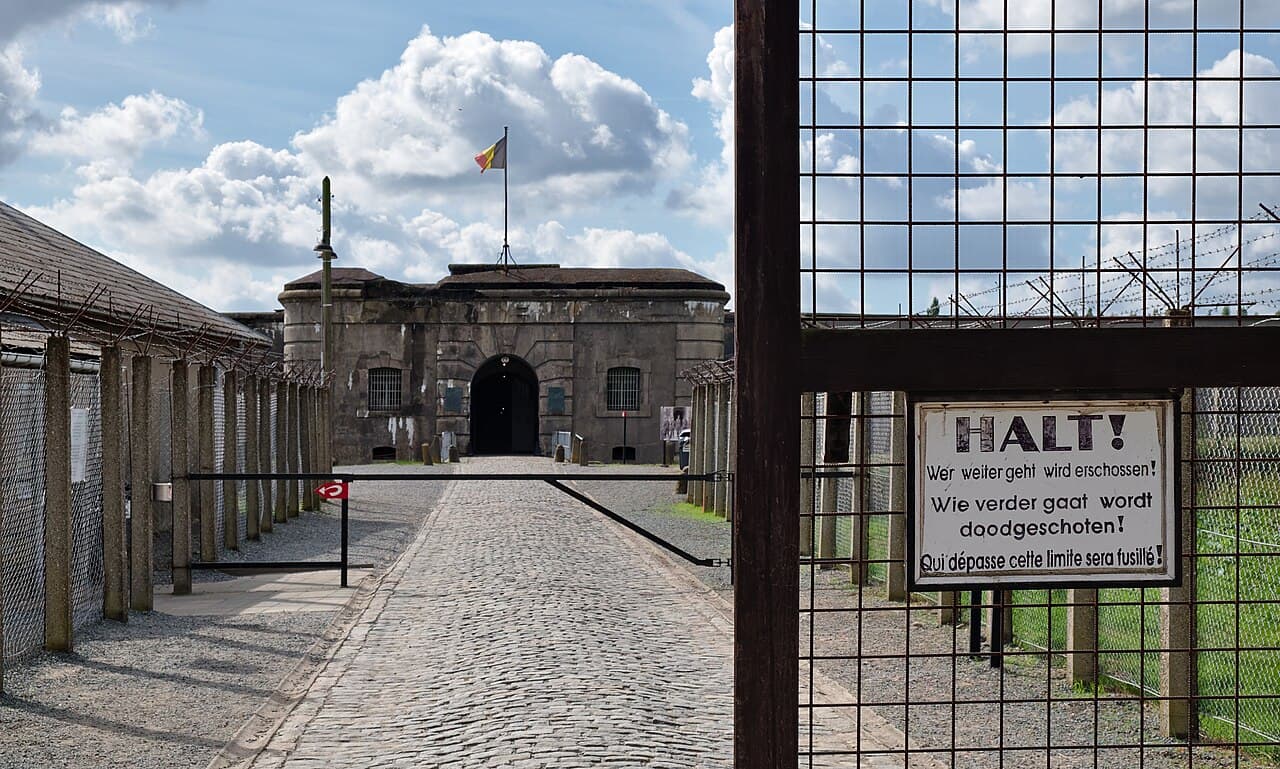
Fort Breendonk
Fort Breendonk is a historically significant bastioned fortress located near Mechelen in Belgium. Constructed between 1906 and 1913, it formed part of the second ring of the National Redoubt, a defensive network designed to protect the strategic city of Antwerp. The fort's construction reflects early 20th-century military engineering, characterized by robust defensive features including a five-metre thick earthen cover designed to absorb artillery fire, a water-filled moat encircling the structure, and a roughly rectangular layout measuring approximately 200 by 300 meters.
Architectural design and military function
Fort Breendonk exemplifies the bastioned fortress typology prevalent in the late 19th and early 20th centuries, integrating traditional fortification elements with adaptations to modern artillery threats. The fort's walls were reinforced with concrete and earthworks to withstand bombardment, while its moat added a defensive barrier against infantry assault. The design included multiple defensive layers, such as gun emplacements, barracks, ammunition depots, and observation posts, arranged to maximize defensive coverage and internal security.
Strategic role in national defense
Initially, Fort Breendonk served the Belgian Army as a key component of the National Redoubt, intended to provide a stronghold for retreat and defense in the event of invasion. It played a role during World War I, although it saw limited direct combat due to the rapid German advance. By the time of World War II, advances in warfare and artillery had rendered the fort militarily obsolete as a frontline defense installation.
Fort breendonk during world war ii
Following the Belgian surrender on 28 May 1940, the fort was seized by the Schutzstaffel (SS) and repurposed as a prison camp, known as an Auffanglager, for the detention of political prisoners, members of the resistance, and Jewish detainees. While not officially classified as a concentration camp, Fort Breendonk became notorious for its harsh conditions, including overcrowding, inadequate sanitation, and frequent torture.
Conditions and prisoner treatment
The fort's prisoners endured brutal treatment, with many subjected to physical abuse and psychological torment. Executions were carried out on-site, and the camp became a site of terror during the German occupation. Approximately 3,590 prisoners passed through Fort Breendonk during the war. Of these, 303 died or were executed within the fort, while another 1,741 died in other camps after transfer to larger concentration camps in Eastern Europe.
Symbolism and legacy
In Belgian historical memory, Fort Breendonk symbolizes the cruelty and oppression of the Nazi occupation. The fort's use as a prison camp left a lasting impact on national consciousness, representing the suffering endured by victims of the occupation. The camp was evacuated in September 1944 ahead of the Allied liberation of Belgium.
Post-war history and preservation
After liberation, Fort Breendonk briefly served as a detention center for Belgian collaborators. In 1947, it was declared a national memorial, recognizing its historical significance and the need to preserve its memory. Today, the fort operates as a museum open to the public, offering educational exhibits about its military origins and its dark chapter as a Nazi prison camp.
Museum and public education
The museum at Fort Breendonk preserves much of the original structure and interior, including prison cells, torture chambers, and administrative offices. Visitors can explore the fort's architecture alongside detailed historical displays that document the experiences of prisoners and the broader context of World War II in Belgium. The site serves as a powerful reminder of the consequences of war and totalitarianism.
Trials and justice
Following the war, many personnel involved in the operation of the prison camp were prosecuted in Belgian courts for war crimes and atrocities committed at Fort Breendonk. These trials contributed to post-war justice and the historical record of Nazi occupation abuses.
Location and accessibility
Fort Breendonk is situated in the municipality of Puurs-Sint-Amands in the Flemish Region of Belgium, near the city of Mechelen. Its location within the National Redoubt highlights its strategic importance in Belgium's historical defense system. The fort is accessible to visitors year-round, with guided tours available to provide in-depth historical context.
Visitor information
The fort offers educational programs and commemorative events, particularly around significant anniversaries related to World War II and Belgian history. It remains a key site for those interested in military architecture, 20th-century history, and the legacy of the Nazi occupation in Western Europe.
Frequently asked questions (FAQ)
- What is the historical significance of Fort Breendonk?
- Fort Breendonk was originally built as part of Belgium's National Redoubt to defend Antwerp. During World War II, it was used by the SS as a prison camp for political prisoners and resistance members, becoming a symbol of Nazi brutality in Belgium.
- Can I visit Fort Breendonk today?
- Yes, Fort Breendonk operates as a museum open to the public. Visitors can tour the preserved fortifications, prison cells, and exhibits detailing its military and WWII history.
- When was Fort Breendonk constructed?
- Fort Breendonk was constructed between 1906 and 1913 as part of Belgium's defensive ring around Antwerp.
- Why is Fort Breendonk considered a bastioned fortress?
- Fort Breendonk features traditional bastioned fortress design elements such as thick earthen walls, a water-filled moat, and defensive gun emplacements typical of early 20th-century military architecture.
- What happened to prisoners held at Fort Breendonk during WWII?
- Approximately 3,590 prisoners were held at Fort Breendonk. Many were tortured or executed there, while others were transferred to larger concentration camps in Eastern Europe, where many perished.
- Is Fort Breendonk accessible for educational groups?
- Yes, the museum offers educational programs and guided tours tailored for school groups and visitors interested in history and military architecture.
Photo gallery

Information
Current owner
State museum
Loading map...
Visitor reviews
No reviews yet. Been here? Write the first review and help other travelers!
Write the first reviewVisited this castle? Share your experience
Your review helps other travelers and adds first-hand knowledge to our encyclopedia.


