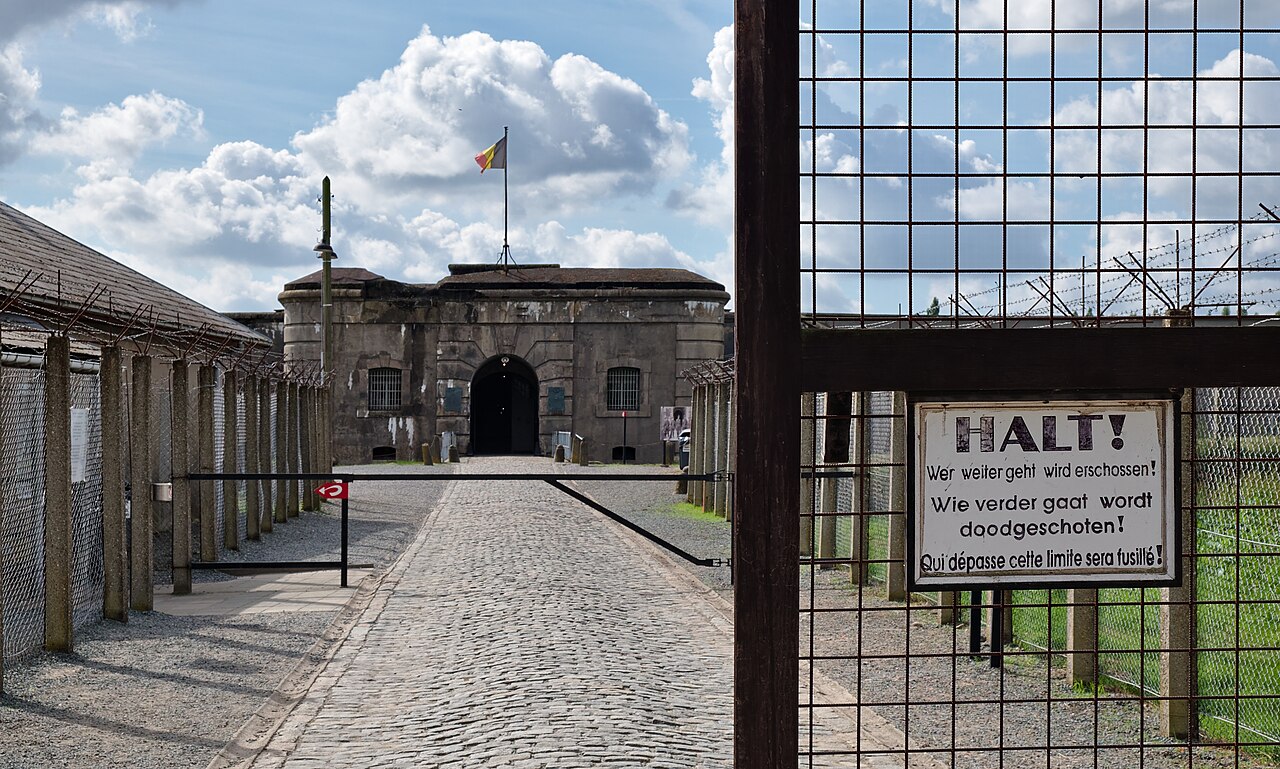
Fort Walem
Fort Walem is a historic military fortification located near the village of Walem in the province of Antwerp, within the Flemish region of Belgium. Constructed in the late 19th century, it formed a key part of Belgium's strategic defense system around the city of Antwerp, known as the National Redoubt. This defensive network was established following Belgium's independence in 1830 to protect against potential invasions from neighboring powers such as the Netherlands and France.
Following the Belgian government's decision in 1859 to fortify Antwerp, a large-scale project was undertaken based on the designs of the military engineer Captain Henri Alexis Brialmont. The initial phase included the construction of the 'Big Rampart,' an extensive 15-kilometer-long earthen rampart encircling Antwerp, featuring 19 gates and an advanced ring of eight forts, collectively known as the Brialmont Forts. These fortifications were completed by 1864 but soon proved insufficient due to rapid urban expansion and advancements in artillery technology.
The construction and design of Fort Walem
To address the shortcomings of the first defensive ring, a second line of forts was commissioned at the end of the 19th century. Among these was Fort Walem, built between 1878 and 1883 to secure the old main road connecting Antwerp and Mechelen. The fort was originally constructed primarily from brick, reflecting typical military engineering practices of the era.
Between 1891 and 1900, Fort Walem underwent significant modernization. It was reinforced with concrete and transformed into an armored fortress to withstand the increasing power of modern artillery. This upgrade included the addition of a wide moat surrounding the fort, enhancing its defensive capabilities. The fort's layout features a trapezoidal ground plan and notably lacks a central reduit, a stronghold common in many contemporary forts.
Architectural features
- The trapezoidal shape provided strategic coverage of the surrounding terrain.
- Construction utilized brick initially, later reinforced with concrete for durability.
- The wide moat served as a formidable obstacle against infantry and siege equipment.
- The absence of a central reduit distinguishes Fort Walem from other forts in the National Redoubt.
Military significance and wartime history
During the German invasion of Belgium in 1914, Fort Walem played a crucial defensive role. The Belgian garrison stationed there resisted German attacks for five days, demonstrating the fort's strategic importance despite suffering heavy damage. The fort's resilience contributed to delaying the German advance toward Antwerp, although it was eventually overcome.
Post-military use and current condition
After its military use declined, Fort Walem found a new role between 1960 and 1992 when it was utilized by the Belgian Civil Protection. During this period, the fort stored hundreds of metal containers filled with gas masks, remnants of which remain scattered throughout the site. Following this, the fort briefly served as an emergency shelter for asylum seekers before being abandoned.
Since 2009, Fort Walem has been owned by an environmental organization dedicated to preserving its unique ecosystem. The fort now serves as a habitat for bats, highlighting its ecological importance beyond its historical military function.
Visiting Fort Walem today
Currently, Fort Walem is in a very ruinous state and is not freely accessible to the public. Visitors can explore the site only during special guided walks organized on select days. Despite its dilapidated condition, the fort remains a fascinating example of 19th-century military architecture and Belgium's efforts to defend Antwerp through the National Redoubt system.
Frequently asked questions (FAQ)
- What is the historical significance of Fort Walem?
- Fort Walem was part of Belgium's National Redoubt defense system built in the late 19th century to protect Antwerp from invasions. It played a key role during the 1914 German invasion, resisting attacks for five days.
- Can I visit Fort Walem freely?
- Fort Walem is currently in a ruinous state and not open for free public visits. Access is limited to guided tours held on special days organized by the managing environmental organization.
- What architectural features distinguish Fort Walem?
- The fort has a trapezoidal ground plan, a wide surrounding moat, and was built initially from brick before being reinforced with concrete. It notably lacks a central reduit, unlike many other forts of its era.
- Who designed Fort Walem?
- Fort Walem was designed by Captain Henri Alexis Brialmont, a prominent Belgian military engineer responsible for many of Antwerp's fortifications in the 19th century.
- What is the current use of Fort Walem?
- Since 2009, Fort Walem has been owned by an environmental organization and serves as a habitat for bats, reflecting its ecological importance beyond its military history.
Information
Architect
Henri Alexis Brialmont
Current owner
Environmental organization
Address
Opposite Antwerpsesteenweg 285, Belgium
Loading map...
Visitor reviews
No reviews yet. Been here? Write the first review and help other travelers!
Write the first reviewVisited this castle? Share your experience
Your review helps other travelers and adds first-hand knowledge to our encyclopedia.