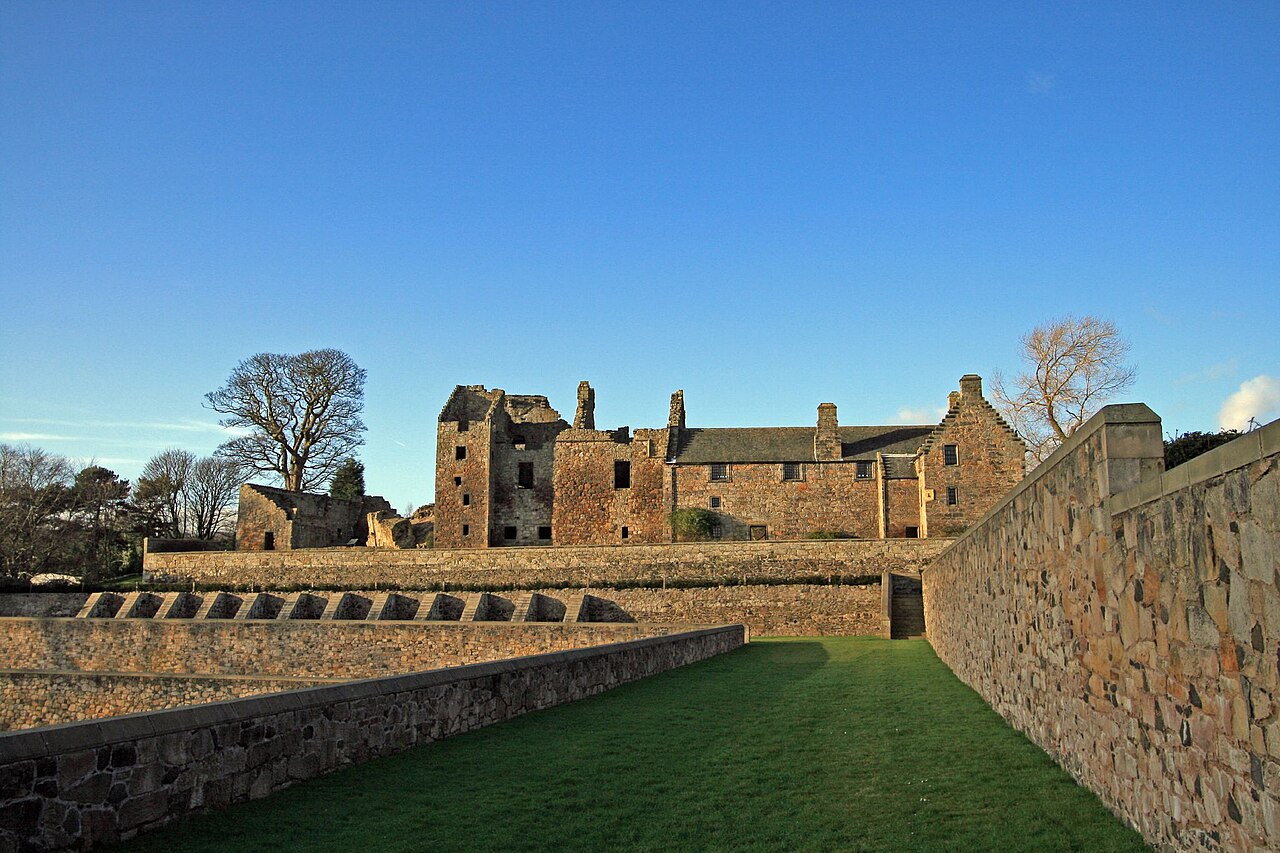
Fordell Castle
Fordell Castle stands as a notable example of a 16th-century fortified tower house located near Dunfermline, Scotland. The castle's origins trace back to the early 13th century, with the earliest documented charter from the Henderson of Fordell family dating to 1217. Although the precise date of the original castle construction remains uncertain, the surviving main entrance tower is believed to have been built in the 15th century, marking it as a significant late medieval structure.
The castle is architecturally distinguished by its Z-plan layout, running east to west, featuring two square towers positioned at the north-west and south-east corners. Each tower contains a circular staircase, making Fordell Castle unique among Scottish tower houses for having two main staircases, each with its own external door. The main entrance is located at the base of the north stair tower, accessed through a studded door protected by a traditional metal grate (yett). This design provided both defense and controlled access to the castle's interior.
Historical development and significant events
The castle underwent major expansions starting in 1566 under James Henderson, 3rd of Fordell, who extended the structure to accommodate the needs of a growing family and the evolving requirements of fortified residences. However, in 1568, the castle suffered damage from a fire, evidence of which remains visible to the left of the main entrance tower. The fire led to a rebuilding phase that restored and enhanced the castle's defensive and residential features.
In the mid-17th century, Sir John Henderson added a significant family mausoleum by rebuilding St Theriot's Chapel in 1650. The castle's military importance was underscored during the turbulent period of the English Civil War when it was garrisoned by troops loyal to Oliver Cromwell in 1651. The castle sustained damage during this occupation, reflecting its strategic value in the region.
Later centuries and restoration efforts
By the 19th century, Fordell Castle had fallen into partial disuse, with the main hall reportedly converted into a stable at one point. Significant modernization occurred under George Mercer-Henderson, who rebuilt the north front in 1855 to designs by the architect Robert Hay. This restoration included the installation of ornate gates and other enhancements that reflected Victorian tastes while respecting the castle's historic character.
The castle remained largely unoccupied until 1953 when author James Henderson CBE purchased the estate. He undertook extensive restoration, making Fordell Castle habitable again after more than two centuries of neglect. This revival preserved many of the castle's original features while adapting it for modern living.
Architectural features and layout
Fordell Castle is a fortalice, a type of fortified house typical of Scotland during the late medieval and early modern periods. Its Z-plan design includes two prominent towers with circular staircases, a rare architectural feature that allowed for separate access routes. The entrance vestibule leads to a series of vaulted basement chambers, which historically served various functions including storage and detention.
The western basement chamber once contained stocks and branks, instruments used for punishment and public humiliation, highlighting the castle's role in local justice. This room has since been converted into a wine cellar. Near the main entrance, visitors can see a rogue's collar or jougs, an iron collar used to restrain offenders, further emphasizing the castle's judicial history.
Defensive and residential elements
The castle's defensive features include thick stone walls, battlements, and the yett protecting the entrance. The dual staircases allowed for strategic movement within the castle, facilitating defense and private access. Residential areas were designed to accommodate the Henderson family comfortably while maintaining security during periods of unrest.
Current status and cultural significance
Today, Fordell Castle remains a private residence and is well preserved thanks to ongoing care by its owners. In 2007, it was sold for £3,850,000, marking one of the highest property sales in Scotland at the time. The castle's combination of historical importance, distinctive architecture, and restoration efforts make it a significant heritage site within the Dunfermline region.
While not generally open to the public, Fordell Castle's exterior and surrounding estate contribute to Scotland's rich collection of fortified houses and tower castles. Its unique features, such as the two main staircases and surviving medieval punishment devices, offer valuable insights into the social and military history of the area.
Information
Loading map...
Visitor reviews
No reviews yet. Been here? Write the first review and help other travelers!
Write the first reviewVisited this castle? Share your experience
Your review helps other travelers and adds first-hand knowledge to our encyclopedia.