Ford Castle
Ford Castle stands as a remarkable testament to the turbulent history and architectural evolution of the Anglo-Scottish borderlands. Located in the village of Ford, Northumberland, England, this Grade I listed building occupies a strategic position at a shallow crossing point on the River Till, approximately 68 meters above sea level. Originally constructed in the 13th century, the castle has witnessed centuries of conflict, ownership changes, and architectural transformations, evolving from a medieval fortress into a refined Tudor mansion.
Early history and medieval origins
The site of Ford Castle was first fortified in the high medieval period by Odinel de Ford during the 1200s. This initial structure was a typical hill castle designed to control the border region between England and Scotland, a zone frequently contested during the Middle Ages. The original fortress was destroyed in 1314 by the forces of Robert the Bruce, the Scottish king who led campaigns to secure Scotland’s independence. This destruction occurred amid the wider conflicts of the Wars of Scottish Independence, underscoring the castle's strategic importance.
Following the destruction, ownership passed through marriage to Sir William Heron, who in 1338 received royal permission to rebuild the castle. The reconstruction established Ford Castle as a quadrangular stronghold featuring four corner towers connected by fortified walls enclosing a central courtyard. This layout was common for border fortresses, balancing defensive strength with administrative function. The castle was authorized to maintain a garrison of up to 40 soldiers and to hold markets and fairs, reflecting its dual military and economic roles.
Border conflicts and family feuds
Throughout the 14th and 15th centuries, Ford Castle was situated in a volatile frontier region and endured frequent raids by Scottish forces. The Heron family, who controlled the castle, became embroiled in a notorious feud with neighboring lords at Etal Castle. This rivalry was marked by violent incidents, including the killing of William Heron in 1428 by John Manners of Etal and the retaliatory murder of Scottish noble Robert Kerr by John Heron, known as "Bastard." The feud persisted for over a century, illustrating the lawlessness and factional violence characteristic of the borderlands.
The visit of king james iv and the battle of flodden
In 1513, Ford Castle gained historical prominence when King James IV of Scotland invaded England during the Anglo-Scottish conflicts. James IV stayed at Ford Castle for several days, where tradition holds he secretly met with Lady Elizabeth Heron, whose husband was a Scottish prisoner. This clandestine meeting was facilitated by a secret staircase connecting their chambers, a unique architectural feature that highlights the castle's design accommodating both security and discretion.
Shortly before his death, James IV left Ford Castle on 5 September 1513 and set it on fire. Four days later, he was killed at the Battle of Flodden, a decisive English victory that significantly impacted the political landscape of the border region. Following the battle, Sir William Heron was released from captivity, and his daughter Elizabeth inherited the castle.
Ownership changes and architectural transformation
In 1551, Elizabeth Heron married Thomas Kerr, a union that, rather than ending hostilities, revived the longstanding feud between the Heron and Kerr families. The early 17th century saw a decline in the castle's military importance following the union of the crowns in 1603, which brought relative peace to the borderlands.
The castle changed hands several times, and in 1661 it came into the possession of Francis Blake through marriage. Blake made improvements to the property until his death in 1717, after which the castle gradually fell into neglect.
Tudor remodeling under sir john hussey delaval
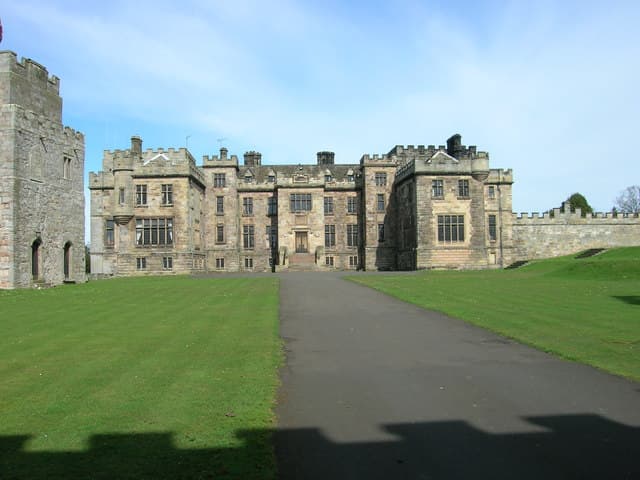
A significant transformation occurred in 1761 when Sir John Hussey Delaval purchased Ford Castle. He extensively remodeled the medieval fortress into a mansion reflecting Tudor architectural style. The renovations included strengthening the outer walls with softer lines, constructing new towers that departed from the original military forms, and creating landscaped gardens. These changes marked a shift from a defensive stronghold to a stately country residence, emphasizing aesthetics and comfort over military utility.
Upon Delaval's death in 1808, the castle passed to his granddaughter Susan, whose marriage to the Marquis of Waterford brought the estate into a prominent noble family. Following the death of the 3rd Marquis in 1859, Lady Louisa Anne, his widow, initiated comprehensive interior redesigns that have largely persisted to the present day.
Modern stewardship and current status
In 1907, the estate, including Ford Castle and nearby Etal Castle, was acquired by James Joicey, 1st Baron Joicey, a coal-mining magnate. The castle remains under the ownership of the Joicey family but has been leased since 1956 to Northumberland County Council as a Young Persons' Residential Centre. This adaptive reuse has contributed to the castle's preservation and public engagement.
Today, Ford Castle stands as a well-preserved example of a high medieval hill castle that has undergone significant architectural evolution. Its quadrangular layout, corner towers, and fortified walls reflect its original defensive purpose, while later Tudor modifications reveal changing tastes and functions. The castle's rich history, marked by border conflicts, noble feuds, and royal visits, makes it a significant cultural and heritage landmark in Northumberland.
Architectural features and notable elements
The castle's quadrangular design is typical of medieval fortifications, with four corner towers linked by curtain walls enclosing a central courtyard. The surviving stonework from the 14th century demonstrates the robust construction techniques used to withstand sieges and raids. The castle's ability to house a garrison of 40 soldiers was vital for maintaining control over the surrounding territory.
A particularly intriguing feature is the secret staircase dating from the early 16th century, which connected the chambers of Lady Elizabeth Heron and King James IV during his 1513 visit. This concealed passage exemplifies the castle's strategic design to facilitate private meetings while ensuring security.
The 18th-century renovations introduced Tudor-style elements, including softened wall profiles, decorative towers, and landscaped gardens, which transformed the castle's character from a fortress to a comfortable residence. The interior redesigns by Lady Louisa Anne in the 19th century added to the castle's grandeur, preserving its historical ambiance while adapting to contemporary needs.
Location and strategic importance
Situated near the Anglo-Scottish border, Ford Castle's location was pivotal in controlling movement across the River Till and defending against Scottish incursions. Its elevation and proximity to key routes made it a valuable military asset during the medieval period. The castle's history of destruction, rebuilding, and modification reflects the shifting political and military dynamics of the borderlands.
Frequently asked questions (FAQ)
- How do I visit Ford Castle and what are the opening hours?
- Ford Castle is currently leased as a Young Persons' Residential Centre and is not generally open to the public for casual visits. Visitors interested in tours or events should check with Northumberland County Council for any special arrangements or open days.
- What is the historical significance of Ford Castle?
- Ford Castle played a key role in the Anglo-Scottish border conflicts from the 13th to 17th centuries. It was a fortified stronghold, a site of noble feuds, and hosted King James IV of Scotland before the Battle of Flodden in 1513.
- Can I see architectural features like the secret staircase during a visit?
- Access to the secret staircase and many internal features is limited due to the castle's current use and preservation status. Special guided tours or events may occasionally provide opportunities to view these unique elements.
- Why is Ford Castle important in Tudor architecture?
- In the 18th century, Ford Castle was extensively remodeled in the Tudor style by Sir John Hussey Delaval. This transformation replaced many medieval defensive features with aesthetic elements typical of Tudor country houses, marking a significant architectural evolution.
- Is Ford Castle accessible for people with disabilities?
- Due to its historic structure and current use, accessibility may be limited. Visitors with specific needs should contact the managing authority in advance to inquire about accommodations.
Photo gallery

Information
Sources & official resources
Verify the information above using these authoritative references.
Loading map...
Visitor reviews
No reviews yet. Been here? Write the first review and help other travelers!
Write the first reviewVisited this castle? Share your experience
Your review helps other travelers and adds first-hand knowledge to our encyclopedia.