Festenstein Castle
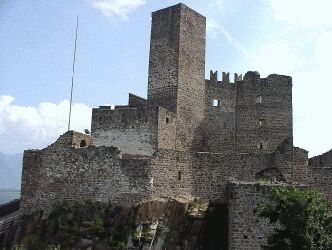
Festenstein Castle is a medieval hill castle ruin located above the municipality of Andrian in South Tyrol, northern Italy. Constructed in the 13th century, this fortress was strategically positioned on a steep porphyry rock outcrop known as the Gaider Schlucht, rising approximately 450 meters above the Adige River valley. Its commanding location provided a defensive advantage and control over the surrounding territory during the High Medieval period.
The castle was originally built by local authorities affiliated with the Counts of Eppan, a noble family influential in the region during the medieval era. Festenstein served as a fortified stronghold and administrative center, primarily functioning as a military outpost and a point for collecting taxes. It was closely connected to the nearby Castel Appiano and managed by ministeriales, a class of servile officials responsible for overseeing estate management and military duties on behalf of the counts.
Historical ownership and strategic role
Throughout its history, Festenstein Castle changed hands multiple times, reflecting the complex feudal and political dynamics of South Tyrol. In 1383, the castle passed to the Lords of Villanders, marking the beginning of a series of ownership transitions. During the 15th century, it came under the possession of the Sparrenberger family. After a significant fire in 1503, the castle was acquired by Hans Übelhör, who likely undertook repairs or rebuilding efforts to restore the fortress.
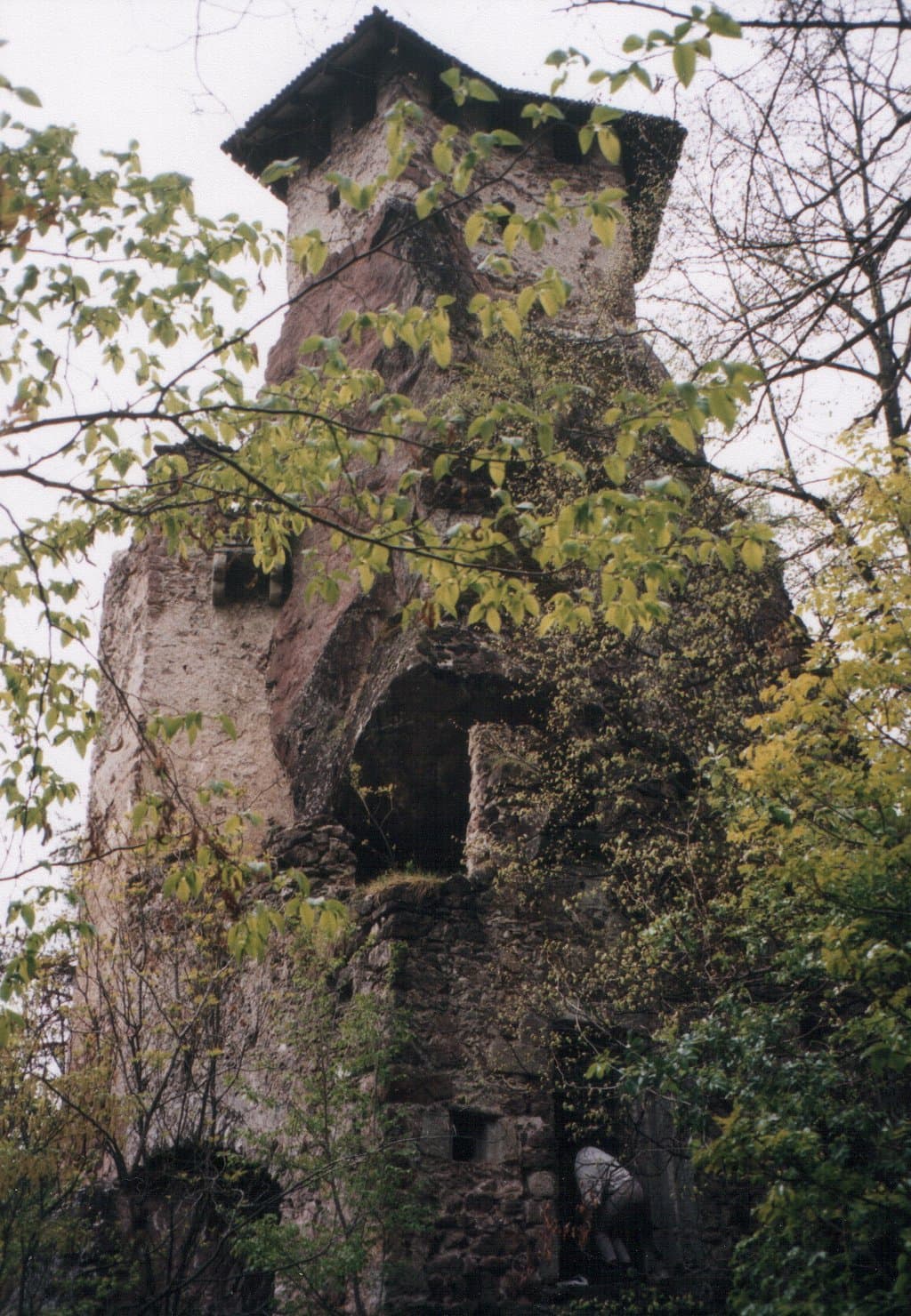
In the mid-17th century, ownership transferred to Franz Lanser, whose family maintained control until the early 19th century. Over this period, the castle’s military importance declined, and it gradually fell into disrepair. The 20th century saw renewed interest when German industrialist Julius Vogel purchased the half-ruined castle in 1910 and initiated restoration work, notably repairing the bergfried by roofing it with historically accurate tiles. However, following Vogel’s death, the castle again suffered neglect.
In 2008, the castle was acquired by Count Meinhard Khuen von Belasi, who, in cooperation with the South Tyrolean Office for Cultural Heritage, began extensive conservation efforts in 2012. These works focused on stabilizing the stone masonry and protecting the remaining structures from further decay, ensuring the preservation of this historic site.
Architectural features and defensive design
Festenstein Castle is a classic example of a hill castle adapted to a challenging natural environment. Its layout is carefully integrated with the steep porphyry rock formation that serves as a natural defensive barrier. The castle’s design exploits the rugged terrain to enhance its fortifications and control access routes.
The bergfried and palas
The most prominent surviving structure is the pentagonal bergfried, or main tower, situated on a rock spur approximately 10 meters high. This tower, consisting of a single story, functioned as a stronghold and lookout point. The rock face forms the rear wall of the palas, the main residential building, demonstrating a fusion of natural and built elements. The palas provided living quarters and functional spaces essential for the castle’s operation.
Defensive walls and access points
The castle’s defensive perimeter includes multiple gates and walls, creating a layered defense system. The approach to the castle is via a fortified path ascending between defensive walls along the rock face. Visitors would have passed through three successive gates before reaching the inner courtyard, known as the "Kehr."
Originally, entry was controlled by a sophisticated drawbridge system connected to a square-shaped first gate positioned several meters above ground level. Although the drawbridge is now scarcely visible, historical evidence confirms its role in regulating access and enhancing security.
Defensive walls along the forebuilding contain narrow vertical openings called Schlitzscharten or arrow slits, allowing defenders to shoot projectiles while remaining protected. The defensive complex extends down the slope on the side considered most vulnerable, illustrating strategic planning to cover all possible approaches.
Additional features and recent restoration
Recent restoration efforts have included the repair of the bergfried’s roof with period-appropriate tiles and the installation of a modern steel staircase replacing an older stairway from the gate chamber to the palas. Clearing of debris has revealed a cellar and a well shaft within the castle grounds, both crucial for sustaining inhabitants during sieges.
Today, Festenstein Castle stands as a stabilized ruin, with repaired masonry and a covered main tower. Its steep terrain and limited access preserve its original defensive advantages while allowing visitors to appreciate the castle’s historic and architectural significance.
Cultural significance and visitor information
Festenstein Castle, also known by various names including Burg Festenstein, Ruine Festenstein, Schloss Festenstein, Castelforte, and Castel Forte, is an important cultural landmark in South Tyrol. Its history reflects the region’s medieval power struggles and feudal administration. The castle’s preservation efforts highlight the commitment to maintaining South Tyrol’s rich architectural heritage.
Access to the castle requires a steep mountain climb, which limits visitor numbers but preserves the site’s authentic atmosphere. The challenging terrain and rugged location make it a destination for those interested in medieval architecture, history, and hiking.
Frequently asked questions (FAQ)
- How do I reach Festenstein Castle?
- Festenstein Castle is accessible only by a steep mountain climb above Andrian. Visitors should wear sturdy footwear and be prepared for a challenging hike through rugged terrain.
- What is the historical significance of Festenstein Castle?
- Festenstein Castle served as a strategic military stronghold and administrative center in South Tyrol during the High Medieval period. It was connected to the Counts of Eppan and later various noble families, reflecting the region's feudal history.
- When was Festenstein Castle built?
- The castle was constructed in the 13th century, likely in the early to mid-1200s, by local authorities linked to the Counts of Eppan.
- Can I visit the interior of Festenstein Castle?
- As a stabilized ruin, Festenstein Castle has limited interior access. Visitors can explore the courtyard and the exterior of the bergfried, but some areas are restricted due to safety concerns.
- What restoration efforts have been made to preserve Festenstein Castle?
- Since 2012, extensive conservation work has been carried out to stabilize the stone masonry, repair the bergfried's roof with period-appropriate tiles, and clear debris to reveal historical features like the cellar and well shaft.
- Is there an entrance fee to visit Festenstein Castle?
- There is no widely publicized entrance fee for Festenstein Castle, but visitors should check locally for any updates or guided tour options.
- What is the best time of year to visit Festenstein Castle?
- The best time to visit is during late spring to early autumn when weather conditions are favorable for hiking and the steep paths are safer and more accessible.
Photo gallery

Information
Sources & official resources
Verify the information above using these authoritative references.
Loading map...
Visitor reviews
No reviews yet. Been here? Write the first review and help other travelers!
Write the first reviewVisited this castle? Share your experience
Your review helps other travelers and adds first-hand knowledge to our encyclopedia.