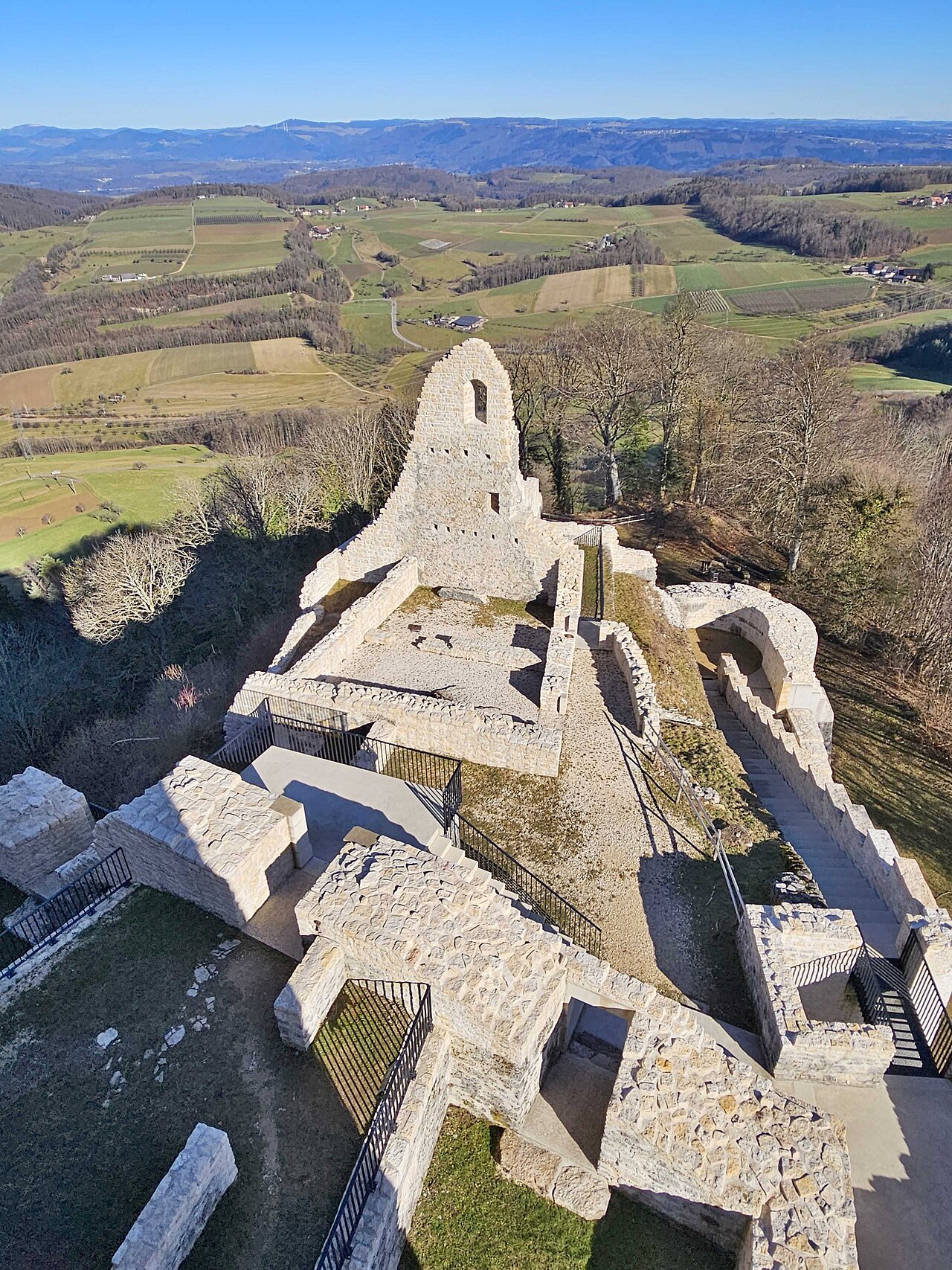
Bischofstein Castle
Bischofstein Castle is a remarkable example of a high medieval hill castle located near Sissach in the canton of Basel-Landschaft, Switzerland. Constructed around 1250 by the noble lords of Eptingen, the castle was strategically positioned on a ridge overlooking the Ergolz valley, commanding vital regional routes and asserting feudal dominance. Its name, meaning "Bishop's Stone," reflects the castle's historical connection to the Bishop of Basel, to whom the site was held as a fief shortly after its construction.
The castle's early history is intertwined with the extinction of the Itkon family, whose lands passed to the Eptingens, prompting the establishment of Bischofstein as a fortified residence and administrative center. The earliest documented lord, Ulrich von Bischofstein, appears in records from 1311, marking the castle's prominence in regional affairs during the high medieval period.
Architectural features and construction phases
Bischofstein Castle exhibits a complex layout that evolved through two primary construction phases, reflecting changing defensive needs and residential functions. Its original fortifications include an irregular ring wall built to conform to the natural rock outcrop, with walls over 1.5 meters thick where protection was needed most, and thinner sections where the steep northwest rock face provided a natural barrier.
The main entrance was located on the northeast side, featuring a gatehouse and access ramp crossing a deep defensive ditch. This original gate structure is still visible today, demonstrating the castle's robust medieval defensive design. Later modifications introduced a zwinger—a fortified outer ward—along with a new outer gate complex on the west and south sides, enhancing the castle's layered defenses.
The bergfried tower
Dominating the castle's center is a large, circular bergfried, the main defensive tower and lookout post. Its walls are approximately 2.3 meters thick, enclosing an interior space about three meters wide. Although the original height is uncertain, architectural analysis suggests it may have risen to around 20 meters, possibly topped with a conical roof. This tower served as a last refuge during sieges and a symbol of lordly power.
Residential and auxiliary buildings
Between the bergfried and the curtain wall lie several stone buildings fulfilling residential and functional roles. The palas, a two-room residential structure in the southwest courtyard, features vaulted ceilings and a cellar beneath. Notably, the northern chamber contained distinctive pointed arch windows crafted from red sandstone, fragments of which have been preserved and displayed in restored sections.
Additional buildings to the south likely served as stables on the ground floor with living quarters above, while a cistern in the northern courtyard collected rainwater, demonstrating thoughtful water management. The discovery of glazed and unglazed stove tiles, partially glazed glass windows with lead framing, and various iron fittings illustrates the castle's relatively comfortable living conditions for its time.
Historical context and ownership transitions
The castle's history reflects the turbulent political landscape of medieval Switzerland. After its construction by the Eptingen family, the castle was transferred as a fief to the Bishop of Basel, strengthening ecclesiastical influence in the region. The devastating 1356 Basel earthquake severely damaged Bischofstein, leading to its gradual abandonment as a noble residence.
Despite earlier beliefs that the castle remained in use into the 15th century, modern archaeological evidence suggests it was deserted soon after the earthquake. Ownership changed hands several times, passing to local Basel officials in the mid-1400s, then to notable families such as Wernher Truchsess von Rheinfelden and Peter Offenburg. The Offenburg family held the castle for about a century before the city of Basel acquired it in 1560, placing it under the management of the Farnsburg regional authority.
Archaeological excavations and preservation efforts
Interest in Bischofstein Castle's ruins grew in the early 20th century, prompting professional archaeological excavations beginning in 1914 and 1916. These initial digs uncovered significant structural remains and artifacts, leading to more extensive community-supported excavations from 1926 onward. A major preservation campaign completed in 1937–38 stabilized the ruins and integrated findings from previous work.
The site has suffered from unauthorized treasure hunting over the centuries, which disturbed archaeological layers. However, careful excavation has revealed valuable insights into medieval castle life, including a nearly complete brass cooking pan, a bronze lock, and numerous iron fittings. These artifacts, along with architectural fragments, are exhibited in local museums such as the Heimatmuseum Sissach, the Kantonsmuseum Baselland, and the Historisches Museum Basel.
Defensive advantages and natural setting
Bischofstein Castle's location on a ridge provided natural defense, with the steep northwest rock face acting as a formidable barrier. The castle's builders enhanced this by excavating deep ditches around the other sides, effectively isolating the fortress from its surroundings. This combination of natural and manmade defenses typifies medieval hill castle construction aimed at maximizing protection with available terrain.
The castle's ring wall, bergfried, gatehouses, and zwinger form a layered defense system, reflecting the military architecture of the high medieval period. The reuse of masonry from older ruins linked to the Itkon family estate demonstrates continuity and resourcefulness in construction practices.
Visitor experience and cultural significance
Today, visitors to Bischofstein Castle can explore the well-preserved ruins, including the imposing bergfried tower accessible via an observation platform reached by ladder. The site offers panoramic views of the Ergolz valley and surrounding landscapes, highlighting its strategic importance. Interpretive displays and local museum exhibits provide context about the castle's history, architecture, and daily life in medieval times.
Bischofstein Castle remains a significant cultural heritage site in Switzerland, embodying the region's medieval history and architectural traditions. Its preservation allows for ongoing study and appreciation of feudal fortifications, noble residences, and ecclesiastical influence during the high medieval era.
Frequently asked questions (FAQ)
- How do I get to Bischofstein Castle from Sissach?
- Bischofstein Castle is located on a ridge near Sissach. Visitors can reach the site by hiking trails starting from the town center, which take approximately 30-45 minutes on foot. The path is moderately challenging and offers scenic views of the Ergolz valley.
- What is the best time of year to visit Bischofstein Castle?
- The best time to visit Bischofstein Castle is during late spring through early autumn (May to September) when weather conditions are favorable for hiking and outdoor exploration. The ruins are open year-round, but winter visits can be hindered by snow and slippery terrain.
- Is Bischofstein Castle wheelchair accessible?
- Due to its hilltop location and rugged terrain, Bischofstein Castle is not wheelchair accessible. Visitors should be prepared for uneven ground and steep paths when exploring the site.
- Are there guided tours available at Bischofstein Castle?
- Guided tours are occasionally offered by local heritage organizations and the Heimatmuseum Sissach. It is recommended to check with these institutions in advance for scheduled tours and special events.
- What architectural features can I see at Bischofstein Castle?
- Visitors can explore the remains of the bergfried tower, curtain walls, gatehouses, zwinger, and residential buildings such as the palas. The castle showcases typical high medieval defensive elements and residential structures, including vaulted chambers and pointed arch windows.
Information
Current owner
City of Basel
Loading map...
Visitor reviews
No reviews yet. Been here? Write the first review and help other travelers!
Write the first reviewVisited this castle? Share your experience
Your review helps other travelers and adds first-hand knowledge to our encyclopedia.