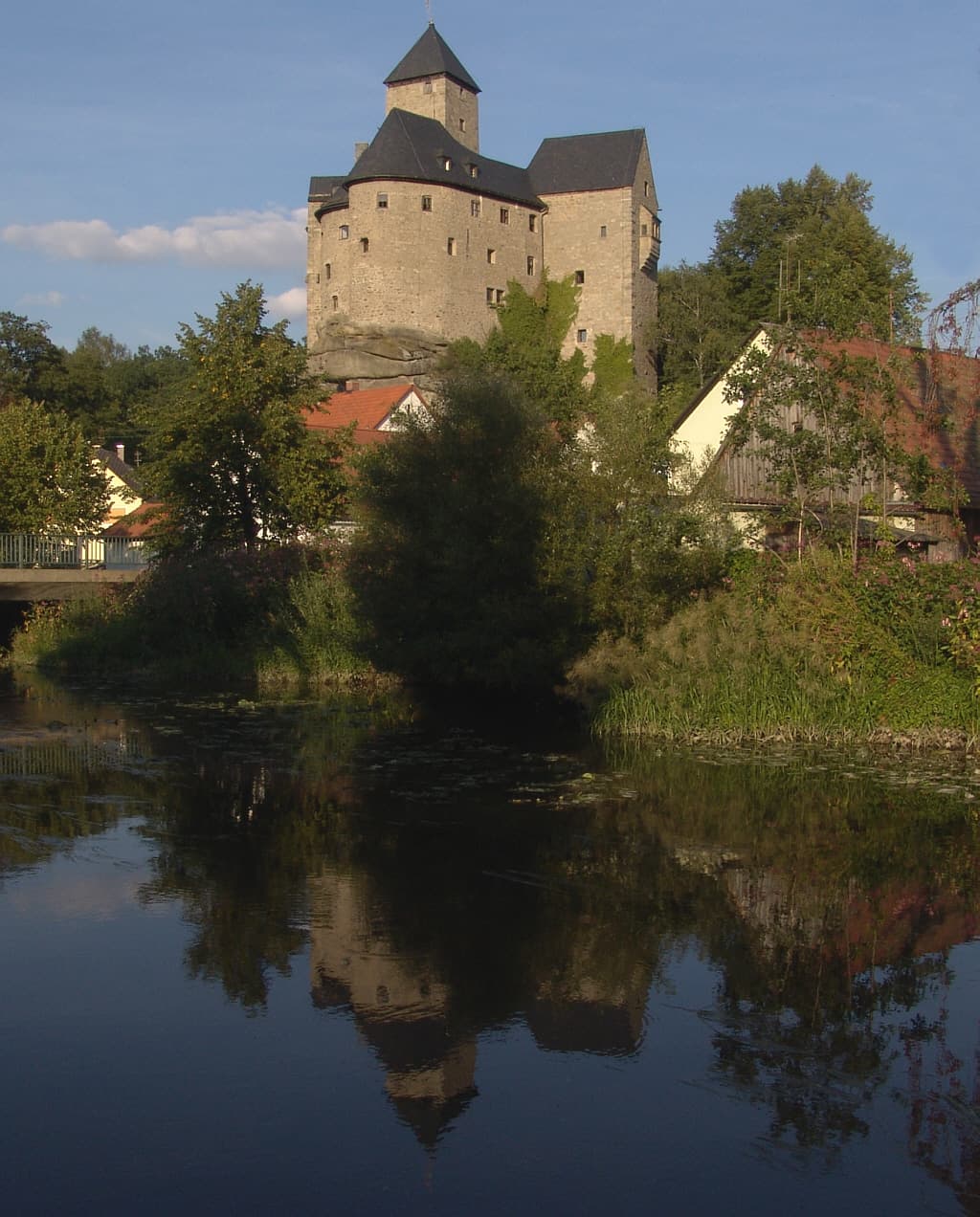
Falkenberg Castle
Falkenberg Castle, located in the municipality of Falkenberg in Oberpfalz, Germany, is a remarkable example of a hill castle with a history spanning over a millennium. Founded probably between 895 and 898 AD, the castle's earliest mentions appear in 1154, indicating its longstanding importance in the region. The castle’s strategic position atop a granite hill, formed by the distinctive Falkenberger granite with its characteristic "Wollsackverwitterung" weathering, provided a natural defensive advantage that medieval builders skillfully enhanced with robust fortifications.
Medieval origins and early history
The origins of Burg Falkenberg trace back to the early medieval period, with archaeological evidence of masonry dating to the 11th century. The castle was initially associated with the local noble Falkenberger family, whose name it bears. The first indirect documentary reference to the castle comes from 1154, mentioning a figure named "Pilegrin de Valkenberch," which suggests a well-established fortress or settlement by that time.
Ownership of the castle changed hands several times during the medieval era. In 1280, it passed to the influential Leuchtenberg family, and around 1300 it was acquired by the Cistercian Waldsassen Abbey. This transition reflects the common medieval practice of religious institutions gaining control over strategic estates, combining spiritual and temporal power.
By the late 15th century, Burg Falkenberg served not only as a defensive stronghold but also as a residence. After 1486, Abbot Udalrich II Birker of the Cistercian order chose the castle as his retirement home, highlighting its role beyond purely military functions.
Architectural features and castle layout
The castle complex is built directly on the granite outcrop, integrating the natural rock formations into its defensive design. The hallmark of the fortress is its bergfried, a tall, slender tower typical of medieval German castles, used for surveillance and defense. Although partially dismantled in 1809—when about one-third of its height was removed to supply stone for local construction—the remaining structure still dominates the site.
Surrounding the bergfried are remnants of medieval defensive walls and buildings, which reveal multiple phases of construction and adaptation over the centuries. Archaeological investigations have identified traces of a former outer bailey, an additional courtyard that would have housed service buildings and provided a further defensive layer, though it no longer survives above ground.
The castle’s position on the granite hill not only offered a commanding view of the surrounding landscape but also leveraged the natural terrain to enhance its fortifications, making it a formidable stronghold in its time.
Historical events and ownership changes
Throughout its history, Falkenberg Castle witnessed significant historical events and changes in ownership that reflect the broader political and religious shifts in the region. After the Cistercian period, in 1571 the castle came under the control of the Electorate of the Palatinate, marking a shift from ecclesiastical to secular governance.
During the Thirty Years' War in the 17th century, the castle was besieged and captured by Swedish forces led by General Hans Christoff von Königsmarck. This event was part of the widespread conflict that devastated much of Central Europe. The siege and subsequent conquest left the castle in ruins, signaling the end of its military significance.
In the early 19th century, following the secularization policies of 1803, the castle became property of the Kingdom of Bavaria. This transition led to structural changes, including the partial dismantling of the bergfried in 1809 to provide building materials for the local parsonage.
20th-century restoration and modern use
After centuries of decay, the castle found a new chapter in the 20th century when Friedrich-Werner Graf von der Schulenburg, a notable German diplomat and participant in the Operation Valkyrie plot against Adolf Hitler, purchased the property as his retirement home. Between 1936 and 1939, Schulenburg undertook a meticulous restoration of the castle, guided by historical paintings and documents to revive its medieval character.
Schulenburg's involvement in the resistance against the Nazi regime led to his execution in 1944. During World War II, the castle was confiscated by the Gestapo and used as a detention site for prisoners from the Flossenbürg concentration camp, adding a somber chapter to its history.
After the war, the Schulenburg family regained ownership. In 2008, the municipality of Falkenberg acquired the castle from the heirs, initiating comprehensive modernization and conservation efforts. The castle reopened in 2015 as a cultural and tourist site, featuring a museum dedicated to Schulenburg's life and the castle's multifaceted history.
Today, Falkenberg Castle offers visitors a unique experience with its museum, hotel accommodations in eight individually designed rooms, a restaurant, and a large knight’s hall for events and conferences. These modern adaptations respect the castle’s heritage while providing contemporary amenities.
Cultural and natural significance
The castle’s location on the distinctive granite hill is not only architecturally significant but also environmentally notable. The geological formation known as "Wollsackverwitterung" creates a natural monument that complements the cultural heritage of the site. This unique combination of natural and historical elements has earned Falkenberg Castle protected status as an architectural and natural monument.
Preservation efforts continue to balance the castle’s historical integrity with its role as a living cultural venue. The castle’s museum educates visitors about its medieval origins, ecclesiastical connections, military history, and 20th-century restoration, ensuring that the legacy of Falkenberg Castle remains vibrant and accessible.
Frequently asked questions (FAQ)
- How do I visit Falkenberg Castle and what are the opening hours?
- Falkenberg Castle is open to visitors daily from 10:00 to 18:00. The castle offers guided tours, a museum, a restaurant, and hotel accommodations. It is advisable to check the official website for any seasonal changes or special events.
- What is the historical significance of Falkenberg Castle?
- Falkenberg Castle has a rich history dating back to the 9th century, serving as a noble residence, religious retreat, and military fortress. It played a role in the Thirty Years' War and was restored in the 20th century by Friedrich-Werner Graf von der Schulenburg.
- Can I stay overnight at Falkenberg Castle?
- Yes, the castle features eight uniquely designed hotel rooms offering a blend of historical ambiance and modern comfort, allowing guests to experience medieval castle life firsthand.
- Is Falkenberg Castle accessible for visitors with mobility issues?
- The castle's hilltop location and historic architecture present some accessibility challenges. However, efforts have been made to accommodate visitors with limited mobility, including accessible paths and facilities. It is recommended to contact the castle in advance for specific accessibility information.
- Why is the castle built on a granite hill important?
- The granite hill, known for its distinctive 'Wollsackverwitterung' weathering, provides a natural defensive advantage and is a protected geological monument. This unique setting enhances the castle's historical and environmental significance.
Photo gallery

Information
Sources & official resources
Verify the information above using these authoritative references.
Loading map...
Visitor reviews
No reviews yet. Been here? Write the first review and help other travelers!
Write the first reviewVisited this castle? Share your experience
Your review helps other travelers and adds first-hand knowledge to our encyclopedia.


