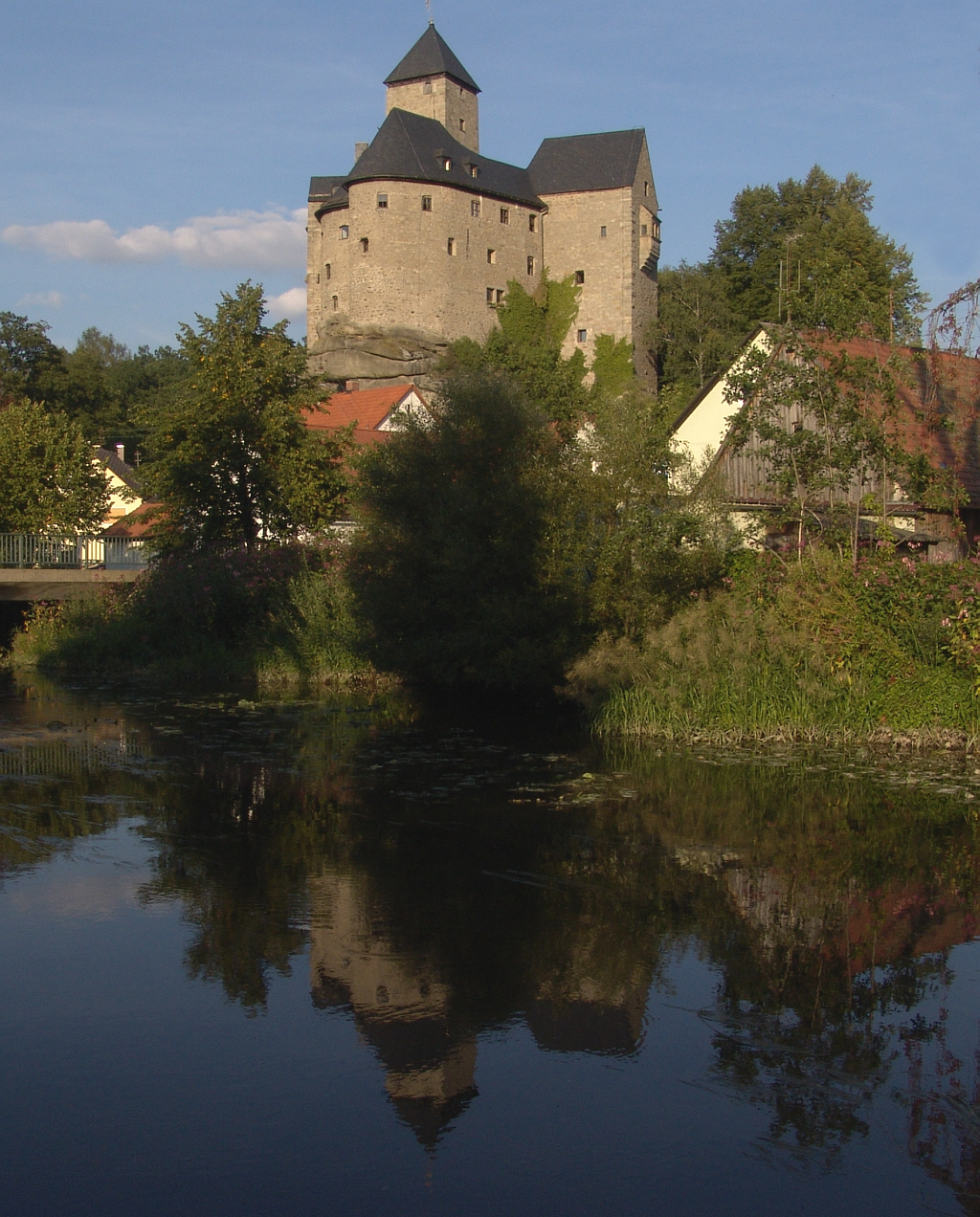
Burg Wildenau
Burg Wildenau stands as a remarkable example of a medieval hill castle situated in the municipality of Plößberg, Bavaria, Germany. Constructed around the early 12th century, this fortress was originally established by the Counts of Sulzbach, a notable noble family within the Holy Roman Empire. Its first documented mention dates to 1125, anchoring its origins firmly in the early medieval period.
The castle occupies a strategic hilltop location, typical of hill castles, designed to oversee and control the surrounding landscape. Its elevated position provided both defensive advantages and a commanding view of the region, essential for medieval military architecture.
Historical development and ownership
Throughout its history, Burg Wildenau witnessed significant shifts in ownership and political influence. In the 12th century, control passed from the founding Counts of Sulzbach to the influential Staufer dynasty, a ruling house that left a lasting imprint on southern Germany. The castle's strategic importance is underscored by its involvement in the Hussite Wars around 1430, when it suffered destruction amidst the religious and political upheavals in Bohemia.
Following its destruction, the castle was promptly rebuilt, and by 1432, it was granted as a fief to Konrad Ermesreuther. The estate's connection to ecclesiastical authority is evident by 1443, when it fell under the jurisdiction of the legal district of Beidl, reflecting the intertwining of secular and church powers during the late medieval period.
The 16th and 17th centuries saw the castle under the ownership of the Reitzenstein family, who received formal enfeoffment from several emperors, including Ferdinand, Maximilian II, and Rudolf III. In the mid-1600s, Burg Wildenau became a Bohemian crown fief, linking its political status to the Kingdom of Bohemia. The von Sazenhofen family subsequently held the fief until their line ended in 1782.
After the extinction of the von Sazenhofen lineage, the castle reverted to the Kingdom of Bavaria. An inventory from 1783 described the castle as partially in ruins but still housing a chapel dedicated to St. Erhard, which notably served both Protestant and Catholic congregations, highlighting a period of religious coexistence in the region.
By the late 20th century, the castle had fallen into significant disrepair until its acquisition in 1992 by Konrad and Ricarda Ackermann, who undertook a comprehensive restoration lasting approximately a decade. Today, despite private ownership, Burg Wildenau preserves its medieval heritage and architectural legacy.
Architectural features and layout
Burg Wildenau features a distinctive U-shaped layout arranged around a small inner courtyard. The fortress includes several multi-story wings dating from the 12th and 14th centuries, identifiable by their traditional saddle roofs and half-hipped roofs, architectural terms describing the specific sloping and hipped roof designs common in medieval German castles.
The bergfried and defensive structures
A central architectural highlight is the Bergfried, or keep, constructed during the Staufer period. This quadrangular tower was built using rusticated ashlar masonry, locally known as Buckelquader, characterized by rough-cut stones with protruding surfaces that provided both strength and a distinct aesthetic. The tower was later modified by adding a flared pointed helmet roof, transforming it into a bell tower capped with a distinctive pointed roof.
Religious architecture: schlosskapelle st. erhard
The west wing of the castle housed the Schlosskapelle St. Erhard, a chapel built over the remains of the former palas, the main residential building of the castle. This chapel, designed as a flat-roofed hall with a three-sided choir recess, served the evangelical Lutheran community until 1912. Its direct attachment to the Bergfried illustrates the integration of military and religious functions within the castle complex.
Later additions and renovations
Additional structures on the northwest side date from the late 17th century, constructed with a combination of rubble stone and ashlar masonry, reflecting ongoing occupation and modification during the post-medieval period. A notable inscription from 1559 on a retaining wall marks a Renaissance-era phase of construction or renovation.
A one-story solid building with a gable roof from the second half of the 19th century stands as an ancillary structure, indicating the castle's continued use and adaptation into modern times.
Historical functions and current condition
Historical descriptions from 1783 note that much of the castle was in a state of collapse, though the lower floors retained vaulted rooms and stables. The tower contained a prison and several vaulted chambers, topped by a small bell, demonstrating the castle's multifunctional role encompassing defense, residence, religion, and judicial functions.
Today, Burg Wildenau is well preserved thanks to modern restoration efforts, maintaining its architectural integrity and historical significance. Its layered construction phases and varied uses over nearly a millennium offer valuable insights into the evolution of medieval fortifications and noble residences in Bavaria.
Cultural significance and visitor information
Although Burg Wildenau remains privately owned and is not generally open to the public, it stands as a significant cultural landmark within the region. Its historical connections to prominent noble families, its survival through turbulent periods such as the Hussite Wars, and its architectural features make it an important subject of study for medieval historians and castle enthusiasts alike.
Frequently asked questions (FAQ)
- When was Burg Wildenau originally built?
- Burg Wildenau was originally constructed around the year 1100 by the Counts of Sulzbach, with its first recorded mention in 1125.
- What architectural style is Burg Wildenau known for?
- Burg Wildenau features medieval architectural elements typical of hill castles, including a Bergfried with rusticated ashlar masonry and traditional saddle and half-hipped roofs.
- Is Burg Wildenau open to the public?
- Burg Wildenau is privately owned and generally not open to the public, but its exterior can be viewed from surrounding areas in Plößberg.
- What historical events affected Burg Wildenau?
- The castle was destroyed during the Hussite Wars around 1430 and subsequently rebuilt, reflecting its resilience through regional conflicts.
- Who were some notable owners of Burg Wildenau?
- Notable owners include the Counts of Sulzbach, the Staufer dynasty, the Reitzenstein family, and the von Sazenhofen family.
Information
Sources & official resources
Verify the information above using these authoritative references.
Loading map...
Visitor reviews
No reviews yet. Been here? Write the first review and help other travelers!
Write the first reviewVisited this castle? Share your experience
Your review helps other travelers and adds first-hand knowledge to our encyclopedia.