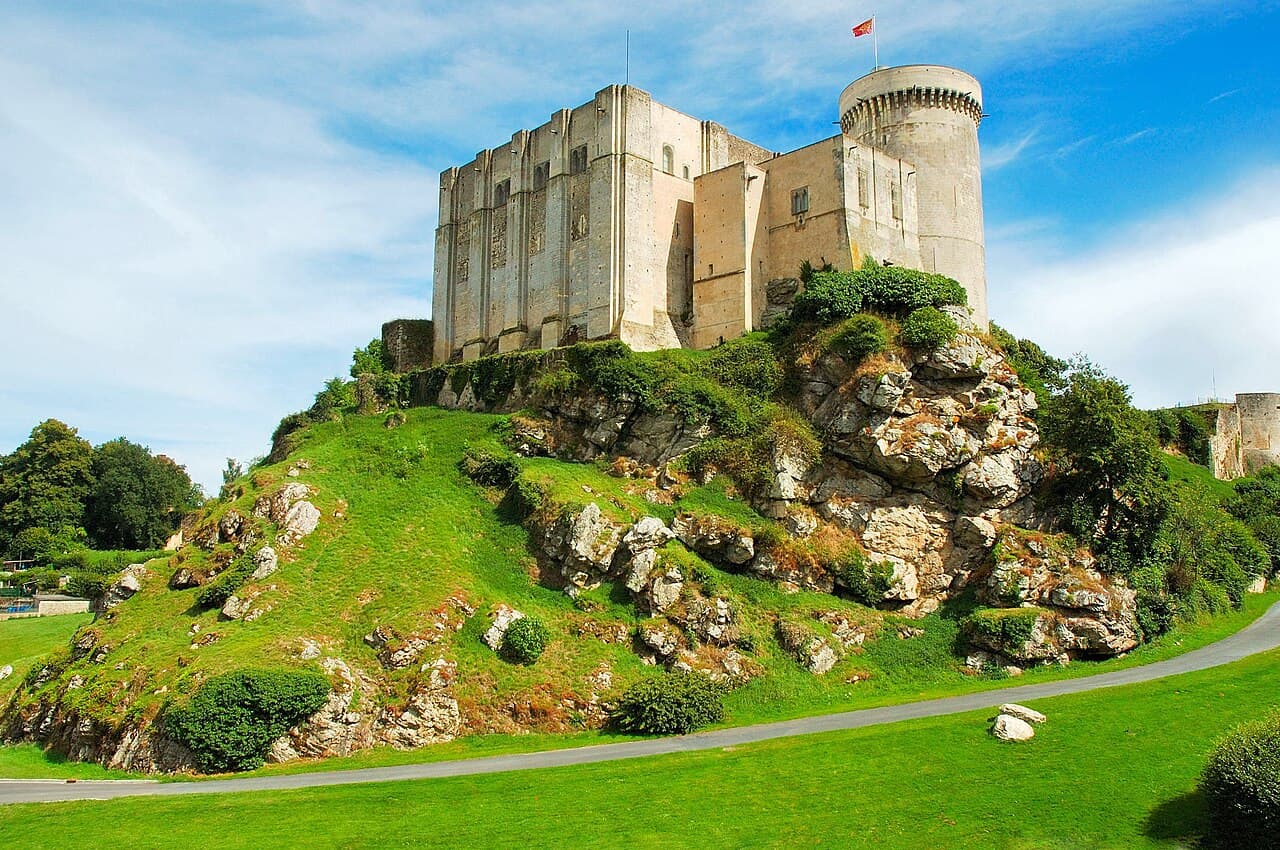
Falaise Castle
Falaise Castle, also known as Château de Falaise or Château Guillaume-le-Conquérant, stands prominently in the town of Falaise, in the Calvados department of Normandy, France. This hill castle occupies a strategic rocky spur formed by the convergence of the Ante and Marescot rivers, commanding views over the surrounding landscape and town below. It is best known as the birthplace of William the Conqueror, the Norman duke who became King of England in 1066, a pivotal figure in medieval European history.
The origins of the castle trace back to the early 10th century, with initial fortifications likely established between 962 and 1020. While some sources attribute the first stone construction to Richard I of Normandy, it is more probable that his son, Richard II, Duke of Normandy, initiated the earliest significant building efforts. The castle's location on a natural schist promontory provided formidable natural defenses, enhanced by man-made fortifications. It was within this early fortress that William, son of Duke Robert I of Normandy and Herleva of Falaise, was born circa 1028. Despite his illegitimate birth, William rose to become one of the most influential rulers of medieval Europe.
Architectural evolution and major constructions
The current visible structure of Falaise Castle does not date from William's birth but was largely rebuilt in the 12th and 13th centuries. After the Norman dukes passed the castle to the English crown, Henry I of England initiated a major reconstruction around 1123, erecting the large quadrangular Norman keep (grand donjon). This imposing tower, measuring approximately 27 by 23 meters and standing 22 meters tall, served as both a defensive stronghold and ducal residence. Its thick walls, up to 3.5 meters wide, were built with irregular small stones reinforced by flat buttresses. The keep's entrance was elevated and protected by a gatehouse with a forebuilding and staircase, typical of Norman military architecture.
The interior of the large keep was functional and residential, containing a great hall, private chambers, and a chapel dedicated to Saint Prix. The chapel featured ribbed vaults supported by sculpted capitals and was originally decorated with painted polychrome walls. The keep also housed storage cellars, a rainwater cistern, and a well, essential for withstanding sieges. Upper floors accommodated garrison quarters and defensive positions, with parapets likely crenellated or outfitted with wooden hoardings. Internal staircases within the walls provided access to latrines and service rooms, while traces of a kitchen and food storage areas remain.
In the mid-12th century, Henry II of England expanded the castle by adding a small quadrangular keep (petit donjon) against the west wall of the large keep. This smaller tower, about 14 by 10 meters and 14 meters high, increased the residential space with a great hall illuminated by four large decorated windows and a south-facing fireplace with ornamental colonnettes. A rectangular turret attached to its north wall may have served as a dungeon or latrine, though its exact purpose remains uncertain.
Following the French conquest of Normandy in 1204, King Philip II Augustus of France ordered the construction of a large round defensive tower around 1207, known as the Tour Talbot. This cylindrical keep, approximately 15 meters in diameter and 30 meters tall with walls 4 meters thick, reflects the evolving military architecture of the period. It features six floors separated by alternating vaulted and wooden floors, narrow arrow slits for defense, and a spiral staircase embedded in the thick northern wall. Originally crowned with machicolations for dropping projectiles on attackers, the tower also contained a well at its base accessible through a shaft in the southern wall.
Historical significance and events
Falaise Castle played a crucial role in Norman and later French-English history. It was the birthplace of William the Conqueror, whose 1066 conquest of England reshaped medieval Europe. The castle served as a ducal seat and royal prison, notably holding Arthur I, Duke of Brittany, nephew and rival claimant to King John of England. Arthur was imprisoned here in 1202 and likely died in 1203 under mysterious circumstances, a dark episode reflecting the castle's political significance.
During the Hundred Years' War (1337–1453), the castle changed hands multiple times between English and French forces. The English commander Talbot repaired the round keep, which subsequently bore his name. The castle withstood sieges and was a strategic military site throughout the conflict. In January 1590, during the French Wars of Religion, Henry IV's troops besieged the castle, breaching its west wall with artillery and forcing surrender. This event marked the decline of the castle's military importance as advances in artillery rendered medieval fortifications obsolete.
By the 17th century, Falaise Castle was abandoned and fell into ruin. It was used as a quarry for building materials, leading to the destruction of upper floors of the keeps. The castle's historical and cultural value was recognized in 1840 when it was designated a monument historique by the French Ministry of Culture.
Restoration and modern use
Restoration efforts began in the 19th century under architect Victor Ruprich-Robert, a disciple of Viollet-le-Duc, who sought to preserve the castle's medieval character. Between 1870 and 1874, the main keeps were stabilized and restored. The castle suffered damage during the Second World War, particularly in the 1944 Battle of the Falaise Pocket, but the three keeps remained intact.
Further restorations from 1987 to 1997 included controversial modern interventions such as a front section of the large keep rebuilt with concrete and steel, which sparked debate among preservationists. Today, the castle is open to the public for a fee and features engaging exhibitions about William the Conqueror and Norman history. Augmented reality tablets enhance the visitor experience, although some areas may occasionally be closed for conservation or health measures.
Architectural features and layout
The castle's three main keeps represent distinct phases of medieval military architecture. The grand donjon is a classic example of Norman keep design, combining residential and defensive functions. The petit donjon expanded living quarters, reflecting evolving noble lifestyles. The round Tour Talbot illustrates the transition to more advanced fortifications suitable for resisting siege engines and early artillery.
The surrounding curtain walls, built in the 13th century, enclose a roughly 600-meter perimeter with sixteen circular or semi-circular towers, including four guarding the main gates. The southern defenses once included water-filled moats, now replaced by promenades. Inside the walls, the castle housed various medieval structures such as a chapel, governor's residence, barracks, workshops, stables, and multiple courtyards separated by defensive walls acting as chicanes.
Seven city gates historically controlled access to the fortress, with the Porte des Cordeliers being one of the best preserved. Archaeological excavations have uncovered underground storerooms for weapons, water, and food, underscoring the castle's capacity for prolonged defense.
Cultural legacy and visitor experience
Falaise Castle remains a powerful symbol of Norman heritage and medieval history. Its association with William the Conqueror draws visitors interested in the origins of the Norman dynasty and the shaping of medieval Europe. The castle's well-preserved keeps and walls offer insight into Norman military architecture and feudal life.
Visitors can explore the castle grounds, climb the towers, and learn through interactive exhibits enhanced by modern technology. Despite some modern interventions, the site retains an authentic atmosphere that connects visitors to its storied past. The castle's position overlooking the town and surrounding valleys provides stunning views and a tangible sense of its historical strategic importance.
Overall, Falaise Castle stands as a testament to the enduring legacy of the Normans and their impact on European history, architecture, and culture.
Frequently asked questions (FAQ)
- How do I get to Falaise Castle?
- Falaise Castle is located in the town of Falaise, France, which is accessible by car or public transport. If you are traveling by train, the nearest station is in Falaise, and from there, it's a short walk to the castle.
- What is the historical significance of Falaise Castle?
- Falaise Castle is renowned as the birthplace of William the Conqueror and played a pivotal role in the Norman Conquest of England. Its history dates back to the 10th century, making it a significant site for understanding medieval France and its influence on European history.
- When was Falaise Castle built?
- Falaise Castle was originally constructed in the 10th century, with significant renovations and expansions occurring in the following centuries. The castle’s architecture reflects the evolution of military fortifications over time.
- Can I visit Falaise Castle year-round?
- Yes, Falaise Castle is open to visitors year-round, although hours may vary seasonally. It’s advisable to check the official website for the most current opening hours before your visit.
- Why is Falaise Castle considered an architectural marvel?
- Falaise Castle features impressive medieval architecture, including its sturdy fortifications, towers, and well-preserved ramparts. The blend of Romanesque and Gothic styles showcases the advancements in castle design during its era.
- Is it possible to access all areas of the castle?
- While many areas of Falaise Castle are accessible to visitors, some sections may have restricted access due to preservation efforts. However, guided tours often cover the most significant and interesting parts of the castle.
- What are the ticket prices for visiting Falaise Castle?
- Ticket prices for Falaise Castle are generally reasonable, with discounts available for students and groups. It is recommended to check the official castle website for the latest pricing and any special offers.
- When is the best time to visit Falaise Castle?
- The best time to visit Falaise Castle is during the spring and early autumn when the weather is pleasant and ideal for exploring the grounds. Additionally, visiting during these seasons often means fewer crowds, allowing for a more enjoyable experience.
- Are there any nearby attractions to visit?
- Yes, near Falaise Castle, you can explore the beautiful town of Falaise, the Church of Saint-Gervais, and the Memorial to the Battle of Normandy. These sites complement your visit to the castle and provide deeper insights into the region's history.
Photo gallery

Information
Website
Visit websiteAddress
Place Guillaume le Conquérant, Falaise, Calvados, Normandie, France
Sources & official resources
Verify the information above using these authoritative references.
Loading map...
Visitor reviews
No reviews yet. Been here? Write the first review and help other travelers!
Write the first reviewVisited this castle? Share your experience
Your review helps other travelers and adds first-hand knowledge to our encyclopedia.



