Eynsford Castle
Eynsford Castle is a remarkable example of an early Norman enclosure castle located in the village of Eynsford, Kent, England. Constructed between 1085 and 1087, it stands on the site of a former Anglo-Saxon fortified burh overlooking the River Darent. The castle was likely built by William de Eynsford I, a knight and sheriff of Kent, during a period of Norman consolidation following the conquest of England. Its strategic location and robust defensive features reflect the turbulent political landscape of the late 11th century, particularly the rivalry between Archbishop Lanfranc of Canterbury and Odo, Bishop of Bayeux.
Historical background and ownership
The castle remained in the hands of the de Eynsford family for nearly two centuries, passing through six generations, all named William, which was a common practice to maintain lineage identity. Around 1130, the castle underwent significant enhancements including the heightening of the curtain walls and the addition of a gate tower, strengthening its defensive capabilities. At roughly the same time, a great hall and ancillary buildings were constructed within the castle's enclosure, marking a transition from purely military fortification to a residence with administrative functions.
Following a destructive fire, these buildings were rebuilt around 1250, demonstrating the castle's ongoing occupation and importance. However, the death of the last de Eynsford heir in 1261 led to the division of the estate between the Heringaud and de Criol families, which sparked prolonged disputes over ownership. This conflict escalated dramatically in 1312 when Nicholas de Criol and his supporters forcefully seized and vandalized the castle in protest against the new owner, Judge William Inge. This event precipitated the castle's abandonment and subsequent decline.
In the centuries that followed, the castle fell into ruin. By the 18th century, the dilapidated structure was repurposed by the Hart-Dykes family as kennels and stables for hunting dogs. Archaeological interest in the castle revived in the 19th and 20th centuries, with excavations revealing much about its construction and history. The castle was placed under state guardianship in 1948, ensuring its preservation as a historic monument accessible to the public.
Architectural features and layout
Enclosure castle design
Eynsford Castle is a rare surviving example of an enclosure castle from the early Norman period that notably lacks a central keep or donjon. Instead, its defense relied on a strong curtain wall enclosing the baileys and strategic use of natural terrain. The castle is situated on a raised platform overlooking the River Darent, providing natural defensive advantages and control over the surrounding landscape.
The curtain walls and moat
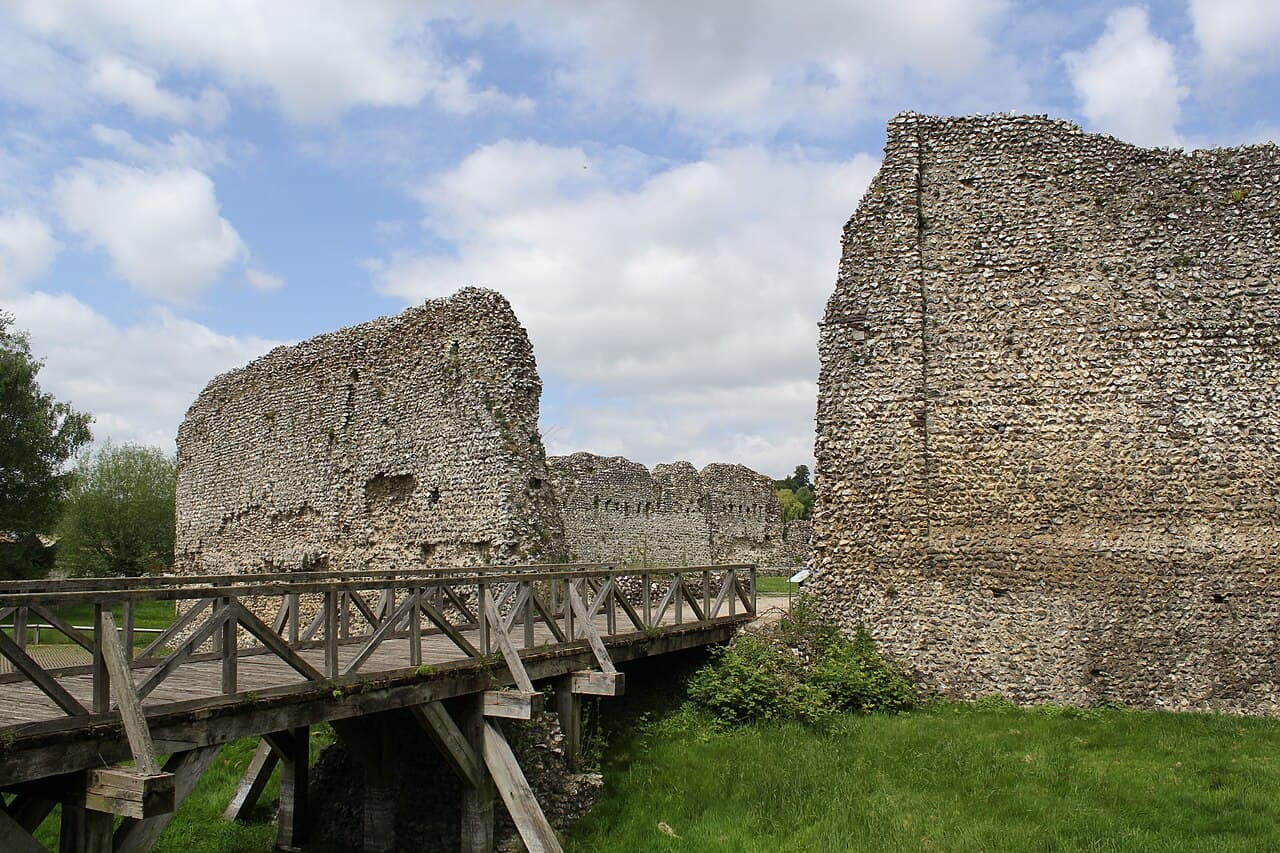
The curtain wall is a defining feature, standing approximately 9 meters tall and nearly 2 meters thick. Constructed primarily from flint rubble with internal timber reinforcements and ironstone slabs, the wall was built in two phases: the lower two-thirds date to the original 11th-century construction, while the upper section, added around 1130, incorporates reused Roman tiles. This upper section also integrates three sets of garderobes, medieval latrines built into the wall for sanitation.
The castle was originally surrounded by a moat, a water-filled ditch that enhanced its defensive perimeter. Access to the inner bailey was via a wooden bridge crossing the moat, later replaced with stone facades and eventually a timber bridge reconstructed during 20th-century restorations.
Entrance and gatehouse
The main entrance was protected by a gatehouse featuring an arched passageway made from Roman bricks, flanked by guardrooms. Though only foundations remain, this structure was integral to the castle's defense and control of access.
Inner bailey buildings
Within the inner bailey, archaeological remains reveal several important buildings. The northwest corner housed a large kitchen, essential for food preparation and service. The northeast corner contained a substantial 12th-century hall complex constructed from flint with green sandstone dressings and reused Roman tiles. This hall included a solar chamber on the first floor, serving as private quarters, and an undercroft below likely used by the castle bailiff for administration and residence. The hall connected to a forebuilding with an additional kitchen, illustrating the castle's role as both a defensive stronghold and a domestic center.
Later history and preservation
After its abandonment in the early 14th century, the castle gradually fell into ruin. By the 19th century, parts of the curtain wall collapsed, but efforts to stabilize and conserve the remains began in earnest after the castle came under state guardianship in 1948. Archaeological excavations conducted in the mid-20th century and early 1980s uncovered significant details about the castle's construction phases and historical usage.
Today, Eynsford Castle is freely accessible to visitors during daylight hours. It offers a tangible connection to Norman military architecture and medieval life, with its well-preserved curtain walls and archaeological remains providing insight into the evolution of castle design in England. While the ruins are relatively simple compared to more elaborate castles, their rarity and historical significance make Eynsford Castle an important heritage site in Kent.
Visiting Eynsford Castle
Visitors to Eynsford Castle can explore the extensive curtain walls and the remains of the inner bailey buildings. The site’s location near the River Darent provides scenic views and a tranquil setting. As the castle is an open ruin without extensive visitor facilities, it is advisable to plan visits during daylight hours and check local resources for any guided tours or events. The castle’s proximity to the village of Eynsford also allows visitors to enjoy local amenities and explore other historic sites in Kent.
Architectural significance and legacy
Eynsford Castle stands out as a rare example of a Norman enclosure castle without a keep, illustrating an alternative approach to fortification that relied heavily on curtain walls and strategic site selection. Its construction using local materials such as flint and the reuse of Roman bricks and tiles reflects medieval building practices and resourcefulness. The castle’s history, marked by family lineage, legal disputes, and eventual abandonment, offers valuable insights into the social and political dynamics of medieval England.
As a protected monument, the castle contributes to our understanding of Norman military architecture and the development of castles in the southeast of England. Its preservation allows historians, archaeologists, and visitors to engage directly with a site that encapsulates centuries of English history.
Frequently asked questions (FAQ)
- How do I get to Eynsford Castle?
- Eynsford Castle is located in the village of Eynsford, Kent. It is accessible by car and public transport, with nearby parking and local bus services connecting to the village center.
- What is the historical significance of Eynsford Castle?
- Eynsford Castle is a rare example of an early Norman enclosure castle without a keep, built shortly after the Norman Conquest. It played a key role in the defense of land holdings and reflects medieval architectural practices.
- Can I visit Eynsford Castle for free?
- Yes, Eynsford Castle is freely accessible during daylight hours with no admission fee, allowing visitors to explore the ruins at their own pace.
- What remains can I see at Eynsford Castle?
- Visitors can see the well-preserved curtain walls, the moat, foundations of the gatehouse, kitchen, and 12th-century hall complex, providing insight into the castle's layout and history.
- When is the best time to visit Eynsford Castle?
- The best time to visit is during spring and summer for pleasant weather and longer daylight hours, which enhance the experience of exploring the open-air ruins.
Photo gallery

Information
Opening hours
Daylight hours, freely accessible
Ticket prices
Free
Current owner
State museum
Website
Visit websiteAddress
Village Hall Dr, Eynsford, Kent, United Kingdom
Sources & official resources
Verify the information above using these authoritative references.
Loading map...
Visitor reviews
No reviews yet. Been here? Write the first review and help other travelers!
Write the first reviewVisited this castle? Share your experience
Your review helps other travelers and adds first-hand knowledge to our encyclopedia.