Eijsden Castle
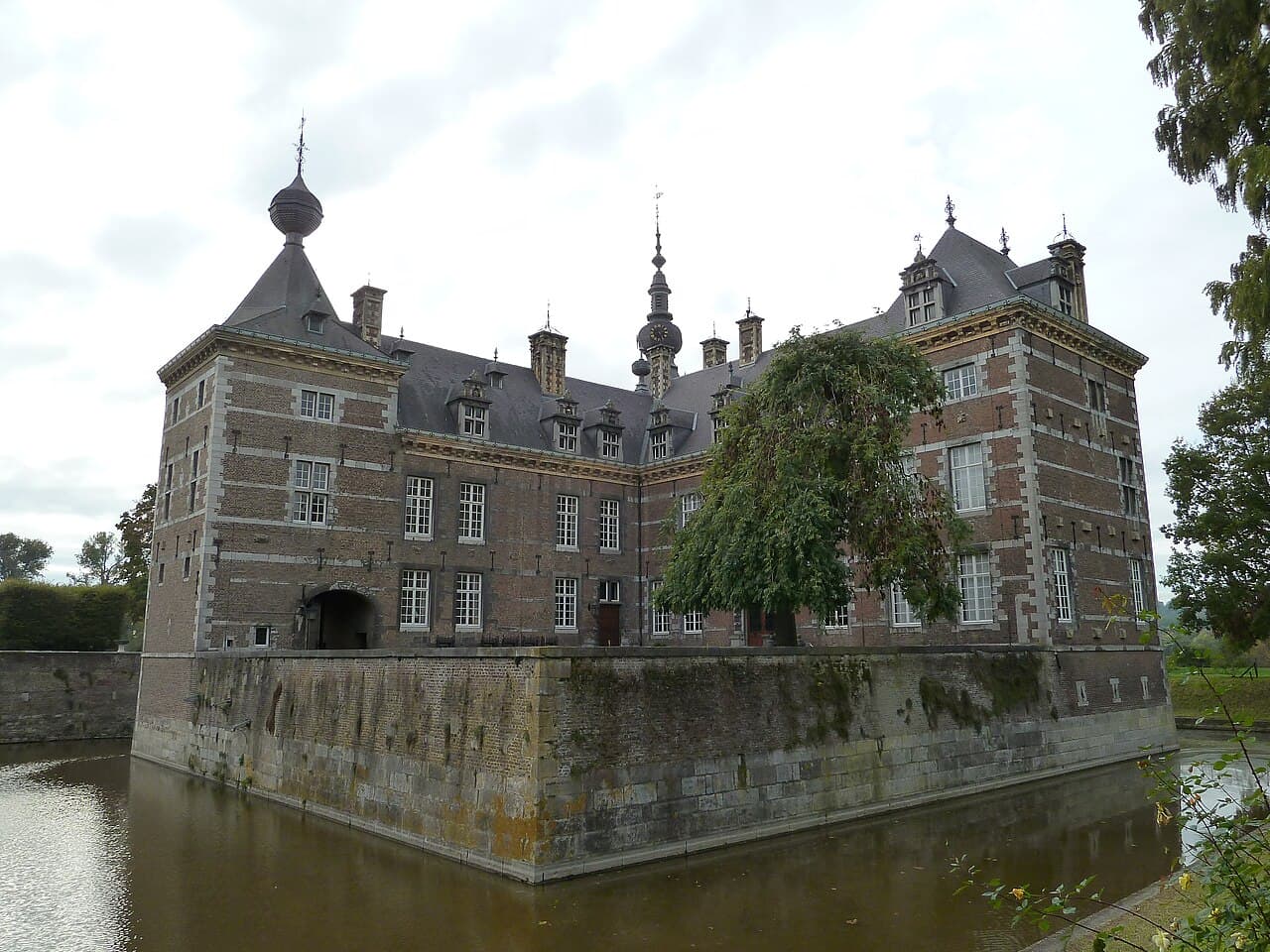
Eijsden Castle, locally known as Kasteel Eijsden, is a distinguished example of a moated manor house located in the village of Eijsden, in the Limburg province of the Netherlands. This historic estate stands as a remarkable representation of the Mosan Renaissance architectural style, characterized by its elegant use of alternating brick and stone bands and richly adorned facades. The castle's origins trace back to a medieval fortified farmstead, historically referred to as the Caestertburg or the Borg, though no physical remains of this earliest structure survive today.
The present castle was constructed in 1636 by Arnold de Lamargelle, replacing the earlier buildings with a sophisticated L-shaped layout that includes two angled wings connected by a heavy corner tower and a smaller stair tower. This design reflects the stylistic and defensive sensibilities of the period, combining both residential comfort and fortification. The castle is surrounded by a water-filled moat, enhancing its defensive character and classifying it as a water castle.
Historically, the site has been significant since at least the early Middle Ages, when the estate belonged to the powerful prince-bishops of Liège. The first recorded mention dates to 1334, when Duke John III of Brabant granted the estate, then known as "den hof tot Esde," to Dyederic van Montjoy en Valkenburg. Over the centuries, the property passed through several noble families, including the van Hoensbroeck, de Geloes, and currently the de Liedekerke family, who maintain ownership today.
Architectural features and design
Mosan renaissance style
The castle exemplifies the Mosan Renaissance style, notable for its distinctive "speklagen" technique—alternating horizontal bands of red brick and white Namur stone. This decorative masonry not only enhances the visual appeal but also emphasizes structural elements such as window frames and cornices, which are crafted from durable white stone. The use of these materials creates a striking contrast and highlights the castle's elegant proportions.
Layout and defensive elements
Eijsden Castle's L-shaped plan is anchored by a prominent heavy corner tower at the junction of the two wings, flanked by a slender stair tower. Both towers are capped with traditional helmet-shaped roofs topped by bulbous spires, a distinctive feature restored during the late 19th century renovations. The eastern wing concludes with a tower-like building housing the main gate, which grants access to the inner courtyard. Above this entrance is the date "1636" and the combined coats of arms of the De Lamargelle and von Bocholtz families, symbolizing their alliance.
Interior and renovations
The interior of the castle was enhanced significantly between 1767 and 1770 under architect Etienne Fayen from Liège. Ground-floor rooms feature exquisite Louis XV style stucco and wood paneling, including painted lintels above the dining room doors. The first floor was later updated with staircases and landings reflecting the Louis XVI style. Notably, the castle contains a mantelpiece originally from nearby Oost Castle, linking it to the regional noble heritage.
A major restoration from 1881 to 1886 introduced dormer windows to the roof, renewed the corner tower’s spire, and added the bulbous spire to the stair turret. The south facade was enhanced with blue stone cross windows, and the cornices were refreshed. The courtyard entrance was given a neo-Renaissance update, blending historical and 19th-century stylistic elements.
Historical significance and ownership
Early history and noble ownership
The castle's earliest known mention in 1334 places it under the control of the prince-bishops of Liège, a dominant religious and political force in the region during the Middle Ages. The estate was granted to Dyederic van Montjoy en Valkenburg by Duke John III of Brabant, marking the beginning of its noble lineage. In the mid-16th century, ownership passed to Arnold II Huyn van Amstenrade, a prominent lord and official who held multiple titles including governor of Maastricht and captain-general of Limburg.
Arnold II's daughter, Anna, married Willem de Lamargelle, and their son Arnold de Lamargelle built the current castle in 1636-1637. Through marriage and inheritance, the estate later passed to the van Hoensbroeck family, then the de Geloes family, and finally to the de Liedekerke family, who remain the current owners.
Military and political roles
Eijsden Castle played a notable role during military conflicts in the region. During the Franco-Dutch War (1672-1676), it served as the headquarters for William III of Orange while he coordinated the defense against French forces, including during the 1673 siege of Maastricht. Later, in 1748, the castle was used by French Marshal Count Ulrich Friedrich Waldemar von Löwenthal during the Battle of Lauffeld.
The castle’s strategic location near the Maas River and close to important towns made it a valuable military asset throughout its history.
Grounds, gardens, and park
The castle is surrounded by a moat, emphasizing its defensive origins. Adjacent to the main building is a gatehouse and forecourt constructed in 1649 after a fire destroyed earlier structures. These buildings feature helmet roofs with bulbous spires, consistent with the castle's architectural language.
The surrounding castle park was redesigned around 1900 by the renowned French landscape architect Achille Duchêne, replacing an earlier 18th-century garden. The current park features a neo-Rococo pond and a sculpture group of three putti, cherubic figures that add a playful classical touch to the landscape.
A small section of the original 18th-century garden remains on the north side of the castle, including an 18th-century ice cellar historically used for food storage before refrigeration. The southern terrace wall is adorned with garden ornaments salvaged from Oost Castle, including busts, vases, and a statue of the shepherd god Pan, linking the estate to classical mythology and regional heritage.
Preservation and current status
In 1952, the castle suffered a significant structural failure when the eastern facade of the gate tower collapsed into the moat. This was carefully rebuilt by 1958, preserving the historic character of the castle. The entire complex has undergone various restorations to maintain its architectural integrity, including major works in the late 19th century and mid-20th century.
Today, Eijsden Castle remains a private residence of the Belgian noble family De Liedekerke. While the castle itself is not generally open to the public, the bailey and gardens are freely accessible, and group visits to the interior can be arranged by appointment.
The castle stands as a testament to the rich cultural and architectural heritage of the Limburg region, combining elements of medieval fortification with Renaissance elegance and later historicist restorations. Its layered history, noble associations, and well-preserved grounds make it a significant landmark in Dutch heritage.
Frequently asked questions (FAQ)
- What is the historical significance of Eijsden Castle?
- Eijsden Castle, dating back to the 15th century, is a prime example of medieval architecture in the Netherlands. It has played a vital role in the region's history, serving both as a defensive structure and a residence for noble families.
- When was Eijsden Castle built?
- Eijsden Castle was originally constructed in the late 15th century, around 1465. Over the years, it has undergone several renovations, preserving its historical charm while adapting to modern needs.
- Can I visit Eijsden Castle?
- Yes, Eijsden Castle is open to visitors, allowing them to explore its beautiful grounds and learn about its rich history. Guided tours are available, providing insight into the castle's architecture and the stories of its past inhabitants.
- What are the opening hours for Eijsden Castle?
- Eijsden Castle is typically open to visitors from Tuesday to Sunday, with hours varying by season. It is recommended to check the official website for the most current opening times before planning your visit.
- Is Eijsden Castle accessible for people with disabilities?
- Yes, Eijsden Castle strives to be accessible to all visitors. While some areas may have limitations due to the castle's historical structure, staff are available to assist with accessibility needs.
- What is the best time to visit Eijsden Castle?
- The best time to visit Eijsden Castle is during the spring and summer months when the gardens are in full bloom and the weather is pleasant. Additionally, many events and activities take place during this period, enhancing the visitor experience.
- How much do tickets to Eijsden Castle cost?
- Ticket prices for Eijsden Castle are generally affordable, with discounts available for children, students, and seniors. It is advisable to purchase tickets in advance during peak tourist season to ensure availability.
- Are there any nearby attractions to Eijsden Castle?
- Yes, the area surrounding Eijsden Castle offers several attractions, including beautiful walking trails along the river and charming local shops. The nearby village of Eijsden also features quaint cafes and restaurants, perfect for a relaxing visit.

Information
Sources & official resources
Verify the information above using these authoritative references.
Loading map...
Visitor reviews
No reviews yet. Been here? Write the first review and help other travelers!
Write the first reviewVisited this castle? Share your experience
Your review helps other travelers and adds first-hand knowledge to our encyclopedia.