Fort Eben-Emael
Fort Eben-Emael is a significant example of 20th-century military architecture located near the village of Ében-Émael, between Liège and Maastricht on the Belgian-Dutch border. Constructed from 1931 to 1935, this bastioned fortress was designed to protect Belgium from a potential German invasion through the narrow Dutch corridor. It guarded the strategically vital Albert Canal, a critical defensive line in Belgium's fortification system.
Design and construction
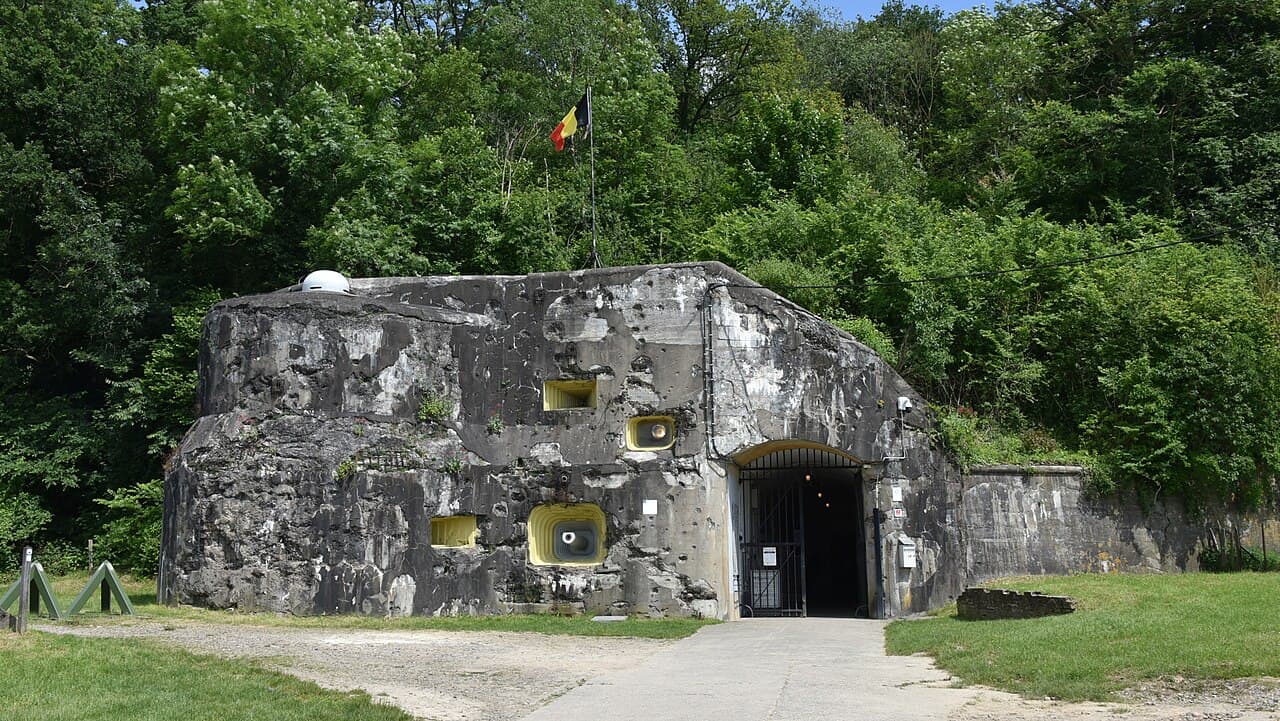
The fort was built using reinforced concrete and steel, incorporating the latest military engineering concepts of its time. It featured multiple underground galleries, artillery casemates, and armored gun turrets that were integrated into the natural landscape, making it difficult to detect and target. The design emphasized defense in depth with interconnected tunnels allowing movement of troops and supplies protected from enemy fire.
Its bastioned layout allowed for overlapping fields of fire from heavy artillery pieces, including 75 mm guns and 120 mm howitzers. The fort's walls and ceilings were constructed to withstand direct hits from contemporary artillery shells, reflecting advancements in fortress design following experiences from World War I.
Strategic importance and military role
Fort Eben-Emael was part of Belgium's effort to modernize its defenses in the interwar period, replacing older fortifications like those at Liège and Namur. It was reputed to be one of the most formidable fortresses in the world at the time of its completion, intended to delay or prevent a German advance into Belgium.
Its location near the border allowed it to control key transportation routes and the Albert Canal crossings. The fort was equipped with state-of-the-art observation posts and communication systems to coordinate with other Belgian defensive positions.
The 1940 airborne assault
Despite its formidable design, Fort Eben-Emael was neutralized in a daring operation by German forces on 10–11 May 1940. In the first large-scale strategic airborne assault in military history, a small force of approximately 85 German paratroopers and glider troops landed on the fort using gliders. They exploited the fort's vulnerabilities by disabling key artillery positions and communication lines before the Belgian garrison could mount an effective defense.
This operation allowed German ground forces to advance rapidly into Belgium, bypassing the fort's defenses. The assault demonstrated the evolving nature of warfare, where airborne troops could overcome even the most heavily fortified positions.
Post-war status and preservation
After World War II, Fort Eben-Emael remained under Belgian military control but was eventually decommissioned as a defensive position. Recognizing its historical and architectural significance, the fort has been preserved as a museum open to the public. Visitors can explore its underground galleries, artillery positions, and learn about its role in the early stages of World War II.
The museum provides educational exhibits on the fort's construction, the 1940 assault, and Belgium's military history. Its preservation offers a unique insight into interwar fortress design and the transition to modern warfare tactics.
Architectural features and innovations
Fort Eben-Emael incorporated several innovative features for its time, including a complex system of underground tunnels spanning several kilometers, which housed living quarters, ammunition storage, and command centers. The use of armored cupolas for artillery and observation allowed the fort to maintain a low profile while providing effective firepower.
The fort's design reflected lessons learned from World War I, emphasizing protection against aerial bombardment and artillery shelling. Its reinforced concrete structures and strategic placement on elevated terrain contributed to its reputation as an impregnable fortress before 1940.
Visiting Fort Eben-Emael today
Today, Fort Eben-Emael serves as a museum and historical site. It offers guided tours that take visitors through the extensive underground networks and explain the fort's construction, armament, and the dramatic events of the 1940 assault. The site is accessible to visitors interested in military history, fortress architecture, and World War II studies.
Visitors should check the official website or contact the museum for current opening hours and ticket prices. The site provides an educational experience highlighting Belgium's military heritage and the evolution of fortress design in the 20th century.
Frequently asked questions (FAQ)
- What is the historical significance of Fort Eben-Emael?
- Fort Eben-Emael was a key Belgian fortress designed to defend against German invasion and was the site of the first strategic airborne assault in history during World War II.
- Can I visit Fort Eben-Emael today?
- Yes, Fort Eben-Emael is preserved as a museum open to the public, offering guided tours of its underground galleries and fortifications.
- When was Fort Eben-Emael constructed?
- The fort was constructed between 1931 and 1935 as part of Belgium's interwar defensive strategy.
- What type of fortress is Fort Eben-Emael?
- Fort Eben-Emael is a bastioned fortress, featuring reinforced concrete and armored gun turrets designed for heavy artillery defense.
- How did German forces capture Fort Eben-Emael in 1940?
- German paratroopers and glider troops conducted a surprise airborne assault on 10–11 May 1940, disabling key defenses and allowing rapid German ground invasion.
Photo gallery

Information
Current owner
Belgian Army
Loading map...
Visitor reviews
No reviews yet. Been here? Write the first review and help other travelers!
Write the first reviewVisited this castle? Share your experience
Your review helps other travelers and adds first-hand knowledge to our encyclopedia.