Ehrenfels Castle Ruins
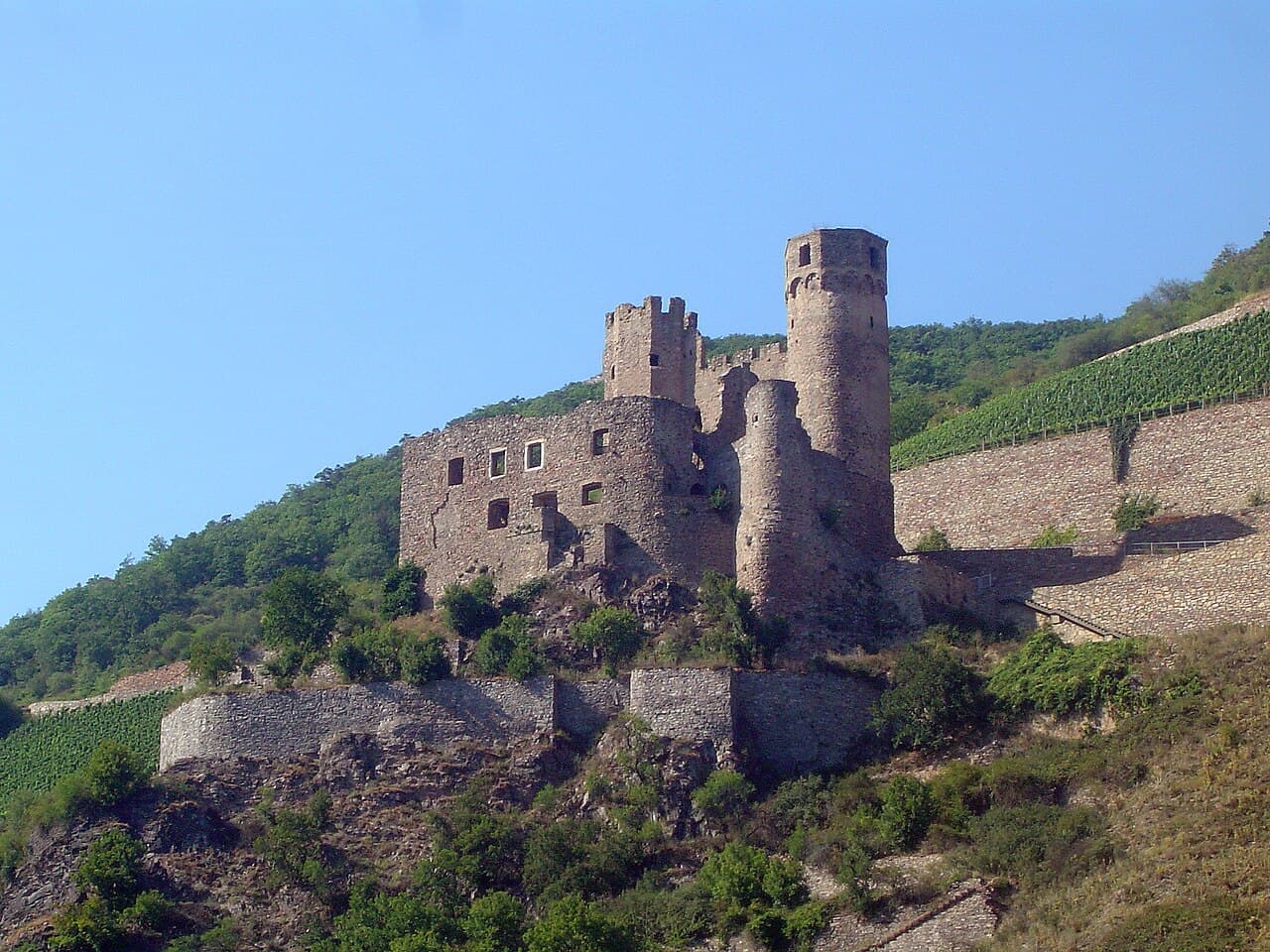
Ehrenfels Castle is a significant high medieval hillside castle ruin perched above the Rhine Gorge near Rüdesheim am Rhein in Hesse, Germany. Constructed around 1212 at the behest of the Archbishop of Mainz, it served as a strategic defensive fortress against the ambitions of Elector Palatine Henry V, who sought to diminish the archbishop's influence in the region. The castle's location on the steep eastern bank of the Rhine River amidst extensive vineyards allowed it to control river traffic and collect customs duties, bolstered by the nearby Mouse Tower situated below at the river's edge.
Historical context and strategic importance
The castle was part of Mainz's efforts to assert dominance over the Rhine trade routes and protect its territorial interests during the turbulent High Medieval period. Staffed by Burgmannen—castle knights or armed retainers—the fortress was a key customs post, monitoring the vital shipping lanes on the Rhine. Its construction reflects the typical medieval hillside castle design, optimized for surveillance and defense.
Architectural features and layout
Ehrenfels Castle was built as a hill castle with natural steep slopes enhancing its defenses. The ruins today reveal remnants of thick defensive curtain walls and towers that once guarded the approaches. The castle complex included a keep, residential quarters, and storage facilities necessary for sustaining a garrison and managing customs operations. Its position overlooking the river allowed for control of both land and water routes.
Relationship with the Mouse Tower
The Mouse Tower (Mäuseturm), located downstream, served as an auxiliary watchtower and customs enforcement point complementing Ehrenfels Castle's control over river traffic. Together, these structures formed a defensive network securing the Rhine corridor.
Destruction and decline
The castle suffered heavy damage during the Thirty Years' War (1618–1648), a devastating conflict that ravaged much of central Europe. Its strategic importance made it a target for opposing forces. Ultimately, Ehrenfels was devastated during the 1689 Siege of Mainz by French troops under Lieutenant General Nicolas Chalon du Blé. The siege led to the castle's ruinous state, from which it has never fully recovered.
Present condition and access
Today, Ehrenfels Castle remains a ruined archaeological site characterized by partially standing walls and scattered masonry. The site is accessible via a hiking trail through the surrounding vineyards from Rüdesheim, offering scenic views of the Rhine Valley. Visitors can explore the exterior ruins freely; however, the interior is only accessible through guided tours by prior appointment, preserving the fragile remains and enhancing visitor understanding of the site's history.
Legacy and cultural significance
The castle's name lives on in the local Ehrenfelser grape variety, linking the region's viticultural heritage to its medieval past. Ehrenfels Castle stands as a testament to the complex feudal and territorial struggles along the Rhine and remains an evocative landmark reflecting the region's rich history and architectural heritage.
Frequently asked questions (FAQ)
- How do I reach Ehrenfels Castle ruins from Rüdesheim am Rhein?
- You can reach Ehrenfels Castle ruins by hiking through the vineyards from Rüdesheim am Rhein. The trail is well-marked and offers scenic views of the Rhine Gorge.
- Can I visit the interior of Ehrenfels Castle ruins?
- The interior of Ehrenfels Castle ruins is accessible only by guided tours, which require prior appointment to preserve the fragile site.
- What is the historical significance of Ehrenfels Castle?
- Ehrenfels Castle was a key medieval customs post and defensive fortress built in 1212 to control Rhine river traffic and assert Mainz's territorial influence.
- Why was Ehrenfels Castle destroyed?
- The castle was heavily damaged during the Thirty Years' War and finally devastated by French troops in the 1689 Siege of Mainz, leading to its ruinous state.
- Is there a connection between Ehrenfels Castle and local vineyards?
- Yes, Ehrenfels Castle is located amidst extensive vineyards, and the Ehrenfelser grape variety is named after the castle, reflecting its cultural link to regional wine production.
Photo gallery

Photo by Steffen 962•Public domain
Information
Loading map...
Visitor reviews
No reviews yet. Been here? Write the first review and help other travelers!
Write the first reviewVisited this castle? Share your experience
Your review helps other travelers and adds first-hand knowledge to our encyclopedia.