Boosenburg Castle Ruins
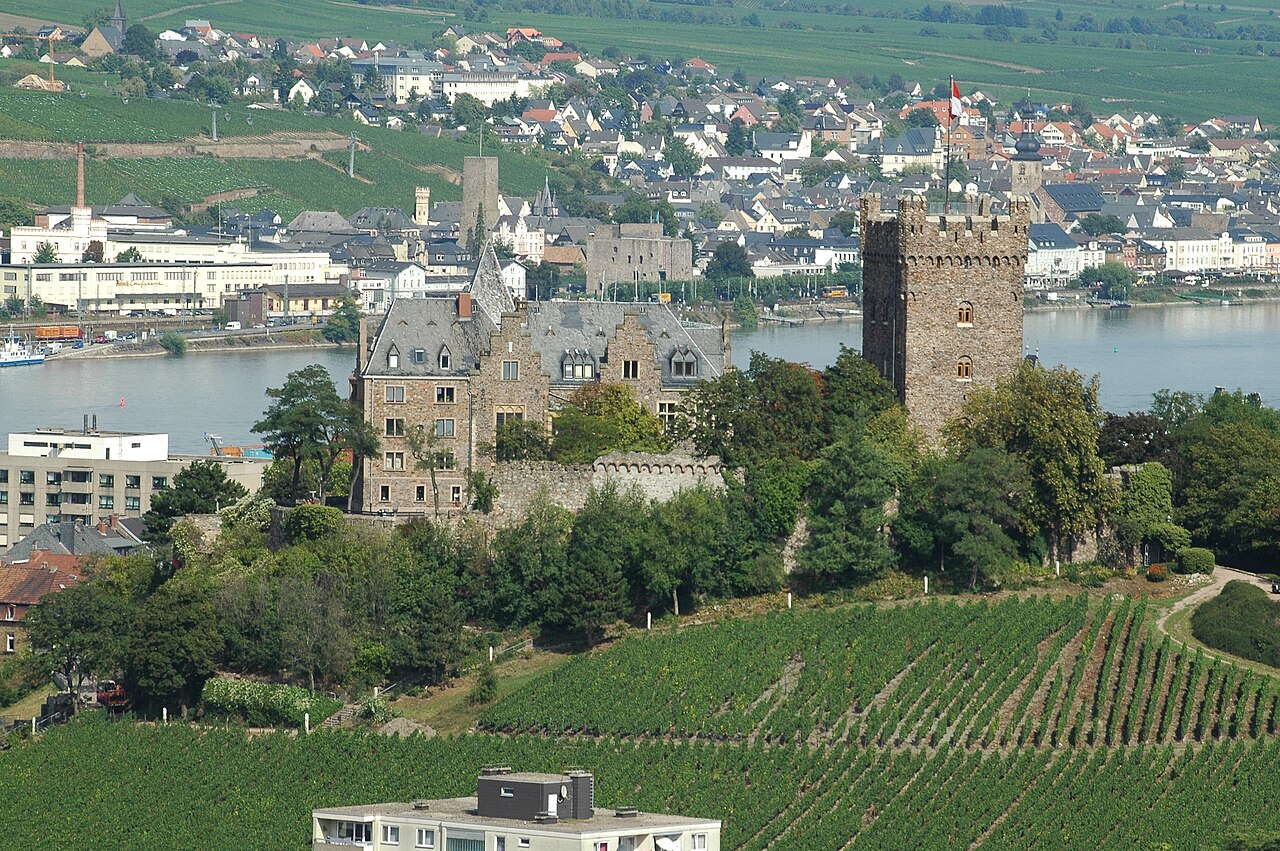
Boosenburg Castle Ruins stand as a remarkable testament to medieval fortifications nestled in Rüdesheim am Rhein, Germany. This hill castle originated in the 12th century and was established by the knightly class, notably by Fuchs von Rüdesheim, reflecting the feudal power structures of the High Medieval period. Boosenburg's enduring bergfried (main tower) remains the focal point of the site, surrounded historically by a formidable ring wall and a nine-meter-wide moat that provided robust defense against invaders.
Medieval origins and architectural features
The castle's original layout centered on a nearly square main building with the bergfried positioned prominently near the entrance, a strategic design common in medieval fortifications. The castle's walls were thick and sturdy, intended to withstand sieges, with the moat acting as a significant deterrent to attackers. Access was controlled via a single entrance reached by a drawbridge over the moat, emphasizing security and defense.
Over the centuries, additional residential and functional buildings were constructed within the castle's fortified perimeter, adapting to the evolving needs of its inhabitants. The bergfried itself, initially a defensive stronghold and symbol of lordly power, was later heightened in the 19th century to enhance its imposing silhouette.
Ownership history and transformations
Boosenburg changed hands multiple times, beginning with the founding knight Fuchs von Rüdesheim. In 1407, it passed to the noble Brömser von Rüdesheim family, and subsequently to the Boos von Waldeck family in 1474, who maintained ownership for over three centuries. The castle was acquired by the counts of Schönborn-Wiesntheid in 1830, who undertook significant renovations between 1836 and 1838, dismantling all buildings except the bergfried.
These renovations included raising the bergfried and adorning it with Gothic Revival battlements and decorative elements inspired by medieval architecture, reflecting the 19th-century romanticism movement's fascination with the Middle Ages. This transformation shifted the castle's character from a purely defensive fortress to a symbol of historical nostalgia and aesthetic appreciation.
19th-century adaptations and cultural significance
After 1860, the castle was purchased by Baptist Sturm, a prominent wine merchant who innovatively converted the castle's moat into a vaulted cellar for wine storage, integrating the region's viticultural heritage with the castle's historic fabric. Following Sturm's death, his widow commissioned a nearby Gothic Revival villa in 1872, designed by architect Franz Schädel, which complemented the castle's romantic medieval ambiance.
Since 1938, Boosenburg has been owned by the Carl Jung family, renowned for their winery business. The castle serves not only as a private residence but also as a cultural venue hosting chamber music and jazz concerts, enriching the local cultural landscape. Its designation as part of the UNESCO World Heritage Site of the Upper Middle Rhine Valley in 2002 underscores its historical and architectural importance.
Remaining structures and present condition
The primary surviving feature of Boosenburg is the bergfried, which dominates the site with its height and medieval character enhanced by 19th-century Gothic Revival modifications. Although the other original buildings were dismantled in the 19th century, the castle's layout and defensive elements such as the moat and ring wall remain evident in the ruins.
The vaulted cellar beneath the former moat is a unique adaptation linking the castle's medieval past with the region's longstanding wine culture. The adjacent Gothic Revival villa adds to the site's picturesque setting, while the castle's proximity to the Brömserburg Castle ruins creates a historic ensemble overlooking the Rhine valley and vineyards, offering visitors a tangible connection to the region's medieval and cultural heritage.
Boosenburg in the context of rhine valley castles
Boosenburg exemplifies the typical evolution of a High Medieval hill castle in the Rhine Valley, transitioning from a feudal stronghold to a romanticized historic monument. Its architectural features, including the bergfried and defensive moat, reflect the military and residential needs of the medieval nobility. The 19th-century Gothic Revival renovations align with broader European trends that sought to preserve and celebrate medieval heritage through architectural restoration and stylistic embellishment.
Situated near the Rhine River, Boosenburg and its neighboring castles like Brömserburg illustrate the strategic importance of this region for controlling trade routes and asserting noble authority. The castle's integration into the UNESCO World Heritage Site highlights its value as part of the rich cultural landscape that defines the Upper Middle Rhine Valley.
Visitor information and cultural events
Today, Boosenburg remains a private residence but also hosts cultural events that engage the public, such as chamber music and jazz concerts. Its scenic location amidst vineyards and the Rhine River makes it a point of interest for visitors exploring the medieval castles and wine culture of the region. While the castle itself is not fully accessible to the public, its exterior and surrounding landscape offer picturesque views and historical ambiance.
Frequently asked questions (FAQ)
- How do I visit Boosenburg Castle Ruins?
- Boosenburg Castle Ruins are privately owned and not generally open for public tours. Visitors can view the castle exterior and surrounding grounds from nearby public paths. Cultural events hosted occasionally may offer limited access.
- What is the historical significance of Boosenburg Castle?
- Boosenburg Castle is a significant example of a 12th-century hill castle in the Rhine Valley, illustrating medieval defensive architecture and noble residence evolution. Its later Gothic Revival renovations reflect 19th-century romanticism.
- When was Boosenburg Castle built and by whom?
- Boosenburg Castle was built in the 12th century by the knight Fuchs von Rüdesheim, representing the Germanic knightly class's presence in the region during the High Middle Ages.
- Can I attend events at Boosenburg Castle?
- The castle is occasionally used as a venue for chamber music and jazz concerts organized by the owning Carl Jung family. Check local event listings for schedules and ticket information.
- Why is the bergfried important at Boosenburg Castle?
- The bergfried is the main tower and key defensive structure of Boosenburg Castle, originally built in the 12th century and later heightened in the 19th century. It symbolizes medieval power and offers commanding views of the Rhine valley.
Photo gallery

Information
Sources & official resources
Verify the information above using these authoritative references.
Loading map...
Visitor reviews
No reviews yet. Been here? Write the first review and help other travelers!
Write the first reviewVisited this castle? Share your experience
Your review helps other travelers and adds first-hand knowledge to our encyclopedia.