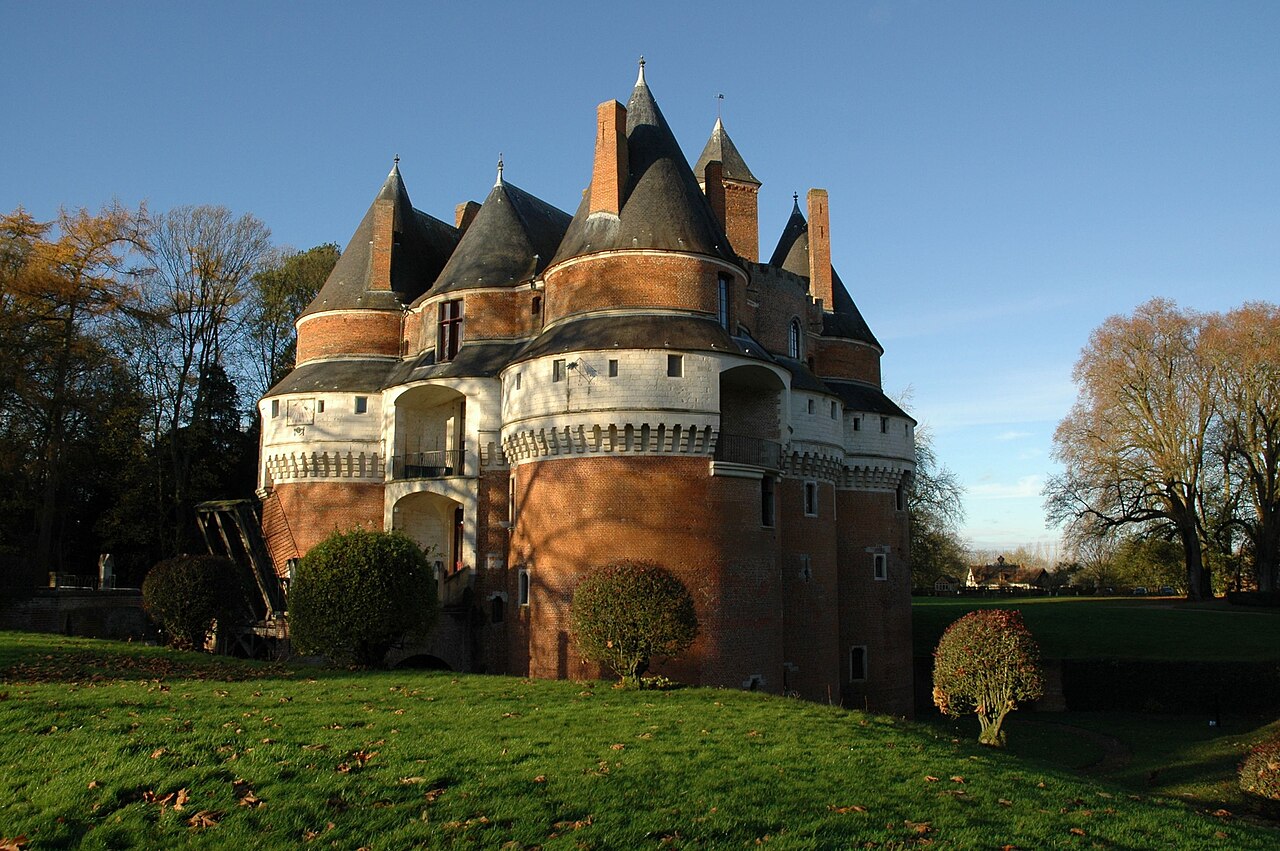
Eaucourt Castle
Eaucourt Castle, also known as Château d'Eaucourt, is a significant medieval fortress located near the village of Eaucourt-sur-Somme in the Hauts-de-France region of northern France. Built during the 12th or 13th century, this hill castle stands on the right bank of the Somme River, a strategic position chosen to control access and defend the territory. The castle's origins are closely tied to the reign of King Philip II of France, who ordered the fortification of towns to consolidate control over newly acquired lands during the High Medieval period.
Historical significance and military role
The castle was initially constructed by the Lords of Ferté as part of a defensive network designed to protect the region from English incursions during the turbulent years of the Hundred Years' War. Eaucourt Castle notably resisted a siege by English troops prior to the Battle of Crécy in 1346, underscoring its military importance. However, in 1358, the castle was deliberately destroyed by the militia of Abbeville to prevent its capture by the English forces. This strategic demolition reflects the castle's critical role in regional power struggles.
Following its destruction, the castle was rebuilt by Simon of Boulainvilliers, but it faced further conflict in 1421 when it was burned down by the troops of the Duke of Burgundy. After the Treaty of Arras in 1435, restoration efforts were led by Jean d'Eaucourt, marking a period of recovery and noble habitation. Despite these efforts, the castle continued to experience violence, including pillaging by mercenaries under Captain Pierre Regnault de Vignoles in 1440.
Ownership of the castle passed through several noble families, including the Soyecourt and Belleforière families. During the French Wars of Religion in the late 16th century, the castle was seized by forces from Abbeville opposing King Henry IV, illustrating its ongoing strategic and symbolic importance. By the late 18th century, the castle was used as a residence for the last time before falling into ruin.
Architectural features and defensive structures
Eaucourt Castle was built as a rectangular enclosure on a small motte measuring approximately 55 by 40 meters, surrounded by a protective moat. The defensive walls were constructed from chalk rubble bound with lime mortar and clay, resting on foundations of silex. These walls stood between 6 and 7 meters high and varied in thickness from 1.5 to 3 meters, providing formidable protection against attackers.
The main entrance featured a fortified gatehouse or châtelet, which served both as an access point and a small keep (donjon). This gatehouse was equipped with machicolations, allowing defenders to drop projectiles on assailants below, and was flanked by two round towers guarding the drawbridge. A smaller watchtower with a spiral staircase was located behind the gatehouse, enhancing the castle's layered defense system.
The interior of the gatehouse included a vaulted guard room with ribbed cross vaults supported by secondary pointed arches, exemplifying the Gothic architectural style prevalent during the castle's prime. A semicircular arch doorway led towards the Baye River, above which a decorative panel displayed a hammered coat of arms flanked by mythical figures, symbolizing strength and protection.
Historical accounts describe the donjon as a separate square tower surrounded by three round towers with pointed roofs and machicolations similar to those at the nearby Château de Rambures. The castle's roofing was made of flat terracotta tiles, and battlements with crenellations crowned the defensive walls, contributing to its imposing silhouette.
Archaeological findings and current condition
Today, Eaucourt Castle survives primarily as a ruin, with the gatehouse and some wall foundations still visible. Archaeological surveys conducted in 2015 uncovered the remains of a polygonal tower and the lordly residence opposite the entrance, shedding light on the castle's layout and domestic spaces. These findings confirm the castle's dual role as both a military fortress and a noble residence.
The castle's peaceful rural surroundings contrast with its turbulent history, and recent efforts have removed boarding from the gatehouse, allowing for public access. The site is now used for medieval re-enactments, enhancing its cultural and educational value.
The castle in the context of medieval fortifications
Eaucourt Castle is a representative example of a high medieval hill castle designed for both defense and habitation. Its strategic location on the Somme River and robust fortifications reflect the military architecture of the period, characterized by thick stone walls, moats, and fortified gatehouses. The castle's history of destruction and reconstruction illustrates the shifting political and military landscape of medieval northern France.
Its architectural features, such as the machicolated gatehouse and rib-vaulted guard room, demonstrate the evolution of castle defenses and Gothic design elements during the 13th and 14th centuries. The castle's gradual decline and eventual abandonment in the 18th century mirror broader trends in the obsolescence of medieval fortifications with the advent of new military technologies and changing political realities.
Frequently asked questions (FAQ)
- What is the historical significance of Eaucourt Castle?
- Eaucourt Castle has a rich history that dates back to the medieval period, serving as a strategic stronghold in the region. Its architecture reflects the feudal era, and it has witnessed numerous historical events that shaped the local culture and heritage.
- When was Eaucourt Castle built?
- Eaucourt Castle was originally constructed in the 12th century, making it one of the enduring monuments of French history. Over the centuries, it has undergone various renovations and restorations, preserving its historical essence while adapting to modern times.
- Can I visit Eaucourt Castle?
- Yes, Eaucourt Castle is open to visitors throughout the year, allowing you to explore its stunning architecture and grounds. Guided tours are available, providing insights into the castle's history and significance.
- What are the opening hours for Eaucourt Castle?
- Eaucourt Castle is typically open from 10 AM to 6 PM, with extended hours during the summer months. It is advisable to check the official website or contact the castle directly for any seasonal changes or special events.
- Is it possible to access Eaucourt Castle with a wheelchair?
- Eaucourt Castle strives to be accessible to all visitors, with certain areas accommodating wheelchairs. However, due to the historic nature of the site, some parts may have limited accessibility, so it’s best to inquire ahead of your visit.
- What is the best time to visit Eaucourt Castle?
- The best time to visit Eaucourt Castle is during the spring and early autumn when the weather is pleasant and the gardens are in full bloom. Additionally, visiting during weekdays can help you avoid larger crowds.
- What are the ticket prices for Eaucourt Castle?
- Ticket prices for Eaucourt Castle are generally affordable, with discounts available for students and seniors. Family packages may also be offered, making it a great option for a day out.
- Are there any nearby attractions to Eaucourt Castle?
- Yes, there are several attractions near Eaucourt Castle, including beautiful parks and historical sites that showcase the region's rich heritage. Local museums and charming villages also offer additional experiences for visitors.
Information
Sources & official resources
Verify the information above using these authoritative references.
Loading map...
Visitor reviews
No reviews yet. Been here? Write the first review and help other travelers!
Write the first reviewVisited this castle? Share your experience
Your review helps other travelers and adds first-hand knowledge to our encyclopedia.