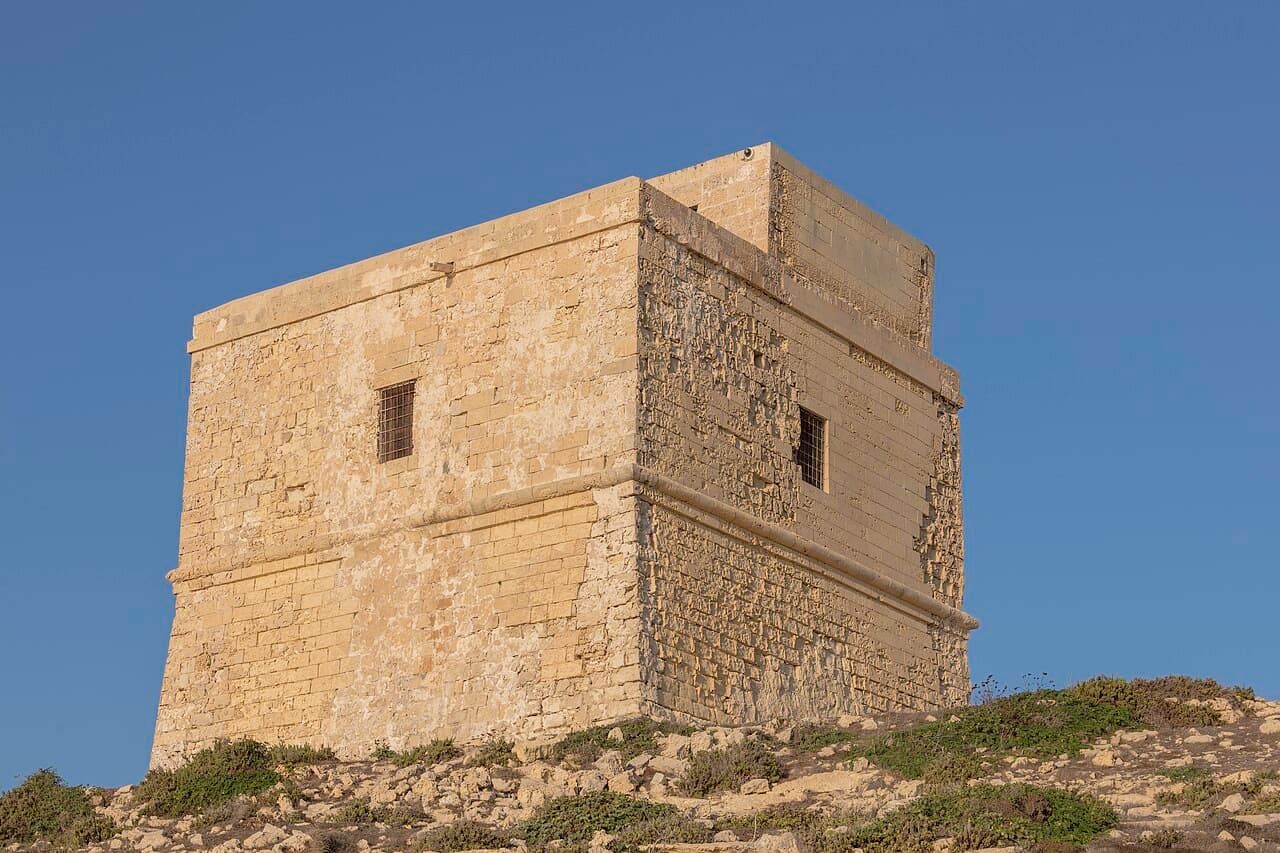
Dwejra Tower (Maltese: Torri tad-Dwejra) is a notable 17th-century coastal watchtower located in Dwejra Bay, San Lawrenz on the island of Gozo, Malta. Completed in 1652, it forms part of the network known as the Lascaris towers, a series of fortifications built during the Renaissance period under the rule of the Knights of St. John. These towers were strategically constructed to provide early warning and defense against Ottoman and Barbary corsair attacks along the Maltese coastline.
Historical context and strategic importance
The construction of Dwejra Tower was commissioned by the Order of Saint John as part of a broader coastal defense system. The tower's placement at Dwejra Bay was critical for monitoring maritime activity and protecting the western coast of Gozo, an island vulnerable to pirate raids and invasions during the 17th century. The tower served as an observation post, relaying signals to neighboring towers and fortifications to alert the island's defenders of approaching threats.
Alongside other surviving towers on Gozo, including Xlendi Tower, Mġarr ix-Xini Tower, and Isopu Tower, Dwejra Tower formed a network that enhanced the island's defensive capabilities. This network was part of the larger system of Lascaris towers built across Malta and Gozo during the mid-1600s, named after Grand Master Giovanni Paolo Lascaris who initiated their construction.
Architectural features and design
Dwejra Tower exemplifies the Renaissance military architecture typical of coastal watchtowers of its era. The tower is a compact, square structure built from local limestone, featuring thick walls designed to withstand cannon fire and attacks. Its elevated position on the rocky coastline provided extensive views of the surrounding sea, enabling early detection of enemy vessels.
The tower includes a single entrance elevated above ground level, accessible originally by a retractable ladder, which enhanced its defensibility. The roof was equipped with a parapet and machicolations to allow defenders to fire upon attackers below. Inside, the tower contained a small garrison room and storage space for ammunition and supplies.
The design reflects the practical requirements of a coastal watchtower rather than a large fortress, focusing on surveillance and communication rather than prolonged defense.
Preservation and current status
Today, Dwejra Tower is well preserved and maintained as a cultural heritage site. It remains one of the four surviving coastal watchtowers on Gozo, retaining much of its original structure and defensive features. The tower is open to the public, offering visitors insight into Malta's maritime defense history and Renaissance military architecture.
Its location within the scenic Dwejra Bay area, known for natural landmarks such as the now-collapsed Azure Window, adds to its appeal for tourists and history enthusiasts alike. The tower is managed to facilitate educational visits and cultural tourism, contributing to the preservation of Malta's rich historical landscape.
Role within the Lascaris towers network
The Lascaris towers were a strategic innovation by the Knights of St. John to safeguard Malta and Gozo during a period of frequent maritime conflict. Dwejra Tower functioned as a critical link in this chain, communicating via smoke signals or fire beacons with adjacent towers to warn of enemy approach.
This system allowed rapid mobilization of local militias and the Order's forces, significantly enhancing the islands' defensive readiness. The tower's modest size and specialized function illustrate the tactical approach of the Knights, emphasizing early warning and coordination over heavy fortification at every point.
Visiting information and significance
Visitors to Dwejra Tower can explore its compact interior and climb to the rooftop parapet, where panoramic views of the Mediterranean coastline are available. The tower's accessibility and preserved state make it an important educational site for understanding Malta's coastal defense strategies during the Renaissance.
Its proximity to other historical sites and natural attractions on Gozo makes it a key stop for cultural tourism. The tower's enduring presence highlights the island's historical vulnerability and the ingenuity of its defenders during a turbulent era in Mediterranean history.
Frequently asked questions (FAQ)
- What is the historical significance of Dwejra Tower?
- Dwejra Tower, built in the early 17th century, served as a watchtower to protect the coastline of Malta from pirates and enemy invasions. Its strategic location allowed for the monitoring of shipping routes and the surrounding waters, making it a key part of Malta's defense system during its time.
- When was Dwejra Tower constructed?
- Dwejra Tower was constructed in 1653 under the orders of the Knights of St. John. It was part of a larger network of coastal defenses that the Knights established to safeguard the islands against potential threats.
- Can I visit Dwejra Tower?
- Yes, visitors can explore Dwejra Tower and enjoy the stunning views of the surrounding landscape and coastline. The site is accessible to the public, making it a popular spot for tourists and history enthusiasts alike.
- What are the opening hours for Dwejra Tower?
- Dwejra Tower is generally open to visitors from morning until sunset, though specific hours may vary by season. It is advisable to check the local tourism website for the most current opening times before planning your visit.
- Is there an entrance fee to visit Dwejra Tower?
- There is no entrance fee to visit Dwejra Tower, allowing visitors to enjoy the historical site free of charge. However, donations for the maintenance and preservation of the tower are appreciated.
- What is the best time to visit Dwejra Tower?
- The best time to visit Dwejra Tower is during the spring and fall when the weather is mild and pleasant. These seasons offer the best conditions for exploring the tower and enjoying the breathtaking views without the summer crowds.
- Are there any nearby attractions to Dwejra Tower?
- Yes, nearby attractions include the Azure Window, a stunning natural rock formation, and the Inland Sea, a picturesque lagoon perfect for swimming and boat trips. Both sites enhance your visit to Dwejra Tower and provide additional opportunities for exploration and enjoyment.
- How do I get to Dwejra Tower?
- Dwejra Tower can be reached by car or public transport from major towns in Malta, with signage directing visitors to the site. Parking is available nearby, making it convenient for those traveling by car.
- Is Dwejra Tower accessible for people with disabilities?
- Dwejra Tower has limited accessibility for individuals with mobility challenges due to its location and terrain. Visitors are encouraged to check with local authorities for any available assistance or facilities tailored to enhance their experience.
Photo gallery

Information
Loading map...
Visitor reviews
No reviews yet. Been here? Write the first review and help other travelers!
Write the first reviewVisited this castle? Share your experience
Your review helps other travelers and adds first-hand knowledge to our encyclopedia.