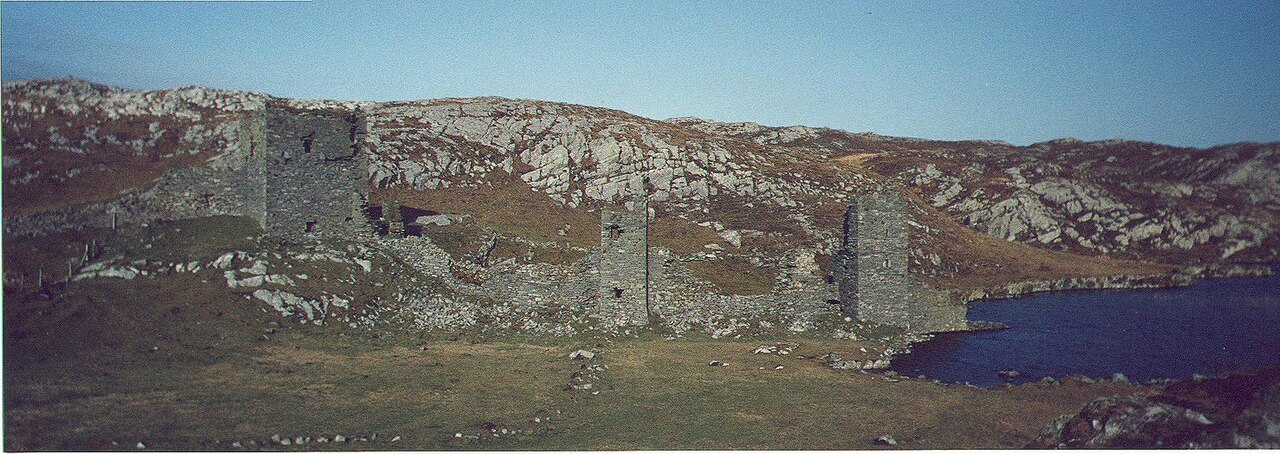
Dunlough Castle
Dunlough Castle, also known as Three Castles Head, stands as a remarkable example of medieval fortification on the Mizen Peninsula in southwestern Ireland. This hill castle is perched atop a narrow rocky promontory, commanding dramatic views over the Atlantic Ocean and showcasing a unique blend of Norman and early Irish defensive architecture. Founded in 1207 by Donagh O’Mahony, the castle represents the enduring legacy of the O’Mahony clan, one of the prominent Gaelic families in County Cork during the late medieval period.
Historical context and origins
The origins of Dunlough Castle are deeply intertwined with the turbulent history of medieval Ireland, marked by the clash between native Gaelic clans and the advancing Norman invaders. The O’Mahony clan, descendants of the ancient Eóganacht Raithlind dynasty, initially controlled a vast territory stretching from Cork City to the western reaches of the Mizen Peninsula. However, their power waned significantly following the arrival of the Normans in the late 12th century, particularly after King Henry II granted the kingdom of Cork to Cambro-Norman knights Robert Fitz-Stephen and Milo de Cogan in 1177.
Faced with this encroachment, the O’Mahonys retreated to the remote and defensible headlands of the Mizen Peninsula, where Donagh O’Mahony constructed Dunlough Castle as a fortified residence and clan stronghold. The castle’s strategic placement on a narrow isthmus between steep cliffs and a dammed lake provided formidable natural defenses, complemented by man-made fortifications.
Architectural features and layout
Dunlough Castle is distinguished by its unusual layout comprising three large rectangular towers connected by a defensive curtain wall spanning approximately 30 meters. Each tower rises to three stories, constructed primarily with dry stone masonry, a technique reflecting earlier Irish building traditions rather than the mortar-bound Norman style. This method has contributed to the castle’s current partially preserved state, with some walls remaining robust while others have succumbed to centuries of weathering.
The three towers
- The eastern tower functioned as the gatehouse, controlling access across the isthmus. Though much of its original gateway has been lost, remnants of a spiral staircase within the tower hint at the defensive sophistication of the design.
- The central tower served as a lookout and storage facility, reinforcing the connecting wall and providing strategic vantage points over the surrounding landscape.
- The western tower, the largest of the three, housed the primary living quarters for the clan. Notably, it features a distinctive second-floor doorway accessible by a removable ladder, a security measure common in O’Mahony castles to prevent unwanted entry.
Defensive elements and natural barriers
The castle’s location on a narrow headland between cliffs rising approximately 120 meters and a dammed lake known as Dun Lough created a formidable natural defense. The curtain wall connecting the towers effectively sealed off the isthmus, making any assault extremely difficult. The lake and cliffs combined to form a near-impenetrable barrier on three sides, with the castle’s entrance being the only vulnerable point, heavily fortified by the gatehouse.
Historical significance and ownership
For over four centuries, Dunlough Castle remained under the control of the O’Mahony clan, serving as their ancestral seat and a symbol of their resilience amid the shifting political landscape of medieval Ireland. The castle witnessed the gradual decline of Gaelic power in the region as Norman and later English influences expanded.
In 1627, the castle was seized by the British crown during the consolidation of English authority in Ireland. It was subsequently leased to various parties, including the Coughlans and the Earl of Cork. Folklore from this period tells of a lawless sept of the O’Donoghues inhabiting the castle, whose tragic fate is shrouded in legend involving mysterious deaths and ghostly apparitions, including the famous White Lady said to haunt the nearby lake.
Access and current condition
Today, Dunlough Castle stands as a partially preserved ruin, accessible to visitors willing to undertake a hike of approximately 30 minutes along ill-defined paths crossing private farmland. The site’s remote and rugged setting contributes to its allure, offering a glimpse into Ireland’s medieval past amid stunning natural scenery.
Visitors should be mindful of roaming sheep on the paths and prepared for uneven terrain. The castle’s ruins provide a tangible connection to the early Norman period in Ireland and the enduring legacy of the O’Mahony clan.
Legend and cultural heritage
Dunlough Castle is steeped in local folklore, enhancing its cultural significance beyond its architectural and historical importance. The tales of the White Lady and the ill-fated O’Donoghue sept add a layer of mystique, attracting visitors interested in both history and legend.
The castle’s integration into a prehistoric promontory fort also highlights the long-standing strategic value of this location, linking Ireland’s ancient past with its medieval heritage.
Frequently asked questions (FAQ)
- How do I reach Dunlough Castle?
- Dunlough Castle is accessible via a 30-minute hike along ill-defined paths crossing private farmland on the Mizen Peninsula. Visitors should wear sturdy footwear and be prepared for uneven terrain.
- What is the historical significance of Dunlough Castle?
- Dunlough Castle was built in 1207 by the O’Mahony clan and served as their ancestral seat for over four centuries, reflecting the Gaelic resilience against Norman and English expansion in Ireland.
- Can I visit Dunlough Castle for free?
- Yes, Dunlough Castle is freely accessible to the public. There is no entrance fee, but visitors should be mindful of private land and roaming sheep on the approach paths.
- Is Dunlough Castle suitable for families and children?
- Due to the remote location and uneven terrain, Dunlough Castle may be challenging for young children and those with mobility issues. Families are advised to assess their comfort with hiking and outdoor conditions before visiting.
- What are the main architectural features of Dunlough Castle?
- The castle features three large rectangular towers connected by a curtain wall, built with dry stone masonry. Notable elements include a gatehouse with a spiral staircase, a lookout tower, and living quarters with a security-enhanced second-floor doorway.
Information
Website
Visit websiteSources & official resources
Verify the information above using these authoritative references.
Loading map...
Visitor reviews
No reviews yet. Been here? Write the first review and help other travelers!
Write the first reviewVisited this castle? Share your experience
Your review helps other travelers and adds first-hand knowledge to our encyclopedia.