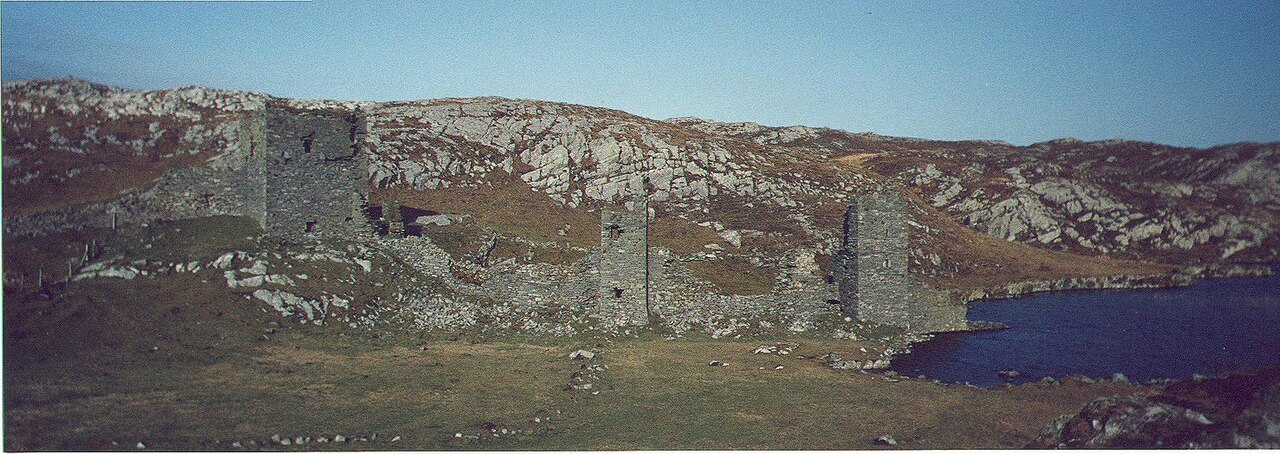
Dunmanus Castle
Dunmanus Castle is a significant example of a late medieval tower house located on the north side of the Mizen Peninsula in County Cork, Ireland. Positioned adjacent to the scenic Dunmanus Bay, this castle reflects the architectural and historical characteristics of the 15th century in Ireland.
Historical background and ownership
The castle was constructed in 1430 by Donogh More O'Mahony, a member of the prominent O'Mahony clan, who were influential Gaelic lords in the region. The O'Mahonys held the castle as a stronghold during a turbulent period marked by frequent conflicts between Gaelic Irish lords and the expanding English Crown authority.
In 1602, during the Nine Years' War which culminated in the collapse of Gaelic resistance, Crown forces captured Dunmanus Castle. However, the O'Mahonys managed to recapture it shortly thereafter, demonstrating the resilience of the clan in maintaining their ancestral lands.
The castle remained in O'Mahony hands until at least 1641, a year notable for the Irish Rebellion that sought to resist English rule. Following the upheavals of the Cromwellian conquest, the castle was sold in 1655 to Emmanuel Moore, an English settler. Subsequently, ownership transferred to Sir William Petty, a notable English economist and surveyor known for his role in the Cromwellian land redistributions.
Architectural features and design
Dunmanus Castle is architecturally significant as a rectangular tower house typical of the late medieval period in Ireland. It appears to be a smaller-scale version of the nearby Kilcoe Castle, sharing similar design elements.
The castle originally stood surrounded by a defensive bawn wall with flankers—projecting towers or turrets designed to provide defensive coverage along the curtain walls. These external fortifications would have enhanced the castle's defensibility against attackers.
The main structure consists of a four-storey high rectangular tower. Notably, a five-storey square tower projects from one corner on two sides, providing additional space and defensive advantage. This projecting tower likely housed stairs or additional chambers and served as a lookout point.
The castle's walls are constructed from local stone, typical of Irish tower houses, with narrow windows and battlements designed for defense. The interior would have included living quarters, storage areas, and possibly a great hall, although much of the internal layout is now lost due to ruin.
Current condition and access
Today, Dunmanus Castle stands as a well-preserved ruin accessible to the public without restrictions. Visitors can explore the exterior and ground-level areas freely, appreciating the castle's imposing silhouette against the backdrop of Dunmanus Bay.
Unfortunately, access to the upper floors is not possible due to safety concerns and the fragile state of the internal structure. Despite this, the castle remains a striking example of late medieval Irish defensive architecture and offers valuable insights into the regional history of County Cork.
Significance in Irish heritage
Dunmanus Castle embodies the turbulent history of Gaelic Ireland during the late medieval and early modern periods. It illustrates the transition from native Irish lordship to English control and the architectural adaptations of the time.
The castle's association with the O'Mahony clan provides a tangible link to one of the principal Gaelic families of Munster, while its later ownership by English figures like Sir William Petty reflects the socio-political changes following the Cromwellian conquest.
Its location on the Mizen Peninsula, a strategic coastal area, underscores its role in controlling access to the region and protecting local interests.
Exploring Dunmanus and nearby attractions
Visitors to Dunmanus Castle can also enjoy the natural beauty of the surrounding Mizen Peninsula, known for its rugged coastline, walking trails, and panoramic views of Dunmanus Bay and the Atlantic Ocean.
Nearby historical sites include Kilcoe Castle, which offers a comparative study of tower house architecture, and various other castles and heritage landmarks scattered throughout County Cork.
The castle's freely accessible ruins provide an authentic experience for those interested in medieval history, architecture, and Irish heritage.
Frequently asked questions (FAQ)
- How do I get to Dunmanus Castle?
- Dunmanus Castle is located on the north side of the Mizen Peninsula in County Cork, Ireland. It is accessible by local roads, and visitors typically reach it by car or bicycle. There are no public transport services directly to the castle, so private transport is recommended.
- What is the historical significance of Dunmanus Castle?
- Dunmanus Castle was built in 1430 by Donogh More O'Mahony and served as a stronghold for the O'Mahony clan during the late medieval period. It witnessed conflicts during the Nine Years' War and the Cromwellian conquest, reflecting the turbulent history of Gaelic Ireland.
- Can I explore the interior of Dunmanus Castle?
- Visitors can freely explore the exterior and ground-level areas of Dunmanus Castle, but access to the upper floors is restricted due to safety concerns. The castle remains a well-preserved ruin offering insight into late medieval Irish architecture.
- When is the best time to visit Dunmanus Castle?
- The best time to visit Dunmanus Castle is during the late spring to early autumn months when the weather in County Cork is milder and more suitable for outdoor exploration of the castle ruins and surrounding landscape.
- Are there any nearby attractions to visit along with Dunmanus Castle?
- Yes, nearby attractions include Kilcoe Castle, another late medieval tower house, as well as the scenic walking trails and coastal views of the Mizen Peninsula. These sites offer a broader understanding of the region's history and natural beauty.
Information
Loading map...
Visitor reviews
No reviews yet. Been here? Write the first review and help other travelers!
Write the first reviewVisited this castle? Share your experience
Your review helps other travelers and adds first-hand knowledge to our encyclopedia.