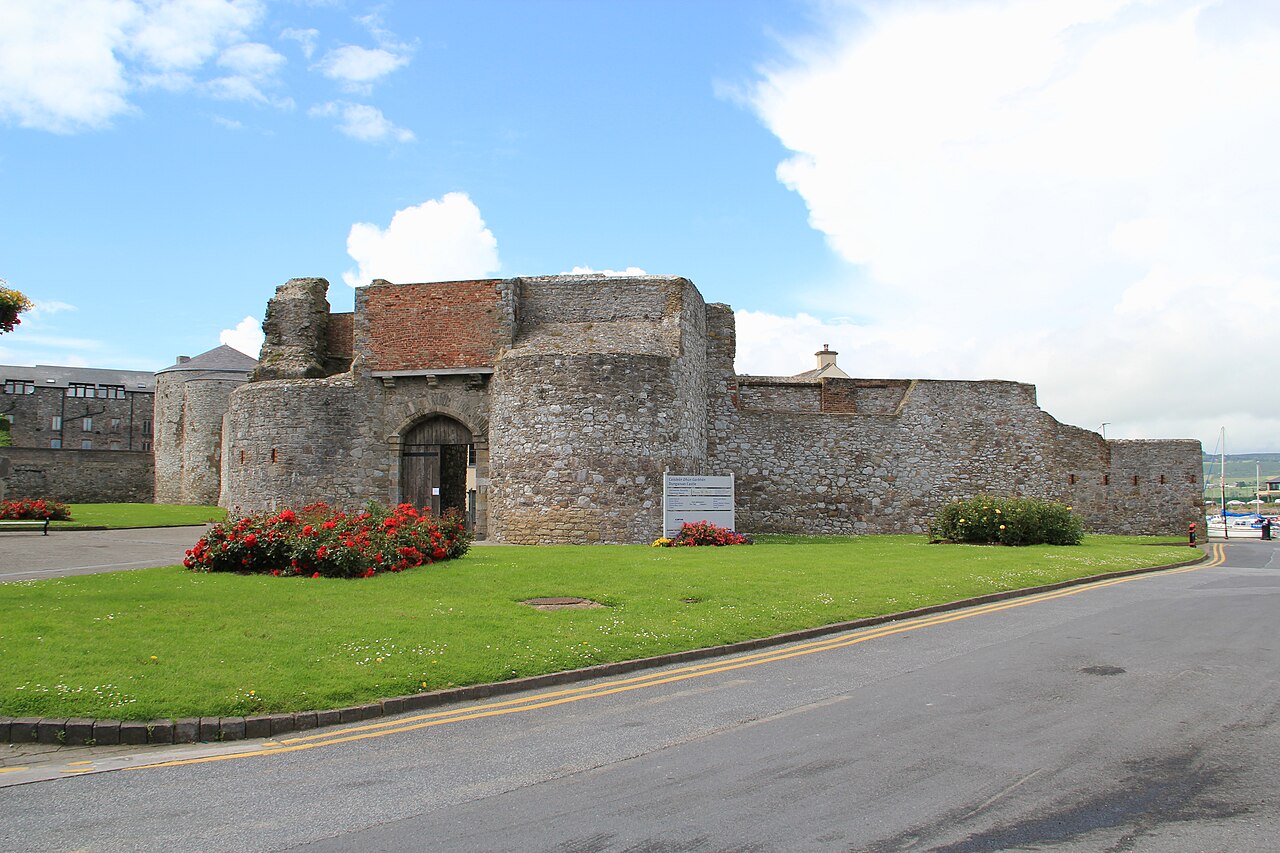
Dungarvan Castle
Dungarvan Castle stands prominently in the town of Dungarvan, situated in County Waterford, Ireland. This historic fortress is a significant example of Anglo-Norman military architecture, reflecting the strategic importance of the region during the medieval period. Its location at the mouth of the River Colligan allowed it to control access to Dungarvan harbor, a vital maritime gateway on Ireland's southeastern coast.
The castle's origins trace back to the late 12th century, with construction traditionally attributed to Prince John, later King John of England. While sources vary slightly on the exact date, it is generally accepted that the initial fortification was established around 1185. This was part of a broader Anglo-Norman effort to consolidate power following their invasion of Ireland in 1169. The site originally hosted a motte-and-bailey fortification, a common early medieval defensive structure, which was replaced by the more durable stone castle that endures today.
Architectural features and construction phases
The polygonal shell keep
The most distinctive feature of Dungarvan Castle is its polygonal shell keep, a rare architectural form in Ireland. This stone enclosure, characterized by multiple angled walls forming a roughly polygonal shape, represents the oldest surviving part of the castle. Shell keeps were a development from the traditional motte-and-bailey design, offering enhanced defensive capabilities by enclosing the summit of the motte with a strong stone wall.
The bailey and curtain walls
Between 1260 and 1275, the castle was expanded with the addition of a bailey, creating an enclosed courtyard surrounded by a strong curtain wall. This outer wall is punctuated by several towers and gatehouses, reinforcing the castle's defenses. The curtain walls and towers were constructed to withstand siege warfare, reflecting the evolving military technologies and threats of the period.
Later modifications and barracks
In the early 18th century, two-storey military barracks were built within the castle grounds to house troops stationed at the site. These barracks survive today and have been restored to serve as exhibition spaces, illustrating the castle's continued military relevance well into the post-medieval era.
Historical significance and ownership
Anglo-norman origins and the fitzgerald era
Following its construction, Dungarvan Castle came under the control of the prominent FitzGerald family from 1285 until 1535. The FitzGeralds were influential Anglo-Norman magnates who played a central role in the governance of southeastern Ireland. Their tenure at the castle coincided with a period of relative stability and consolidation of Anglo-Norman power in the region.
Siege and crown control
In 1535, the castle was captured by Lord Deputy Skeffington using artillery, marking a significant moment in the Tudor reassertion of English authority in Ireland. Subsequently, in 1543, the castle passed into direct control of the English Crown, reflecting the centralization of power during the Tudor conquest of Ireland.
Conflicts of the 17th century
The castle endured multiple sieges and changes of hands during the turbulent Irish Confederate Wars of the 1640s. It was ultimately taken by the forces of Oliver Cromwell in 1649-1650. Unlike many fortifications that saw prolonged fighting, Dungarvan Castle surrendered without significant resistance, underscoring the strategic calculations of the time.
20th-century military and civic use
During the Irish War of Independence and the subsequent Irish Civil War, the castle retained its military significance. It was used as a barracks by the British Army and the Royal Irish Constabulary before being seized by the IRA in 1922. The IRA set fire to the castle upon their departure, causing considerable damage.
Following refurbishment, the castle served as the headquarters for the Garda Síochána, Ireland’s national police force, until 1987. After the police vacated the premises, the castle fell into disrepair but has since been recognized as a National Monument of Ireland, with ongoing preservation efforts.
Architectural and cultural legacy
Dungarvan Castle’s polygonal shell keep is a rare example of Anglo-Norman military architecture in Ireland, demonstrating the transition from wooden motte-and-bailey fortifications to enduring stone castles. The robust curtain walls and corner towers illustrate the castle’s defensive sophistication designed to repel sieges and protect the harbor.
The castle’s layered history is evident in its fabric, from medieval fortifications to early modern barracks. Its survival through centuries of conflict and changing political landscapes highlights its importance as a symbol of regional power and heritage.
Today, Dungarvan Castle is accessible to the public, offering visitors a glimpse into Ireland’s medieval past. Its restored barracks serve as exhibition spaces that interpret the castle’s military and civic roles over time. The castle’s location in the charming town of Dungarvan adds to its appeal as a cultural and historical destination.
Visitor information
Visitors to Dungarvan Castle can explore the well-preserved remains free of charge during opening hours. The castle’s setting near the harbor and river provides picturesque views and a tangible connection to its maritime defensive role. While the castle was temporarily closed during the COVID-19 pandemic, it remains a valued heritage site in Ireland’s rich tapestry of medieval castles.
Frequently asked questions (FAQ)
- How do I get to Dungarvan Castle?
- Dungarvan Castle is located on Castle Street in the town of Dungarvan, County Waterford, Ireland. It is accessible by car and local public transport, with parking available nearby.
- What is the historical significance of Dungarvan Castle?
- Dungarvan Castle is a key Anglo-Norman fortress built in the late 12th century to control the entrance to Dungarvan harbor. It played important roles in medieval conflicts, the Irish Confederate Wars, and 20th-century Irish military history.
- Can I visit Dungarvan Castle for free?
- Yes, visitors can explore Dungarvan Castle free of charge during its opening hours. It offers exhibitions and well-preserved medieval architecture without an entry fee.
- When is the best time to visit Dungarvan Castle?
- The castle is best visited during the warmer months from late spring to early autumn when opening hours are extended and the weather is favorable for exploring the grounds.
- Is Dungarvan Castle wheelchair accessible?
- Due to its medieval structure and terrain, Dungarvan Castle has limited wheelchair accessibility. Visitors with mobility concerns should check with local visitor services for assistance and access options.
Information
Opening hours
Varies seasonally, typically 10:00-17:00
Ticket prices
Free
Current owner
National Monument of Ireland
Website
Visit websiteAddress
Castle St, Dungarvan, County Waterford, Ireland
Sources & official resources
Verify the information above using these authoritative references.
Loading map...
Visitor reviews
No reviews yet. Been here? Write the first review and help other travelers!
Write the first reviewVisited this castle? Share your experience
Your review helps other travelers and adds first-hand knowledge to our encyclopedia.