Dunbeath Castle
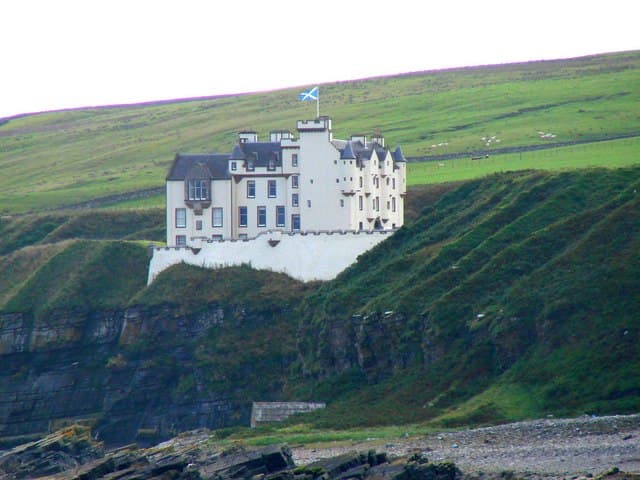
Dunbeath Castle stands prominently on a rocky peninsula on the east coast of Caithness, approximately 2 kilometres south of the village of Dunbeath in northern Scotland. The castle's strategic location atop a narrow promontory overlooking the North Sea provided a natural defensive advantage, enhanced by a dry ditch cutting across the landward approach. This hill castle has a rich history dating back to the 15th century, with the earliest recorded mention in 1428 when the lands belonged to the Earl of Caithness.
The first documented laird was Alexander Sutherland, whose family held the estate before it passed into the hands of the Clan Sinclair through marriage. The union of Alexander Sutherland's daughter with William Sinclair (1410–1484), the first Sinclair Earl of Caithness, marked the beginning of Sinclair ownership. The Sinclairs were responsible for replacing the earlier medieval structure with a substantial four-storey tower house in 1620, a typical architectural form of late medieval Scottish castles.
Architectural evolution and style
The core of Dunbeath Castle is its 17th-century tower house, which forms the oldest surviving part of the building, located at the south-west corner of the complex. This tower house exhibits characteristics typical of Scottish defensive residences of the period, including thick stone walls, narrow windows designed for defense, and a compact vertical layout that maximized security on a limited footprint.
Throughout the 17th century, the castle underwent significant remodeling under the direction of Sir William Sinclair, who enhanced the structure while maintaining its defensive capabilities. The castle's defensive position was further strengthened by the dry ditch on the landward side, a common feature in Scottish castles to impede attackers.
In the 19th century, Dunbeath Castle saw extensive additions and renovations, notably in 1853 and again in 1881, when the renowned architect David Bryce was commissioned. Bryce was a leading figure of the Scots Baronial revival, an architectural style that romanticized medieval Scottish castles with features such as turrets, battlements, crow-stepped gables, and decorative stonework. These additions to Dunbeath Castle were designed to complement and harmonize with the original tower house, blending historical authenticity with Victorian-era tastes.
Historical significance and events
Dunbeath Castle played a role during the turbulent period of the Wars of the Three Kingdoms in the mid-17th century. In March 1650, it was attacked by the Royalist forces led by James Graham, 1st Marquess of Montrose. During this conflict, Sir John Sinclair rode to Edinburgh to warn of Montrose's advance, leaving his wife to defend the castle against the Royalist commander Sir John Hurry. Despite her efforts, the castle was surrendered and a Royalist garrison was installed.
Following Montrose's defeat at the Battle of Carbisdale in April 1650, the opposing forces under David Leslie recaptured Dunbeath Castle. This episode highlights the castle's strategic importance in the civil wars that engulfed Scotland during this era.
Ownership and preservation history
For over three centuries, Dunbeath Castle remained in the hands of the Sinclair family, from the early 15th century until 1945. Notably, from 1894 to 1945, it was owned by Vice-Admiral Sir Edwyn Alexander-Sinclair. After this long period of family ownership, the castle was sold to Bertram Currie in 1945.
Subsequent owners included Harry and Helen (Sinclaire) Blythe from 1967 to 1976, followed by Ray Stanton Avery. In 1997, the castle was acquired by its current owner, Stuart Wyndham Murray-Threipland. Dunbeath Castle remains a private residence and is not open to the public.
Architectural features and grounds
The castle's layout reflects its evolution over centuries. The south-west tower house is the oldest surviving section, with later expansions extending to the north and east. These additions reflect the Scots Baronial style popular in the 19th century, featuring turrets and decorative stonework that blend with the original medieval structure.
Internally, the castle's interiors have been extensively altered over time, reflecting changing tastes and needs of its occupants. Despite these changes, the castle retains much of its historic character and architectural integrity.
The grounds surrounding Dunbeath Castle are notable for their inclusion in the Inventory of Gardens and Designed Landscapes in Scotland. The landscape complements the castle's imposing presence on the peninsula and contributes to its significance as a heritage site.
Defensive features
The castle's defensive design includes the dry ditch on the landward side, which cuts across the narrow promontory. This feature would have served to hinder attackers approaching from inland, a common defensive measure in Scottish castles situated on promontories or hills.
Cultural and heritage status
Dunbeath Castle is classified as a Category A listed building, recognizing its national significance as an outstanding example of Scottish castle architecture with a layered history spanning from the late medieval period through the 19th century. Its preservation contributes to the understanding of Scotland's architectural and historical development.
Frequently asked questions (FAQ)
- How do I get to Dunbeath Castle?
- Dunbeath Castle is located in the scenic Highland region of the United Kingdom. The best way to reach the castle is by car, as public transport options are limited. There is parking available on-site for visitors.
- What is the historical significance of Dunbeath Castle?
- Dunbeath Castle dates back to the 14th century and has a rich history tied to the Clan Sinclair. The castle has witnessed various historical events and changes in ownership, making it an important landmark in Scottish heritage.
- When was Dunbeath Castle built?
- Dunbeath Castle was constructed in the late 14th century, showcasing medieval architecture. Over the centuries, it has undergone several renovations while retaining its historical charm.
- Can I take guided tours of Dunbeath Castle?
- Currently, Dunbeath Castle does not offer formal guided tours, but visitors can explore the grounds and appreciate the architecture. Informational plaques are available to enhance your experience and understanding of the castle's history.
- Why is Dunbeath Castle a popular destination for visitors?
- Visitors are drawn to Dunbeath Castle for its stunning coastal views and historical significance. The castle's picturesque setting and intriguing past make it a perfect spot for history enthusiasts and photographers alike.
- Is it possible to visit Dunbeath Castle year-round?
- Dunbeath Castle is accessible to visitors primarily during the spring and summer months when the weather is milder. However, it's advisable to check local conditions and any seasonal restrictions before planning your visit.
- What are the opening hours for Dunbeath Castle?
- Dunbeath Castle's opening hours vary depending on the season. Generally, it is open from late spring to early autumn, but visitors should verify the schedule ahead of time to ensure access.
- What are some nearby attractions to Dunbeath Castle?
- While visiting Dunbeath Castle, you can explore the beautiful Dunbeath Heritage Centre and the stunning coastal walks nearby. The area is rich in natural beauty, making it an excellent destination for outdoor activities.
- What are the ticket prices for visiting Dunbeath Castle?
- Currently, no entry fee is charged for visiting Dunbeath Castle, making it an affordable option for history lovers. However, donations are appreciated to help maintain the site and its grounds.
Photo gallery

Information
Website
Visit websiteSources & official resources
Verify the information above using these authoritative references.
Loading map...
Visitor reviews
No reviews yet. Been here? Write the first review and help other travelers!
Write the first reviewVisited this castle? Share your experience
Your review helps other travelers and adds first-hand knowledge to our encyclopedia.