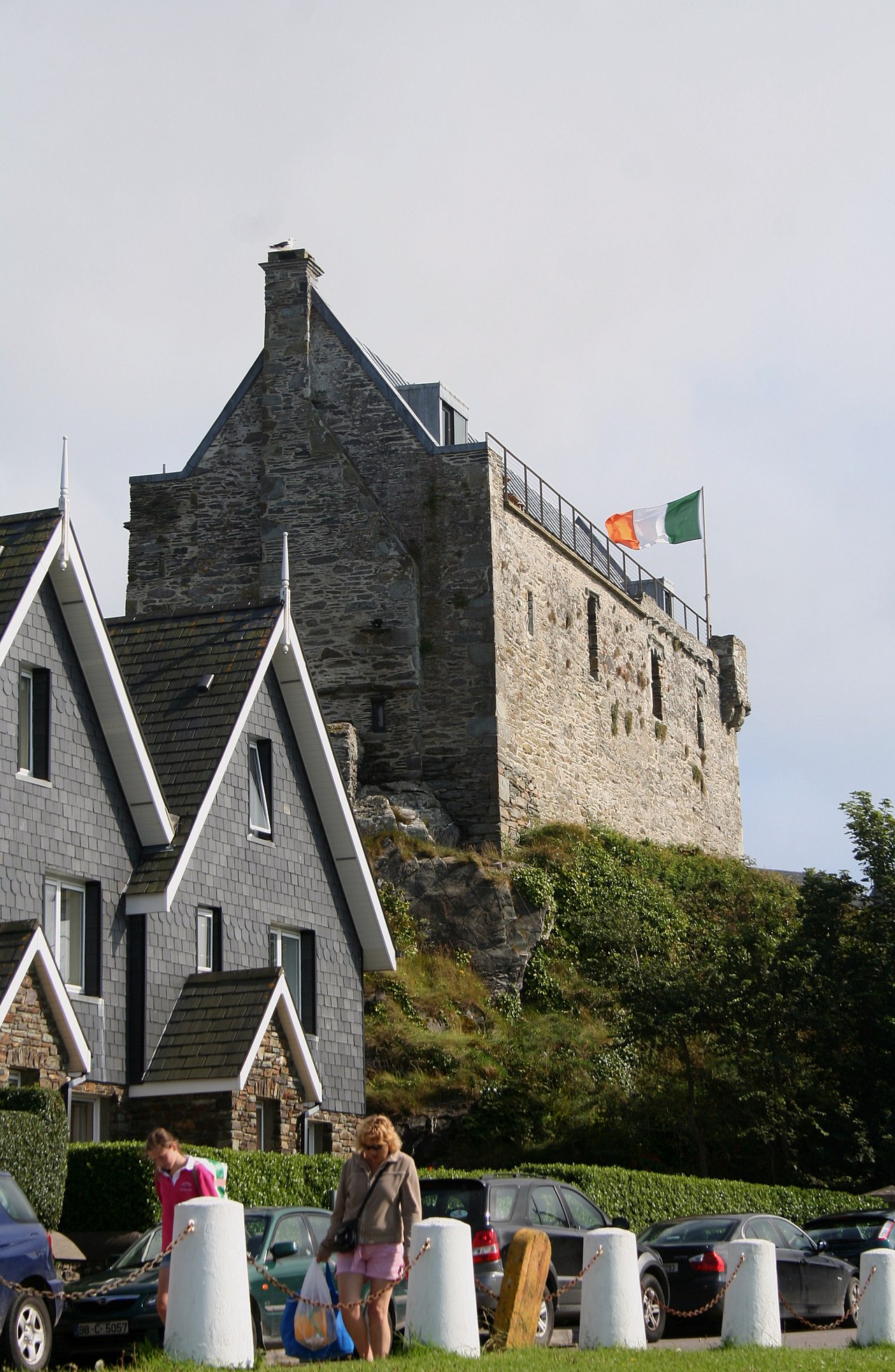
Dunasead Castle
Dunasead Castle, also known as Dún a Séad, Dunashad, or Baltimore Castle, is a historic fortified house located in the coastal village of Baltimore in County Cork, Ireland. Perched on a sandstone ridge overlooking the harbor, the castle occupies a site with a long history of fortification dating back to the early medieval period. Its strategic position made it a key defensive and residential stronghold through centuries of regional conflict and shifting control.
Early fortifications and medieval history
The earliest known fortification on the site of Dunasead Castle was likely a celtic ringfort, dating from the Bronze or Iron Age. This ancient defensive enclosure was eventually replaced in the early 13th century when the anglo-norman FitzStephens family constructed the first castle here around 1215. This initial structure consisted of a tower house accompanied by a defensive bawn, a walled courtyard typical of Anglo-Norman castles in Ireland.
In 1305, the castle was attacked and destroyed by the MacCarthy clan, a powerful Gaelic family asserting dominance in the region. Following this, the O'Driscoll clan, a smaller but influential Gaelic family, took control of the site and rebuilt the castle. Throughout the late medieval period, the O'Driscolls faced constant pressure from rival Gaelic clans and Anglo-Norman settlers, leading to frequent attacks and damage to the castle and its surrounding lands.
Conflicts and rebuilding in the late medieval and renaissance periods
The O'Driscolls were embroiled in ongoing conflicts, notably with merchants from Waterford, which escalated into a prolonged feud beginning in 1368. This feud led to retaliatory raids, including a significant attack in 1537 when Waterford forces sacked Dunasead and other O'Driscoll properties. Despite this devastation, the castle was rebuilt and continued to serve as a stronghold.
During the early 17th century, the present-day structure of Dunasead Castle was constructed by the O'Driscolls around the 1620s. This Renaissance-period fortified house featured a two-storey rectangular main building with an attic, enclosed within a surrounding bawn wall. The castle's design reflected a transition from purely military fortress to a fortified residence, balancing defense with domestic comfort.
In 1631, the castle narrowly escaped destruction during a raid by pirates from Algiers who attacked Baltimore and captured over 100 inhabitants for slavery in North Africa. This event is a notable episode in the castle's history, illustrating the turbulent maritime threats of the era.
17th-century turmoil and decline
During the Irish Confederate Wars in the 1640s, Dunasead Castle was surrendered to Oliver Cromwell's forces and subsequently passed into the hands of the Coppinger family. The O'Driscolls attempted to retake the castle by force in 1642, but their efforts were unsuccessful. By the end of the 17th century, the Coppingers were forfeited, and the castle gradually fell into ruin.
Architectural features and restoration
The surviving structure of Dunasead Castle comprises the main rectangular house measuring approximately 6 by 18 meters (20 by 59 feet), integrated into the south-west section of the enclosing bawn wall. The building is constructed primarily from local masonry set on the natural sandstone ridge. Defensive features include narrow slit windows on the ground floor and a bartizan turret on the south-west corner, emphasizing protection while maintaining residential functionality.
The surrounding bawn walls provide an enclosed courtyard but are less heavily fortified than earlier medieval castles, reflecting the castle's evolution into a fortified residence rather than a military fortress. No significant decorative stonework or inscriptions have been recorded on the current fabric of the castle.
Between 1997 and 2005, the castle underwent extensive restoration led by the McCarthy family, transforming the ruined structure into a restored historic site. Initially rebuilt as a private residence, Dunasead Castle now functions as a small museum open to visitors, offering insights into its rich history and architectural evolution.
Visiting dunasead castle today
Today, Dunasead Castle stands as a well-preserved example of a 17th-century fortified house with layers of history visible in its architecture and location. Visitors can explore the castle for a small fee, enjoying its scenic views over Baltimore Harbor and learning about the turbulent history of the O'Driscoll clan and the wider region.
The castle's setting on a rocky cliff provides a dramatic backdrop, and its restoration allows for appreciation of both its defensive features and domestic aspects. Dunasead Castle remains a significant cultural heritage site in County Cork, reflecting the complex history of Anglo-Norman and Gaelic interactions in Ireland.
Frequently asked questions about dunasead castle
- What is the historical significance of Dunasead Castle?
Dunasead Castle is significant for its long history as a fortified site from the early 13th century, reflecting the turbulent interactions between Anglo-Norman settlers and Gaelic clans in Ireland. - When was Dunasead Castle built?
The present castle dates from the early 17th century, built around the 1620s by the O'Driscoll family on the site of earlier medieval fortifications. - Can I visit Dunasead Castle?
Yes, Dunasead Castle is open to visitors for a small fee, offering tours that highlight its history and architecture. - What architectural style is Dunasead Castle?
The castle is a Renaissance-period fortified house featuring defensive elements such as slit windows and a bartizan turret, reflecting a blend of military and residential design. - Is Dunasead Castle well preserved?
After extensive restoration between 1997 and 2005, Dunasead Castle is well preserved and functions as a museum today. - What happened during the 1631 pirate raid?
In 1631, pirates from Algiers raided Baltimore, capturing 107 inhabitants for slavery. The castle itself narrowly escaped destruction during this attack. - Where is Dunasead Castle located?
It is located in Baltimore, County Cork, Ireland, on a sandstone ridge overlooking Baltimore Harbor.
Frequently asked questions (FAQ)
- What is the historical significance of Dunasead Castle?
- Dunasead Castle has a rich history dating back to the 12th century, serving as a stronghold for various noble families. Its strategic location has made it an important site throughout various historical conflicts in the region.
- When was Dunasead Castle built?
- Dunasead Castle was originally constructed in the early 1100s, showcasing medieval architecture that has been preserved over the centuries. It underwent several renovations and expansions, reflecting the trends in architectural design throughout its history.
- What are the opening hours for Dunasead Castle?
- Dunasead Castle is open to visitors from 10 AM to 5 PM daily, with extended hours during the summer months. It is advisable to check the official website for any seasonal changes or special closures.
- Can I take guided tours at Dunasead Castle?
- Yes, guided tours are available at Dunasead Castle, providing visitors with an in-depth look at its history and architecture. Tours typically run every hour and can be booked in advance to guarantee a spot.
- Is Dunasead Castle accessible for visitors with disabilities?
- Dunasead Castle strives to be accessible to all visitors, with ramps and designated pathways for those with mobility challenges. It is recommended to contact the castle prior to your visit for specific accessibility arrangements.
- What are the ticket prices for Dunasead Castle?
- Tickets for Dunasead Castle are priced at £10 for adults and £5 for children aged 5-15. Family tickets are also available at a discounted rate, providing an affordable option for visiting families.
- When is the best time to visit Dunasead Castle?
- The best time to visit Dunasead Castle is during the spring and early autumn when the weather is mild and the gardens are in full bloom. Additionally, visiting during weekdays can help avoid larger crowds.
- Are there any nearby attractions to Dunasead Castle?
- Yes, several attractions are located near Dunasead Castle, including the historic town center and beautiful parks. Visitors can also explore local museums and art galleries that showcase the region's heritage.
Information
Website
Visit websiteAddress
The Square, United Kingdom of Great Britain and Northern Ireland
Sources & official resources
Verify the information above using these authoritative references.
Loading map...
Visitor reviews
No reviews yet. Been here? Write the first review and help other travelers!
Write the first reviewVisited this castle? Share your experience
Your review helps other travelers and adds first-hand knowledge to our encyclopedia.