Dubno Castle
Dubno Castle stands as a remarkable example of a hill castle in Ukraine, with origins tracing back to the 10th century. Originally established by the Volhynian people, the site served as a fortified center known as a detinets, which was a common form of early medieval fortification used to protect settlements. This early fortress played a crucial role in anchoring the historical identity of the town of Dubno during the early medieval period.
The castle's initial wooden and earthwork fortifications were destroyed during the devastating Mongol invasions of 1240–1241, which left much of the region in ruins. In the late 14th and early 15th centuries, the site was revitalized by Prince Fedor Ostrogski, who constructed a new fortification primarily from wood and earth. This new structure featured earthen ramparts and a wooden palisade that enclosed residential and utility buildings, marking a transition from a purely military outpost to a more settled fortified seat.
Transition to stone fortifications and Renaissance enhancements
Recognizing the vulnerability of wooden defenses, the castle underwent a significant transformation around 1492 when Prince Konstantin Ostrogski initiated the construction of a stone fortress. This new fortress was strategically positioned on higher, more defensible terrain, laying the foundation for future expansions and renovations that would enhance its military capabilities.
In the early 17th century, the castle saw substantial enhancements under the direction of Castellan Janusz Ostrogski. He remodeled the fortress in the late Renaissance style, incorporating two large bastions equipped with watchtowers. These bastions reflected contemporary European military architectural trends, particularly the Italian bastion fort style, designed to withstand the growing threat of artillery warfare.
Strategic location and defensive features
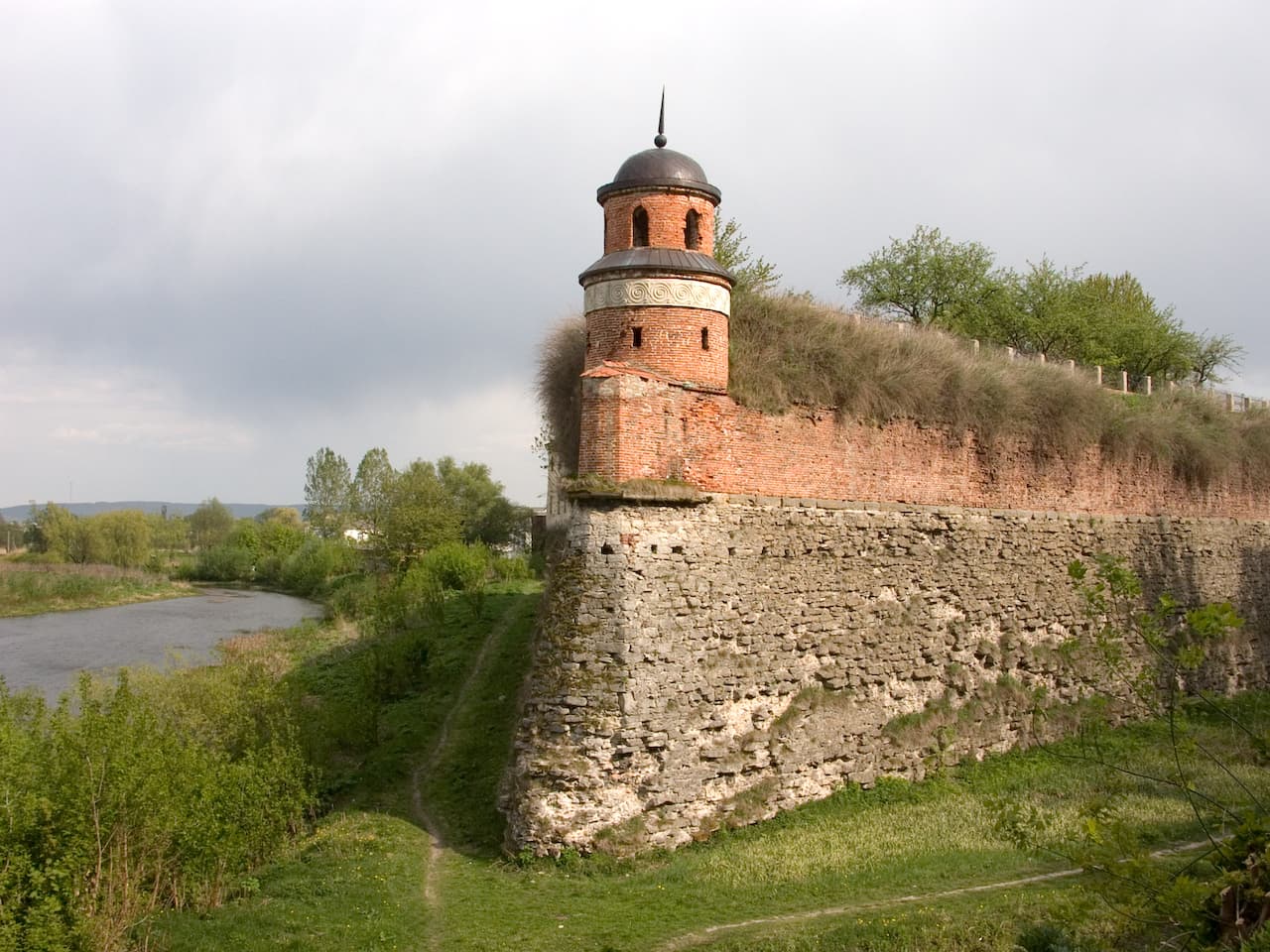
Dubno Castle is prominently situated on a headland along the Ikva River, which naturally curves around the site on two sides. This geographical positioning provided strong natural defenses, further reinforced by marshlands protecting the remaining perimeter. The castle's trapezoidal layout, shaped mainly during the early 17th century renovations, exemplifies the integration of natural and manmade defenses.
The fortress is dominated by two large bastions, each featuring rounded corner towers known as cavaliers topped with dome-shaped roofs. These bastions flank a central curtain wall, which is constructed with a solid base of sandstone blocks and upper sections of brickwork. Surrounding the castle is a deep moat continuously filled with water diverted from the Ikva River, with a stone counterscarp on the outer edge enhancing the moat's defensive capabilities.
Access to the inner fortress is gained through a vaulted gatehouse dating from the 16th century. Despite later alterations, this gatehouse retains a richly decorated portal featuring rustic ornamentation, a triangular pediment, and the coat of arms of the Ostrogski-Zasławski families crowned by a princely mitre, symbolizing the noble heritage of the castle's builders and owners.
Interior structures and residential palaces
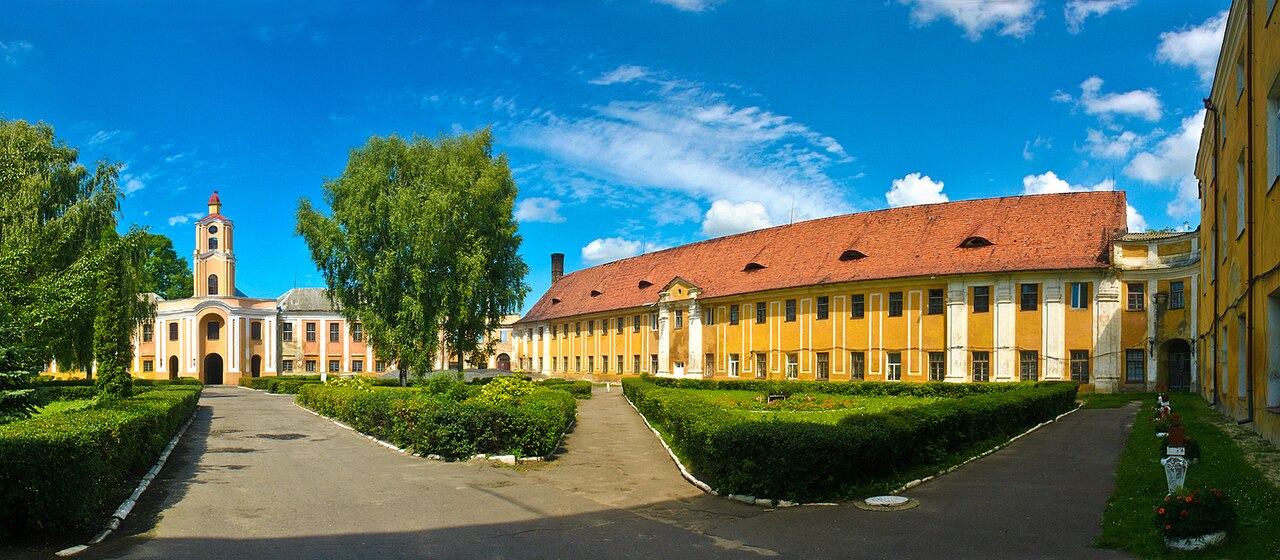
Beyond the gatehouse lies a vaulted passageway within a three-story building that includes an attic. This structure now houses the historical museum but was originally part of the castle's entrance complex. Within the defensive ring, vaulted casemates line much of the courtyard perimeter. These spacious chambers were large enough to allow carriages to enter and maneuver, indicating multifunctional use for storage, shelter, and defense.
Below the castle, an extensive network of wide underground tunnels and hiding places was constructed. These subterranean spaces served as shelters during sieges and storage for food and ammunition, demonstrating the castle's preparedness for prolonged military engagements.
The castle complex includes two notable palatial residences. The Ostrogski Palace occupies the southern part of the enclosure. Its exact construction date and architect remain unclear, but it preserves fragments of medieval ornamental decoration above the first floor, attesting to its early origins. On the northern side, the Lubomirski Palace was rebuilt in the late 18th century, likely under the direction of architect Henryk Ittar. This palace features a modest exterior but retains fine classical friezes and heraldic symbols internally, reflecting the noble status of its occupants. Additionally, a smaller Karwacki Palace from the same period is located along the southern curtain wall, adding to the residential complexity of the site.
Military significance and armaments
Historically, Dubno Castle was well-armed, boasting an armory that housed 73 cannons in the 16th century. It also maintained a foundry capable of producing a wide range of firearms, from muskets and falconets to more modern rifles and machine guns over time. This continuous military significance is reflected in the castle's robust fortifications and adaptations to evolving warfare technologies.
Defensive features include a steep, vertical retaining wall made of rough stone facing the town, enhancing resistance to assault. The bastions contain casemates connected internally to surrounding fortifications, allowing defenders to move and operate artillery under cover. These architectural details highlight the castle's strategic design to withstand prolonged sieges and artillery attacks.
Historical ownership and turbulent past
Throughout its history, Dubno Castle remained in private hands, passing through several noble families, including the Ostrogski, Zasławski, Sanguszko, and Lubomirski lineages. Ownership shifted notably in the late 19th century when the castle was sold to military authorities, leading to its use by various occupying armies over the decades, including the Russian Imperial, Austro-Hungarian, forces of the Ukrainian People's Republic, Polish troops, Soviet military, and German forces during World War II.
Despite numerous attempts by Tatars, Cossacks, Russian, and Swedish armies to capture the fortress, it withstood these sieges until World War II. During this tumultuous period, the castle served as a prison for the Soviet NKVD secret police. In 1941, a tragic massacre of prisoners occurred within its walls, precipitating further violent events in the town.
Archaeological discoveries and modern use
Archaeological excavations beginning in 1995 under Dr. I.K. Sveshnikov confirmed the historical continuity of Dubno as a princely seat from the late 10th to early 11th centuries. These findings enriched understanding of the castle's earlier phases and its long-standing regional importance.
Since Ukraine's independence in 1991, Dubno Castle has transitioned from military use to a cultural and historical museum. It remains largely preserved and is undergoing restoration efforts, with well-maintained grounds supporting its role as a significant heritage site and tourist attraction. The robust structures continue to convey the castle's strategic importance through the centuries, making it a vital link to Ukraine's medieval and early modern past.
Frequently asked questions (FAQ)
- How do I get to Dubno Castle?
- Dubno Castle is located in the town of Dubno, Volyn Oblast, Ukraine. It is accessible by car or local public transport from nearby cities such as Lutsk. The castle is situated on a hill near the Ikva River, making it a prominent local landmark.
- What is the best time to visit Dubno Castle?
- The best time to visit Dubno Castle is during the late spring to early autumn months (May to September) when the weather is favorable for exploring the outdoor fortifications and surrounding grounds.
- Is Dubno Castle wheelchair accessible?
- Due to its historic nature and terrain, Dubno Castle has limited wheelchair accessibility. Visitors with mobility issues should check in advance with the museum staff for available accommodations.
- What architectural styles are represented at Dubno Castle?
- Dubno Castle primarily features Renaissance architectural elements, especially visible in its bastions and palatial residences. Earlier medieval fortifications also contribute to its mixed stylistic heritage.
- Are guided tours available at Dubno Castle?
- Yes, guided tours are available at Dubno Castle, providing detailed insights into its history, architecture, and role in regional conflicts. Tours can be booked at the museum entrance or through the official website.
Photo gallery

Information
Opening hours
10:00-18:00, daily
Ticket prices
€3 adult, €1.5 child
Current owner
Municipality
Website
Visit websiteSources & official resources
Verify the information above using these authoritative references.
Loading map...
Visitor reviews
No reviews yet. Been here? Write the first review and help other travelers!
Write the first reviewVisited this castle? Share your experience
Your review helps other travelers and adds first-hand knowledge to our encyclopedia.