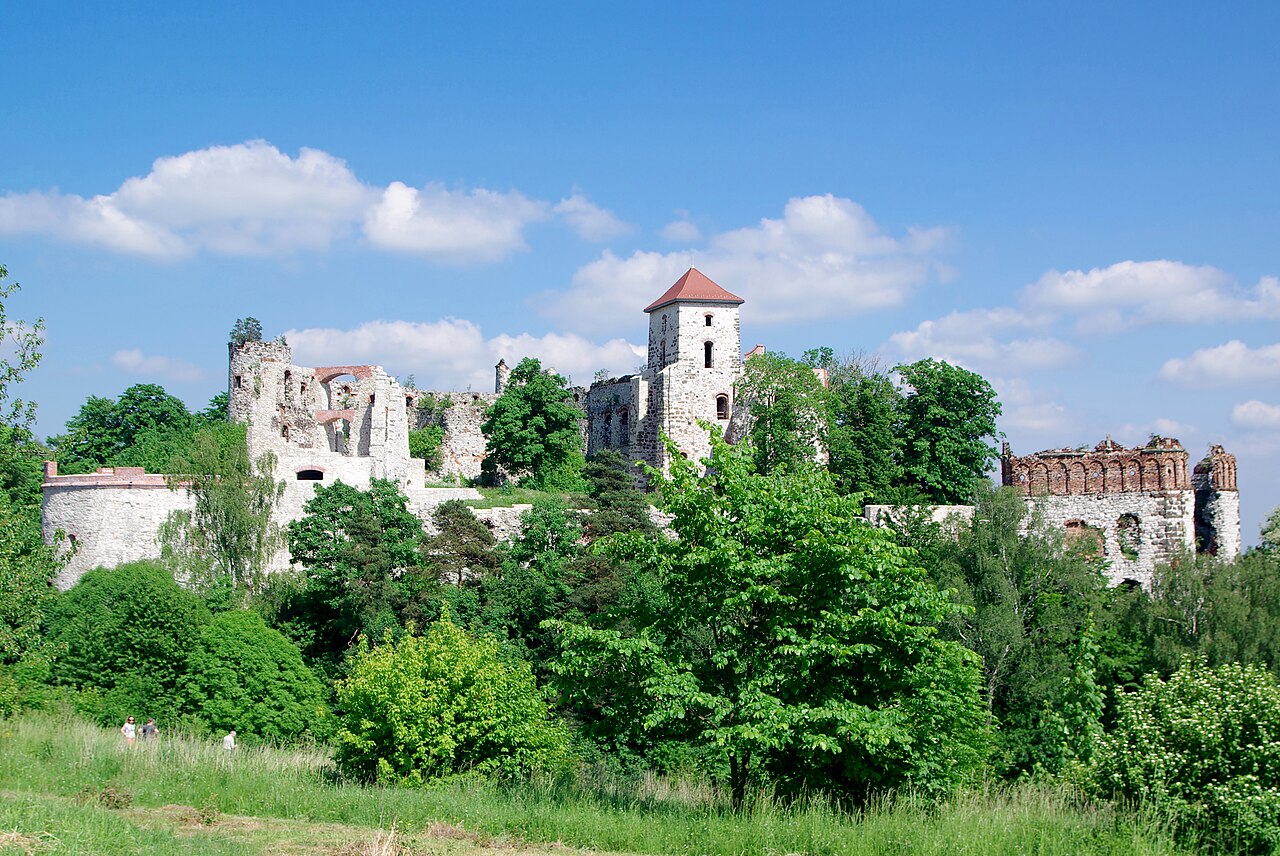
Located west of the village of Dubie on a hill known as "Zamczysko," the site features the remains of a medieval stone tower. This tower is believed to have been constructed during the High Medieval period, likely in the early 15th century, although the exact date remains uncertain. The structure's precise function is debated; it may have served as a defensive residential tower or a knightly stronghold. The tower was strategically positioned on a natural defensive promontory overlooking the valley of the Racławka River, taking advantage of steep slopes and a deep ditch, possibly artificially enhanced, that cut off the narrow spur approximately 100 meters in length.
Architectural features and site layout
The southern part of the hill forms an extensive bailey shaped like an elongated triangle, bordered to the west by a rocky cliff. This bailey was once enclosed by a distinct earthen rampart, which may have been reinforced with a palisade. The tower itself was situated on the northern edge of the bailey, adjacent to the defensive ditch or moat, indicating its role in protecting the most vulnerable side of the fortification.
Excavated foundations reveal the tower was rectangular, measuring approximately 4.7 by 6.4 meters, with buttresses strengthening the corners. The construction material was broken dolomite stone, typical for the region. The modest size of the tower suggests it was a fortified residence or watchtower rather than a large castle keep.
Historical context and ownership
The village of Dubie is first mentioned in historical records in 1270, but there is no direct written reference to the tower itself. This absence may indicate the tower was in use only briefly or that construction was never fully completed. Over the centuries, Dubie was owned by various noble families, but the financial resources required to build such a defensive structure suggest the patron was likely from a wealthy lineage.
Among the known owners, the Toporczyk family stands out as a plausible patron, with notable members such as Żegota, the Kraków standard-bearer, or his brother Śmił of Dubie and Pisar Dubski. If one of them commissioned the tower, its construction probably dates to the early 1400s.
The tower's role in the region
The defensive tower at Dubie is one of the lesser-known fortifications within the Jura Krakowsko-Częstochowska area, a region renowned for its numerous medieval castles and fortresses. Its remote and concealed location has contributed to its obscurity, with local residents often unaware of its existence. The tower's remains are partially covered by earth, but the foundation outlines remain clearly visible, offering valuable insight into medieval defensive architecture in this part of Poland.
Preservation and archaeological potential
Currently, the tower exists as ruins, with only the foundations and some earthworks surviving. The site has not undergone extensive archaeological excavation, leaving many questions about its precise history and function unanswered. Future archaeological research could shed light on the tower's construction phases, its occupants, and its role in regional defense networks.
With proper signage and conservation efforts, the ruins on Zamczysko hill could become a notable tourist attraction within the Jura region. The site's natural beauty combined with its historical significance offers potential for educational and cultural tourism, enriching visitors' understanding of medieval fortifications in Poland.
Access and visitor information
Visitors to Dubie can explore the hill known as Zamczysko, where the tower ruins are located. Due to the site's subtle remains and overgrowth, finding the exact location may require some effort and local guidance. There are currently no formal visitor facilities or interpretive panels, but the site presents an intriguing destination for enthusiasts of medieval architecture and Polish history.
Frequently asked questions (FAQ)
- How do I get to Dubie Castle?
- Dubie Castle is located in the picturesque village of Dubie, Poland. You can reach it by car or public transportation from nearby cities like Kraków or Wrocław, with local bus services available. The castle is well-signposted, making it easy to find.
- What is the historical significance of Dubie Castle?
- Dubie Castle dates back to the 14th century and played a crucial role in the region's defense during various conflicts. Its architecture reflects the evolution of defensive structures in Poland over the centuries. Today, the castle stands as a testament to the rich history of the area.
- When was Dubie Castle last renovated?
- Dubie Castle underwent significant renovations in the early 2000s to preserve its historical features and improve visitor access. These renovations have helped restore the castle to its former glory, allowing visitors to appreciate its architectural beauty and historical significance.
- Can I take a guided tour of Dubie Castle?
- Yes, guided tours are available at Dubie Castle, offering visitors in-depth insights into its history and architectural features. Tours typically last around an hour and are conducted by knowledgeable guides who can answer any questions you may have. Be sure to check the schedule in advance for tour times.
- Why is Dubie Castle considered an architectural gem?
- Dubie Castle is characterized by its unique blend of Gothic and Renaissance architectural styles, showcasing intricate details and robust fortifications. Its strategic location and impressive structure make it an exceptional example of medieval military architecture in Poland. Visitors are often struck by its aesthetic appeal and historical context.
- Is it possible to host events at Dubie Castle?
- Yes, Dubie Castle offers facilities for hosting various events, including weddings and corporate gatherings. The castle's stunning setting and historical ambiance provide a memorable backdrop for special occasions. Interested parties should contact the castle management for more details on availability and services.
- What are the opening hours for Dubie Castle?
- Dubie Castle is open to visitors from 10 AM to 5 PM, Tuesday through Sunday. It is advisable to check the castle's official website for any seasonal changes in hours or special closures. Planning your visit during these hours ensures you can fully explore the site.
- What are the ticket prices for visiting Dubie Castle?
- Admission to Dubie Castle is reasonably priced, with tickets typically costing around 25 PLN for adults and discounted rates for students and seniors. Children under a certain age may enter for free. Special family rates and group discounts are also available, making it accessible for all visitors.
- When is the best time to visit Dubie Castle?
- The best time to visit Dubie Castle is during the spring and early autumn months when the weather is mild, and the surrounding landscape is particularly beautiful. Festivals and events often occur during these seasons, adding to the experience. Summer can be busy, but it also offers vibrant activity at the castle.
- Are there any nearby attractions to Dubie Castle?
- Yes, there are several attractions near Dubie Castle, including charming local villages and scenic nature trails perfect for hiking. Additionally, historical sites and museums in the surrounding areas provide more insight into the region's rich heritage. Exploring these nearby attractions can enhance your visit to the castle.
Information
Loading map...
Visitor reviews
No reviews yet. Been here? Write the first review and help other travelers!
Write the first reviewVisited this castle? Share your experience
Your review helps other travelers and adds first-hand knowledge to our encyclopedia.