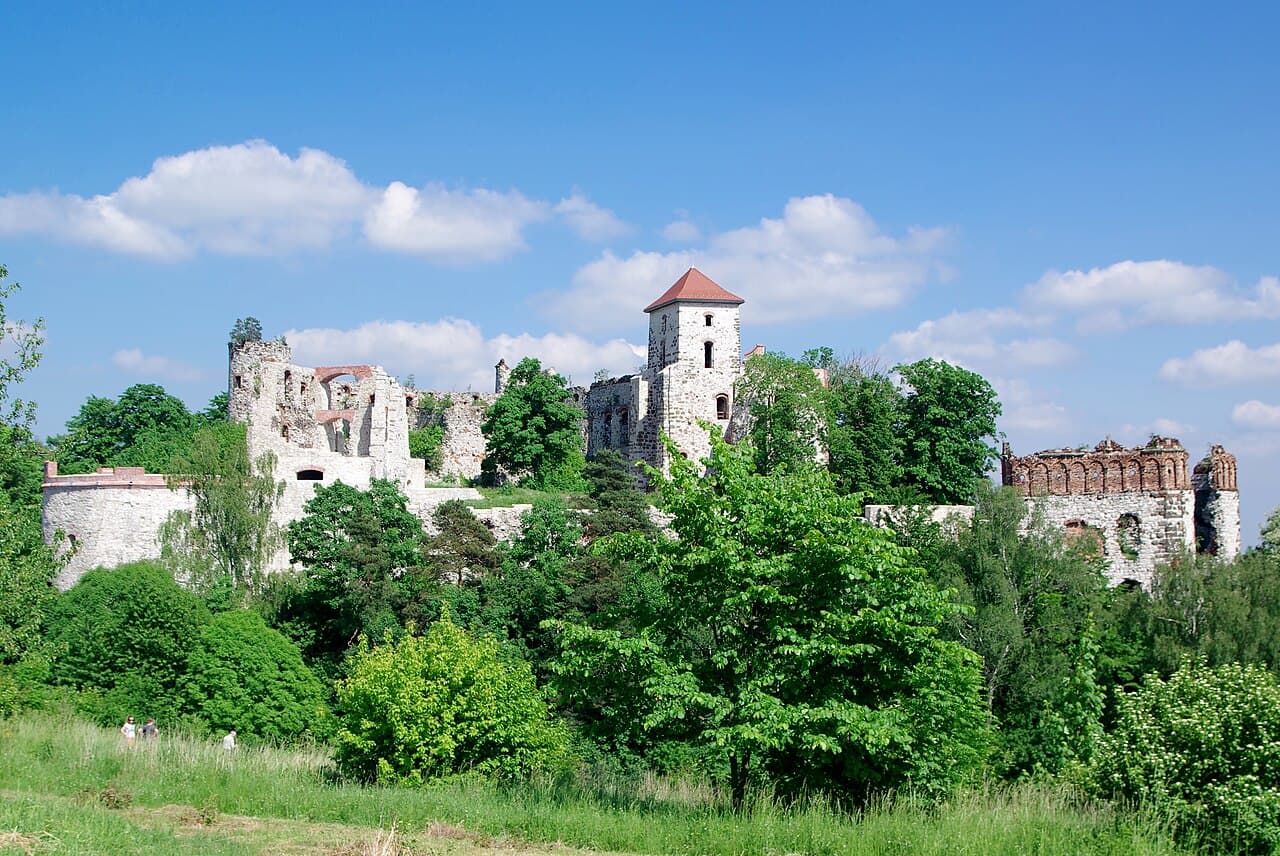
Tenczyn Castle, located in Rudno, Poland, is a striking example of a Renaissance bastioned fortress that bears the marks of centuries of Polish history and noble heritage. Perched atop the highest hill of the Garb Tenczyński range at 411 meters elevation, the castle's ruins evoke the grandeur and turbulent past of one of Poland's most influential noble families, the Tęczyński clan. The castle's evolution from a medieval stronghold to a magnate's residence reflects broader architectural and historical trends in Poland from the 14th to the 18th centuries.
The earliest historical mention related to the site dates back to 1308, with the first wooden fortress likely established around 1319 by Jan Nawój of Morawica, Castellan of Kraków. This initial structure included a wooden fortification with a stone tower, now known as the Nawojowa Tower, which remains the largest surviving tower of the complex. The transition to stone construction began in the mid-14th century under Jan Nawój's son, Jędrzej Tęczyński, who served as governor of Kraków and Sandomierz. His contributions included expanding the castle's footprint and fortifications, establishing the family name, and enhancing its defensive capabilities.
Medieval origins and early expansions
The original castle was built on an irregular oval plan atop a volcanic rock, maximizing natural defenses. Early medieval phases saw the construction of several round Gothic towers and a chapel, founded by Jędrzej's son, Jasko Tęczyński. The castle's strategic importance is underscored by its role after the Battle of Grunwald (1410), when King Władysław Jagiełło imprisoned captured Teutonic Knights within its walls. This event highlights Tenczyn's status as a significant military and political stronghold in medieval Poland.
Architectural features of the medieval castle
The medieval fortress included the prominent Nawojowa Tower, three additional round towers, and a fortified chapel. The castle's defensive walls and gate structures were designed to leverage the natural topography, with thick stone walls and narrow firing slits for archers. The castle's position atop the Garb Tenczyński ridge provided commanding views and control over the surrounding region.
Renaissance transformation under jan tęczyński
In the mid-16th century, the castle entered a new phase of development under Jan Tęczyński, Castellan of Wojnicz and Great Chamberlain of the Crown. Around 1570, he initiated a comprehensive reconstruction to modernize the fortress in line with Renaissance architectural principles and to adapt to the advent of gunpowder weaponry.
Fortification upgrades and residential enhancements
The castle's defenses were enhanced with the addition of two multi-storey pentagonal bastions on the southern side, designed to withstand artillery attacks. A curtain wall encircled the complex, complemented by a unique northern barbican featuring a circular gatehouse and a vaulted passage approximately 60 meters long with numerous firing slits. This barbican remains one of the most distinctive defensive features in Poland.
The residential quarters were expanded into three wings arranged around a trapezoidal courtyard open to the west. The eastern and northern wings housed representative apartments and living quarters, with exterior walls serving as part of the defensive perimeter. The castle's interior was richly decorated in the Renaissance style, with attics, cornices, and arcaded cloisters (krużganki) enhancing the courtyard's aesthetic and functional qualities.
Cultural significance and notable residents
Tenczyn Castle was not only a military fortress but also a cultural hub during the Polish Renaissance. It attracted prominent figures such as Mikołaj Rej, Jan Kochanowski, and Piotr Kochanowski, who frequented the estate in the 16th century. The castle's chapel was thoroughly rebuilt in the early 17th century by Agnieszka Firlejowa née Tęczyńska, reflecting the family's religious devotion and social status.
Decline and destruction during the deluge
The castle's fortunes declined sharply during the mid-17th century. Following the death of Jan Magnus Tęczyński in 1637, the last male heir of the family, the estate passed to his daughter Izabela Opalińska. During the Swedish Deluge (1655–1656), rumors that the Polish Crown Jewels were hidden in Tenczyn led to a siege by Swedish-Brandenburgian forces under Kurt Christoph von Königsmarck. Despite fierce defense led by Captain Jan Dziula, the castle was captured, its defenders massacred, and the fortress was set ablaze in 1656.
Though partially rebuilt afterward, the castle never regained its former prominence. Ownership passed through noble families including the Sieniawski, Czartoryski, and Lubomirski clans. A devastating fire caused by lightning in 1768 destroyed much of the residential areas, accelerating the castle's decline into ruin.
Modern history and preservation efforts
In 1816, the castle became property of the Potocki family, who held it until World War II. The 20th century saw the castle fall into neglect, with initial conservation efforts beginning in 1912-13 and continuing intermittently after the war. Due to its deteriorating condition, the castle was closed to visitors in 2009 but has since undergone stabilization and partial restoration, allowing renewed public access.
Architectural remains and visitor experience
Today, visitors to Tenczyn Castle can explore the evocative ruins that include the Nawojowa Tower, the barbican, bastions, the gate tower, the chapel ruins, and remnants of the residential wings. The castle's layout, defensive structures, and Renaissance decorative elements offer insight into the evolution of Polish castle architecture and noble life.
The castle grounds also feature a natural monument sycamore maple tree within the courtyard, symbolizing the enduring connection between the site's cultural heritage and its natural environment. The surrounding landscape of the Garb Tenczyński hills provides scenic views and a sense of the castle's strategic importance.
Historical legacy and cultural importance
Tenczyn Castle stands as a testament to the medieval and Renaissance history of Poland, reflecting the rise and fall of noble families, military conflicts, and architectural innovation. Its ruins are a valuable cultural landmark within the Kraków-Częstochowa Upland, attracting historians, architects, and tourists interested in Poland's rich heritage.
Ongoing preservation efforts aim to maintain the structural integrity of the ruins and enhance visitor engagement, ensuring that Tenczyn remains a prominent site for education and cultural tourism.
Frequently asked questions (FAQ)
- How do I get to Tenczyn Castle in Rudno?
- Tenczyn Castle is located in the village of Rudno in the Lesser Poland Voivodeship. It is accessible by car via local roads from Kraków or other nearby towns. There are parking facilities near the castle ruins for visitors.
- What are the opening hours and ticket prices for Tenczyn Castle?
- The castle is generally open to visitors during the warmer months, but due to its ruinous condition, opening hours may vary. Tickets are modestly priced, with discounts for children and seniors. It is recommended to check the official website or local tourist information for current details.
- What architectural styles are visible at Tenczyn Castle?
- Tenczyn Castle showcases a blend of Gothic and Renaissance architectural styles. The original medieval fortress features Gothic towers and chapel ruins, while Renaissance renovations added bastions, curtain walls, and decorative elements such as attics and arcades.
- Is Tenczyn Castle accessible for visitors with limited mobility?
- Due to the castle's ruinous state and uneven terrain, accessibility for visitors with limited mobility is limited. Some paths and viewing areas may be challenging to navigate. Visitors are advised to wear appropriate footwear and exercise caution.
- When is the best time to visit Tenczyn Castle?
- The best time to visit Tenczyn Castle is during late spring to early autumn when the weather is mild and the surrounding landscape is lush. This period offers the most comfortable conditions for exploring the ruins and enjoying panoramic views.
Photo gallery

Information
Sources & official resources
Verify the information above using these authoritative references.
Loading map...
Visitor reviews
No reviews yet. Been here? Write the first review and help other travelers!
Write the first reviewVisited this castle? Share your experience
Your review helps other travelers and adds first-hand knowledge to our encyclopedia.