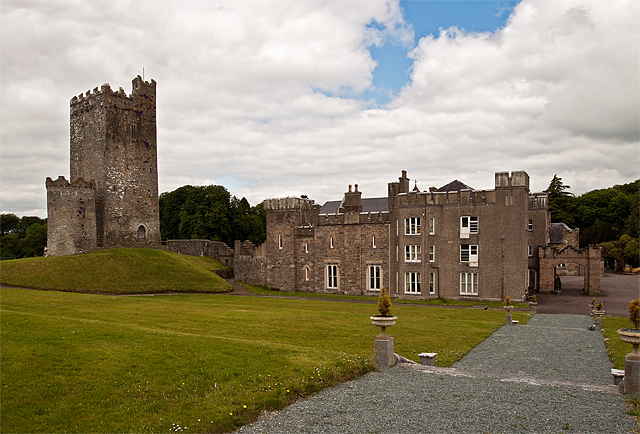
Dromiscane Castle
Dromiscane Castle is a historic site located in the townland of the same name, north of Millstreet in County Cork, Ireland. Known locally as the Boing, named after a nearby ford through the River Blackwater, the castle's remains stand quietly in a field on private farmland. Though access is restricted, the landowner has occasionally allowed visitors to explore the site, which is characterized by overgrown ruins with limited visible architectural detail.
Historical background and ownership
The exact date of Dromiscane Castle's construction remains uncertain. It was originally a stronghold of the O'Keeffe family, a prominent Gaelic Irish clan in the region. The castle was designed as a tower house—a typical form of fortified residence common in Ireland from the late medieval period onward. This tower house was rectangular and was surrounded by a rectangular bawn, a defensive enclosure wall. Each of the bawn's four corners was fortified with circular flankers, which provided defensive positions to cover the curtain walls and protect the tower.
In 1592, the castle was seized by the Drishane McCarthys, a branch of the powerful McCarthy dynasty. However, the castle was later reclaimed by the McDonagh-McCarthys of Kanturk, who were overlords of the O'Keeffe territory in the Duhallow region. This reflects the turbulent nature of Gaelic lordship and inter-clan conflicts during the late 16th century in Munster.
By the late 17th century, specifically the 1690s, ownership had passed to Sir Nicholas Chinnery, indicating a transfer of property likely influenced by the political and social upheavals following the Cromwellian conquest and Williamite wars in Ireland.
Architectural features and condition
The original castle consisted primarily of a high rectangular tower house surrounded by a defensive bawn with circular flankers at each corner. This layout was typical of many Irish tower houses, combining residential and defensive functions. The tower house would have served as the main living quarters and last line of defense, while the bawn provided an enclosed courtyard for livestock and additional protection.
By the mid-18th century, records from 1750 noted that the tower house had been demolished. Today, only three of the four original circular flankers remain, along with fragments of the curtain wall that once enclosed the bawn. These surviving elements give a glimpse into the castle's defensive design, although much of the structure is now overgrown and in a state of ruin.
The castle's ruinous state means that detailed architectural features are scarce. The remaining flankers are rounded towers that would have allowed defenders to cover the walls with crossfire, a common defensive feature in Irish tower houses and bawns. The curtain walls, though partially collapsed, would have been thick stone walls designed to resist attack and protect the interior courtyard.
Location and accessibility
Dromiscane Castle is situated in a rural setting on private farmland north of Millstreet in County Cork. The site is not freely accessible to the public, requiring permission from the landowner for visits. Its location near the River Blackwater and the ford known as the Boing highlights its strategic placement for controlling local river crossings and territory.
The castle in the context of Irish tower houses
Dromiscane Castle is an example of the many tower houses that dotted the Irish landscape from the late medieval period into the early modern era. These structures were typically built by Gaelic lords or Anglo-Norman settlers as fortified residences that balanced defense with domestic needs. The inclusion of a bawn with circular flankers was a common defensive adaptation in Munster to protect against raids and local conflicts.
Unlike some more elaborate castles, Dromiscane never developed into a large fortress but remained a relatively modest stronghold. Its history of changing ownership among Gaelic families and later Anglo-Irish gentry reflects the broader political shifts in Ireland from the 16th to the 18th centuries.
Preservation and historical significance
Today, the remains of Dromiscane Castle stand as a partially preserved ruin, illustrating the typical features of a late medieval Irish tower house and its associated bawn. Although much of the original structure has been lost, the surviving flankers and curtain wall fragments provide valuable insights into the defensive architecture of the period.
The castle's connection to prominent local families such as the O'Keeffes and McCarthys adds to its historical importance, representing the complex social and military landscape of County Cork during the late medieval and early modern periods. Its location near the River Blackwater also emphasizes the strategic considerations that influenced castle siting in Ireland.
Frequently asked questions (FAQ)
- How do I get to Dromiscane Castle?
- Dromiscane Castle is located in Millstreet, United Kingdom, and is accessible by car and public transport. If you are driving, the castle is situated just off the main roads connecting to Millstreet. Public buses also run frequently from nearby towns, making it easy to visit.
- What is the historical significance of Dromiscane Castle?
- Dromiscane Castle dates back to the 15th century and is a remarkable example of medieval architecture in the region. It has witnessed significant historical events and served as a stronghold for local chieftains. The castle's rich history provides insight into the feudal system and the conflicts that shaped Ireland.
- When was Dromiscane Castle built?
- Dromiscane Castle was constructed in the late 1400s, with its architecture reflecting the defensive needs of the time. Initially built as a stronghold, it has survived centuries of tumultuous history, making it a fascinating site for history enthusiasts.
- Can I take a guided tour of Dromiscane Castle?
- Yes, guided tours of Dromiscane Castle are available for visitors. These tours provide in-depth insights into the castle's history, architecture, and the surrounding area. It’s advisable to book in advance, especially during peak tourist seasons.
- Why is Dromiscane Castle popular among visitors?
- Dromiscane Castle attracts visitors due to its stunning architecture and rich history, as well as its picturesque setting. The castle offers a unique glimpse into Ireland's medieval past, and the surrounding landscapes provide beautiful views for photography enthusiasts.
- Is it possible to access Dromiscane Castle for those with mobility issues?
- Dromiscane Castle has limited accessibility due to its historical architecture, which includes uneven surfaces and stairs. However, the staff is committed to accommodating all visitors, so it is recommended to contact them in advance to discuss specific needs.
- What are the opening hours for Dromiscane Castle?
- Dromiscane Castle is typically open to visitors from 10 AM to 5 PM during the tourist season, which runs from April to October. It’s best to check the official website or contact the castle directly for the most current opening hours and any seasonal variations.
- What are the ticket prices for visiting Dromiscane Castle?
- Ticket prices for Dromiscane Castle are generally affordable, with discounts available for children, students, and seniors. Family tickets are also offered for those visiting in groups. For the most accurate pricing, it's advisable to check the castle's official website before your visit.
- What nearby attractions can I visit after Dromiscane Castle?
- After visiting Dromiscane Castle, you can explore the beautiful countryside of Millstreet or visit nearby attractions such as the Clara Mountain and the Millstreet Country Park. The region is known for its natural beauty, offering various outdoor activities and scenic walks.
Information
Loading map...
Visitor reviews
No reviews yet. Been here? Write the first review and help other travelers!
Write the first reviewVisited this castle? Share your experience
Your review helps other travelers and adds first-hand knowledge to our encyclopedia.